
CAVALLINI, PIETRO. — Painter and mosaicist of the Cerroni family, born in Rome between 1240 and 1250, and died there at a very advanced age, perhaps a hundred years old. In 1273 he signed a notarial document in the archive of S. Maria Maggiore: «Petrus dictus Cavallinus de Cerronibus». In 1291 he worked in mosaic on the band beneath the apsidal semi-dome in the basilica of S. Maria in Trastevere; some time later, probably in 1293, with the assistance of collaborators, he covered the interior of the church of S. Cecilia in Trastevere with paintings. In 1308 he was in Naples, where later, but before 1320, he was employed in decorating the church of S. Maria Donna Regina. Having returned to Rome, he worked on commission from Pope Giovanni XXII (1316–34), executing some mosaic figures on the façade of the ancient Ostian basilica, later partly transferred to the interior, onto the wall of the triumphal arch facing the presbytery.
In addition to these works, which still exist, Ghiberti, and Vasari on his sole authority, mention others that have been lost, among them above all the decoration of the presbytery of the church of the Aracoeli and the fresco decoration of the walls of the basilica of S. Paolo; the latter, executed between 1270 and 1280, was destroyed when the basilica was rebuilt after the fire of 1823. Some drawings made around 1640 by Antonio Eclissi nevertheless remain from the decoration of S. Paolo. They are now preserved in the Vatican Library’s cod. lat. barberinianus no. 4406 and may be of interest to us because, if for no other reason, they reveal the iconographic schemes used by C. in that work.
Thus, for about twenty years already, C. had been active in Rome when, in 1291, on commission from Bertoldo Stefaneschi, he executed in mosaic the band beneath the apsidal semi-dome of S. Maria in Trastevere, where in seven panels he depicted scenes from the life of the Virgin and the Virgin in glory among ss. Pietro and Paolo, with Stefaneschi kneeling. The iconographic schemes used by C., here as in his other works, are still those of the Byzantine tradition, although he sometimes interprets them while seeking to render with greater «credibility» the relationship, altered over the centuries, between setting and figures.
Nevertheless, the tone of his representation is always courtly and has the character of a true celebration. The types, too, are traditional, although the master tends to eliminate from his images anything that might appear to be mannerist convention. The forms of Cavallini’s images convey a sense both of solidity and softness. In C., color in fact gives substance to the form, which is rounded in the transitions between planes graduated through uninterrupted variations of tone.
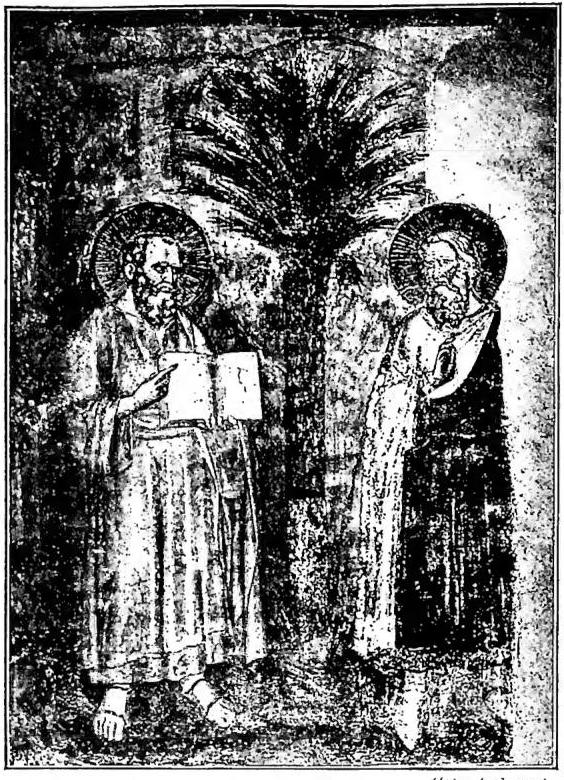
The same stylistic characteristics appear at S. Cecilia in Trastevere, where on the counterfaçade wall the upper section of the scene of the Last Judgment survives from the church’s entire decoration: Christ among the Apostles, several angelic figures, and groups of the elect and the damned. At S. Cecilia, however, C. painted directly on the wall, using a freer technique than that of mosaic, with its conventions inherited from the Eastern tradition. This allowed him, particularly in the chromatic field, to achieve not so much innovations as highly significant refinements. The forms seem truly moulded in a rich, dense paste teeming with sap, revealed to the light already vibrant with its own tones. The types of the figures, too, become increasingly emancipated from those sanctioned by tradition; yet, rather than different, and also in view of certain easy comparisons with ancient Roman portraiture, they appear animated by a new spirit. The apostles of S. Cecilia, imposing, statuesque, and solemn, belong to a new generation of images that reveals itself here for the first time. Christ the Judge, seated among them, has a face illumined by a light of the highest spirituality, arising from a perfect inner peace that makes this image something new. In Naples, where he lived for at least ten years, C. probably conceived the idea for the entire decoration of the church of S. Maria Donna Regina; but only those pairs of apostles, saints, and prophets belong to his hand which, within eight panels—four on each side—appear near the presbytery beside the windows. The rest is the work of followers and continuators, who continued to work even after C. had left the city.
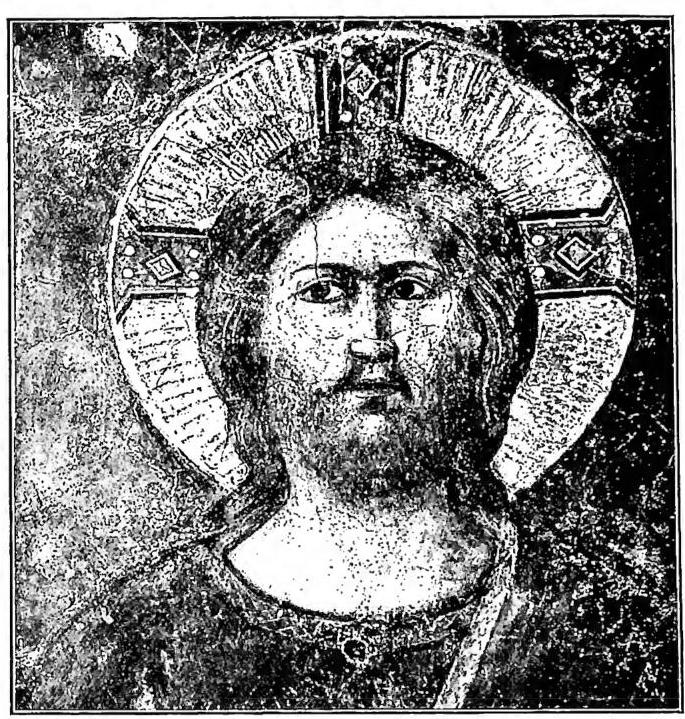
(Alinari photograph) CAVALLINI, PIETRO — Christ in the fresco of the Last Judgment. Rome, monastery of S. Cecilia in Trastevere.
What remains of the mosaics of the ancient façade of S. Paolo, executed after the works in Napoli, does not permit a judgment. Vasari also attributes to C. a work of sculpture: the large wooden crucifix in the chapel of the Sacrament at S. Paolo. The Vasarian attribution, which for a long time had been entirely disregarded, instead deserves every consideration. That sculpture is certainly the masterpiece of Roman sculpture at the beginning of the 14th century and is the work of a master whose culture and experience do not differ from those proper to C. in those years.
In addition to the three great pictorial cycles mentioned above, other works are attributed to the master; of all these, the closest to him are the decoration of the apse of the Roman church of S. Giorgio in Velabro and the lunette of the tomb of Cardinal d’Acquasparta in the church of the Aracoeli. Yet even in these paintings it may perhaps be possible to recognize only the hand of faithful followers, some of whom, almost invariably of little merit, repeated, like a weary echo, the master’s forms beyond the middle of the 16th century in Lazio, Campania, and also Umbria, where, especially in Perugia, at the beginning of the century, several works of Cavallinian character are found.
Austere, meditative, religious in temperament, Cimabue (v.), Duccio (v.), C. belongs to the generation preceding that of Giotto. Nourished by the culture proper to the courtly and Byzantine-influenced Roman painters, he was always inclined to explore every traditional mode of expression in order to resolve it into a personal experience. Through his knowledge of the eastern Neo-Hellenistic art whose examples were then frequent in Italy, this led him back to the very sources of ancient classicism.
As the years progressed, the tone of the Cavallinian artistic language gradually changed, not only through the refinement of its expressive means, but also through the transcendence of those ideas and those “medieval sentiments” that appeared in his early works. In the frescoes of S. Maria Donna Regina in Napoli, his figures essentially express the world of the master’s highly poetic imagination, and express it through such direct and immediate harmonies that they give us a sense of fulfillment characteristic of classical art. – Vedi Tavv. LXX-LXXI.