Machine translation of the 1948–1954 Italian original. The original text is authoritative.
DUCCIO di BUONINSEGNA. — Sienese painter. The first record of his activity dates from 1278, the year in which the Municipality of Siena paid him for decorating twelve chests intended to house public documents. But despite the modesty of these beginnings, he must soon have achieved fame even beyond his native city, since in 1285 the confraternity of the Laudesi of S. Maria Novella in Florence commissioned from him a large altarpiece which today, with few exceptions, critics are almost unanimously agreed to identify with the monumental Madonna in the Rucellai Chapel of that same church. From 1285 to 1295 he is mentioned several times as a “painter of books,” that is, as a decorator of the covers of the Biccherna and Gabella registers (the financial offices of the Municipality of Siena); in 1295, together with Giovanni Pisano and other masters, he gave advice
on the construction of the fountain at Pian d'Ovile in Siena, and in 1302 he painted an altarpiece, now lost, for the inner chapel of the Palazzo Pubblico.
On 9 October 1308 the Operaio of the Cathedral, Messer Jacopo di Gilberto Marescotti, commissioned from him the large altarpiece painted on both sides, with predella and crowning, to be placed on the high altar of the Cathedral: D. worked uninterruptedly for 32 months on this magnificent work, called the Maestà, and when he had completed it, on 9 June
1311, a crowd of people, together with the clergy and the governing authorities, accompanied its transfer with great celebrations from the artist’s workshop, located in Via Stalloreggi, to the Cathedral. In 1506 it was removed from the high altar of the Duomo, and in 1795 the two faces were separated and placed in the chapels of S. Ansano and the Sacrament, where they remained until 1881, when they were transferred to the museum of the Opera. Four panels of the crowning may have been lost, while of the small scenes of the predella, two are lost and eight are preserved in London,
New York and Washington. Several documents allude to the artist’s financial defaults: in 1299 he received two minor sentences, for having failed to swear loyalty to the captain of the people and for not having enlisted with the city militia in the expedition against the barons of Maremma. He died between 1315 and 1318, survived by his wife Taviana; of his eight children, at least four are known to have been painters, but their activity is unknown to us.
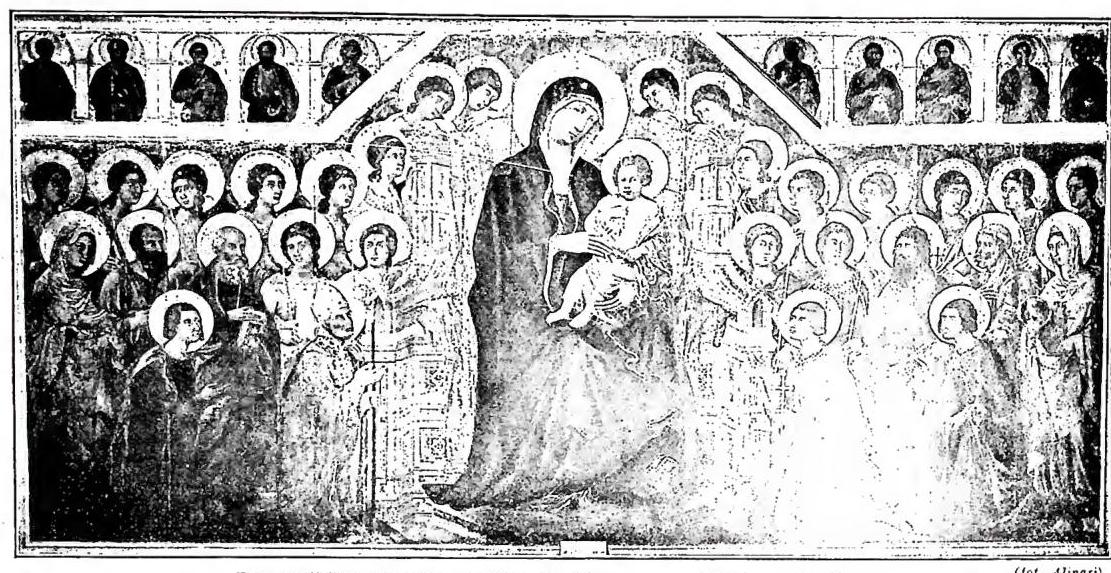
The Maestà, besides being one of the greatest masterpieces of medieval painting, is also the only securely documented work by D., who thus wished to be remembered in an invocation written on the step of the Madonna’s throne: MATER SANCTA DEI - SIS CAUSA SENIS REQUIET - SIS DUCIO VITA - TE QUIA DEFINNIT ITA. The front indeed depicts the Virgin and Child enthroned, surrounded by twenty adoring angels, by s. Caterina of Alexandria, s. Paul, s. John the Evangelist, s. John the Baptist, s. Peter and s. Agnese. In the foreground kneel the four patron saints of Siena, s. Ansano, s. Savino, s. Crescenzio and s. Vittore, while along the upper edge of the panel the busts of the other Apostles are arranged beneath small arches. The reverse is divided into twenty-six compartments illustrating the Passion of Christ, from the entry into Jerusalem to the appearance at Emmaus. On its front side, the predella bears seven small scenes from the infancy of Jesus, interspersed with six figures of prophets; on the reverse, ten episodes from the life of Christ: the panels constituting the crowning illustrate the life of Mary after the Resurrection and Christ’s final appearances. The predella and the crowning were probably completed after 1311; nevertheless, the magnificent ensemble displays admirable stylistic homogeneity and must be regarded as having been executed entirely by D.’s hand, with the exception of a few panels in the crowning, where the painter may have availed himself of the assistance of a collaborator. The iconographic scheme of the small scenes, like that of the great composition on the front, is still of wholly Byzantine tradition: that Byzantine tradition which was reinvigorated between the ninth and twelfth centuries by the renewed growth of spirits and forms of
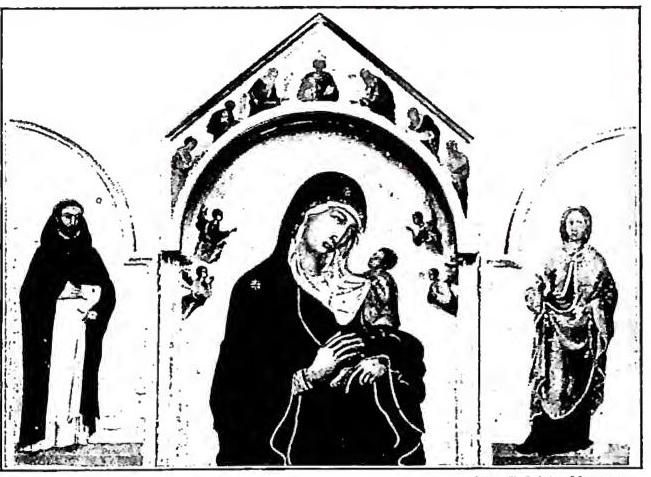
DUCCIO DI BUONINSEGNA — The Maestà — Siena, Museo dell’Opera del Duomo. (phot. British Museum) DUCCIO di BUONINSEGNA — Virgin and Child between Two Saints. London, British Museum. (phot. Alinari)classicism, which is reflected with exceptional refinement in thirteenth-century Tuscan painting. But D. breathes new life and immediacy into those venerable models, imparting to them a sense of a humanly deeper truth, while his language is enriched and softened by welcoming, for the first time in Italian painting, the modulated cadences of Gothic linearism. The Maestà represents the culmination of a complex stylistic evolution that begins with the Madonna di Crevole (Siena, Museo dell’Opera), now almost unanimously recognized as an early work by D.; the already mentioned monumental Madonna Rucellai in Florence dates from 1285, and in 1288 D. — as has been demonstrated by very recent investigations — supplied the cartoons for the great circular stained-glass window of the choir of Siena Cathedral. This is divided into eleven sections, representing the four Evangelists, the four patron saints of Siena, the Burial, the Assumption, and the Coronation of the Virgin; in these, several fundamental themes of the Maestà are already anticipated. The window, still preserved in situ, also constitutes the first great Italian creation in the field of historiated stained glass. The small, exquisitely refined Madonna dei Francescani (Siena picture gallery, no. 20), on account of the highly developed Gothic taste of its line, belongs to a considerably later period than was believed until recently, when it was placed at the beginning of D.’s activity. The two Madonne in the Museum of Bern and the Stoclet Collection in Brussels, as well as the triptych in the National Gallery in London, are placed close to the Madonna dei Francescani; the Madonna in the gallery of Perugia is likewise earlier than the Maestà. Two polyptychs (nos. 47 and 28) in the Siena picture gallery, in which — especially in the second — a very substantial participation by assistants can be observed, would document the final phase in the development of the Ducciesque manner, after the Maestà, whereas for other highly notable paintings, such as the Madonna in the parish church of Badia a Isola, the attribution to D. remains highly controversial. In the lucid vision of this great master, the poetry of Hellenistic naturalism comes to life again, transfigured within the intimacy of the new Christian sentiment; in the language through which the figures in his narratives express themselves, the destinies of the entire subsequent Sienese school of painting are already fully revealed. - Vedi tavv. CXXIII - CXXIV.
BIBL.: C. H. Weigelt, D. di B., Lipsia 1911; A. Lisini, Di D. di B., in Rass. d'arte senese, 8 (1912); C. H. Weigelt, s. V. in Thieme-Becker, X (1914), pp. 25-29; R. Van Marle, The Development of the Ital. Schools of Painting, II, L'Aia 1924; E. Cecchi, I trecentisti senesi, Roma 1928 (2ª ed. Milano 1948);
E. Carli, Vetrata ducentesca, Firenze 1946; C. Brandi, Carmine o della pittura, ivi 1947. Enzo Carli
Cite this article
“DUCCIO DI BUONINSEGNA.” Enciclopedia Cattolica, vol. IV (1950), p. 1137. Azione Romana digital edition, https://azioneromana.com/article/duccio-di-buoninsegna.