Machine translation of the 1948–1954 Italian original. The original text is authoritative.
CIMABUE. - Cenni di Pepo known as C., painter
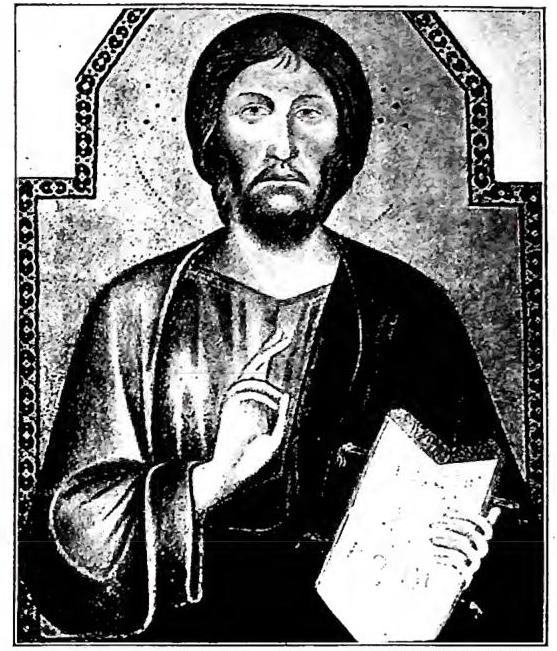
(from P. Mornand, Le visage du Christ, Paris 1570) CIMABUE - Jesus Christ - New York, Duween coll.Florentine, born ca. 1240. Documents inform us only that in 1272 he was in Rome, that in 1301 he contracted to execute in collaboration with the Lucchese Giovanni d'Apparecchiato an altarpiece with the Maestà for the church of S. Chiara in Pisa, and that in 1302 he was working on a figure of S. Giovanni in mosaic in the apse semi-dome of the Cathedral, also in Pisa, where he died in that year. Much more extensive information regarding his activity is provided by Vasari, but the earliest and most important testimony concerning the painter is constituted by the well-known Dantean tercet (Purg., XI, 94-96): where moreover Dante, noting that "credette Cimabue ne lo campo tener lo campo, e ora ha Giotto il grido, so che 'l dun desso scura la fama", does not seem so much to allude to the oblivion into which the painter's name had fallen—whose art had been surpassed by Giotto's new manner—as to the rapid transition of the older master's figure from history to myth, seeing that his fame still persisted. The historicism of the last century, with its rigid criticism of sources and of Vasari's text, seemed to confirm Dante's intuition and, despairing of reconstructing the work of C., went so far as to doubt the very existence of the master (Wickhoff, Richter, Douglas). It is the merit of modern criticism to have restored a complete physiognomy to this name, which had by then become legendary. On the stylistic foundation of the sole work by the master whose authenticity is documentarily attested (the mosaic S. Giovanni for the Cathedral of Pisa), it has established a group of paintings (panels, frescoes, and mosaics) sufficiently homogeneous to illuminate the artistic development of a personality by now well-defined and unmistakable.
The most reliable sequence of works securely by C. is the following: two Stories of Joseph and Naming of the Baptist, mosaic scenes in the cupola of the Baptistery of Florence (Cimabue's hand is recognizable only in certain parts); Painted Cross on panel in the church of S. Domenico at Arezzo; frescoes in the presbytery and transept of the Upper Basilica of S. Francesco in Assisi
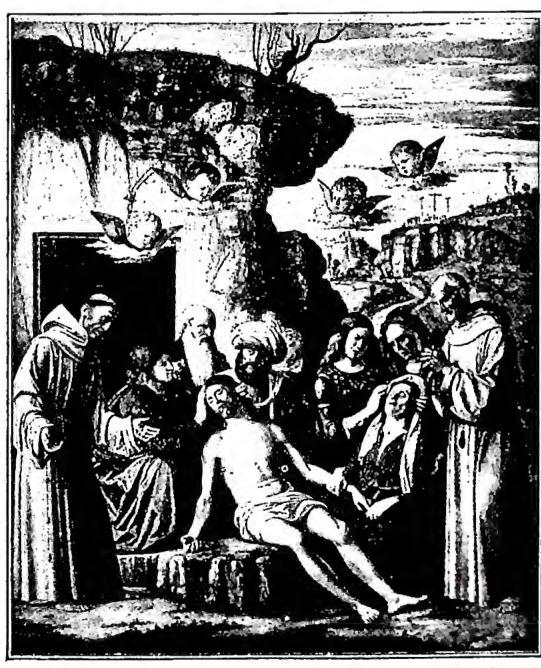
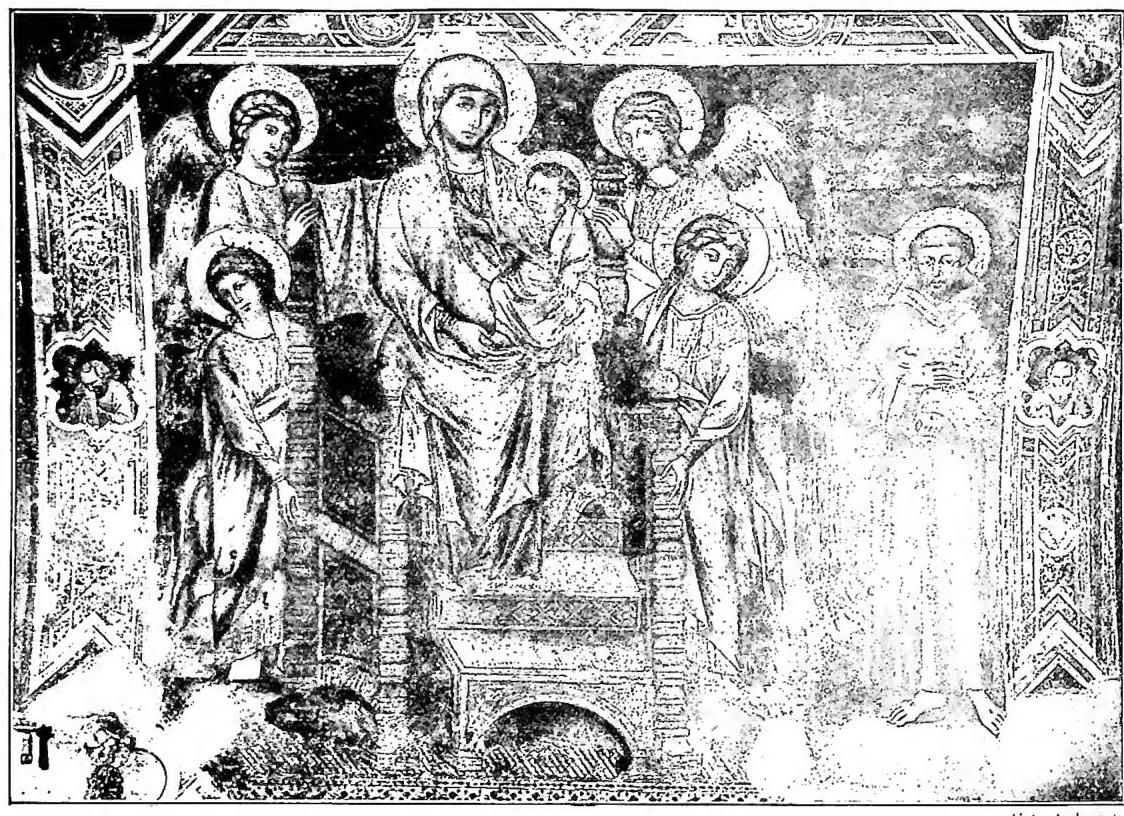
(photo Anderson) CIMA DA CONEGLIANO - Christ Deposed from the Cross. Modena, Pinacoteca.(photo Andricano) CIMABUE - The Virgin Enthroned with Angels and St. Francis - Assisi, Lower Church of St. Francis.(depicting the four Evangelists in the vault of the presbytery, the Stories of the Virgin in the choir, the Apocalyptic Scenes and a large Crucifixion in the left arm of the transept, and Stories of the Apostles Peter and Paul and a Crucifixion in the right arm of the transept), heavily ruined, and a Madonna with Four Angels and St. Francis, heavily repainted, in the transept of the lower basilica; the large panel with the Madonna Enthroned with the Child, Eight Angels, and Four Prophets formerly in the church of S. Trinita in Florence, now in the Uffizi Gallery; the panel with the Madonna Enthroned with the Child and Six Angels formerly in S. Francesco in Pisa, now in the Louvre; the Painted Cross on panel in the Museum of the Opera of S. Croce in Florence and the aforementioned St. John in mosaic in Pisa. A late workshop piece, but with some autograph parts, is the Madonna Enthroned with Two Angels formerly in the church of the Servi, now in the Pinacoteca of Bologna.
The traditional thesis of the Byzantine origins of C.'s art has not found confirmation, in the Vasarian sense, in the recent recognition of the painter's intervention in the mosaic cycle of the dome of the Florentine Baptistery, inasmuch as modern criticism no longer judges these mosaics to be the work of Greek and Byzantine artisans, but rather well-defined expressions of a typically Western and Romanesque taste. C.'s Byzantinism is instead attested by the dependence of the painted Cross of Arezzo on the models of Giunta Pisano: it was Giunta and the painters of his circle—exponents in Pisa of that orientalizing culture nourished by classical reviviscences which is usually defined by the name of "Byzantine neo-hellenism"—that transmitted to C. that abundant repertoire of linguistic solutions, signs, metaphors, and figurative symbols that compose themselves in clear and vigorous metrics in the Aretine Crucifix: and C., almost completely immune to the neo-hellenic grace that characterizes his contemporary Duccio di Buoninsegna, drew rather from the tradition of Byzantium those accents of
solemn severity, liturgical rigor, and dark pomp that constitute the archaic and immutable substratum of that civilization. But already in the Uffizi Maestà, what strikes one is not so much the grandiose organicity of the composition in which Byzantine hieraticism takes concrete form in an architectural construction, as the incisiveness of the line, the harsh energy of the marks and profiles that create effects of plastic relief and confer a passionate dynamism upon the figures. And in the admirable, highly ruined frescoes of Assisi, above all in the Crucifixion of the left transept, the forms appear marked by the robust evidence of Romanesque sculpture, while the conventional dramatic quality of the Byzantine iconographic models appears surpassed in a tragic expressive violence that audaciously shatters the spatial construction of the scene.
With C.'s accentuated individualism, the Byzantine tradition in Italian painting finds its concluding phase, while the progressive assertion of drawing and relief over purely chromatic values (as seen, for example, in the late Crucifix of S. Croce) is a clear prelude to the art of Giotto. - V. Tav. CIII.
BIBL.: G. Vasari, Le vite..., etc. (ed. Milanesi), I. Firenze 1878, pp. 247-67; J. Strzygowski, C. und Rom., Vienna 1888; Venturi, V, pp. 63-80, 195-242; A. Aubert, Die malerische Dekoration der S. Francesco Kirche in Assisi: Ein Beitrag zur Lösung der Cimabuefrage, Lipsia 1907; P. Toesca, Storia dell'arte italiana, I, Torino 1927, pp. 1003-12; A. Nicholson, C., Princeton 1932; R. Salvini, C., Roma 1946; R. Longhi, Giudizio sul Duecento, in Proporzioni, 2 (1948), pp. 15-18, 45-47. Enzo Carli
Cite this article
“CIMABUE.” Enciclopedia Cattolica, vol. III (1949), p. 939. Azione Romana digital edition, https://azioneromana.com/article/cimabue.