
CATHEDRAL. – It is the principal church of the diocese, where the bishop’s cathedra or throne is located. Also called the “Duomo,” or the house of God par excellence, it is the most important church in the diocese (ecclesia mater and maior). If the bishop is invested with some degree of dignity or particular jurisdiction, his cathedral likewise receives the analogous title, namely metropolitan, primatial, or patriarchal.
The cathedral must be solemnly consecrated (cf. can. 1165 §3), and the anniversary of this consecration or dedication is celebrated throughout the diocese with the double rite of the first class and an octave; without an octave by religious. The titular saint is solemnized with the same rite. The episcopal cathedra, or throne, must, according to ancient usage, be situated at the back of the apse, with the altar in front, so that the celebrant faces the people; if the altar is built against the wall, then the
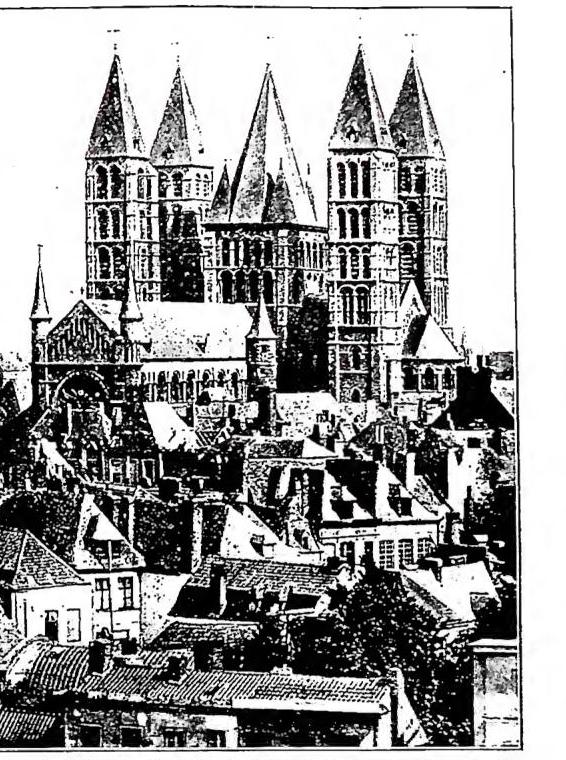
CATTEDRALE — Cathedral of Tournai situated in the upper part of the city. South-west view (begun in 1107 and completed in the fourteenth century).
The throne is therefore located on the Gospel side. The daily liturgy of the Chapter (v.) and consists in the recitation of the Divine Office and the sung Mass of the day. The most solemn functions take place in the cathedral, such as the general sacred ordinations, « vocatis et praesentibus canoniciis », on the Saturdays of the Ember Days, on the Saturday « Sitientes », and on Holy Saturday (cann. 1006 and 1009); the announcement of the movable feasts after the Gospel of the Mass of the Epiphany; the consecration of the holy Oils; and the washing of the feet on Holy Thursday. At Easter, and on another day of his choice, the bishop gives the papal blessing in the cathedral, together with the attached plenary indulgence, according to can. 914.
The CIC contains various provisions concerning cathedrals, in addition to those already cited; these provisions concern: responsibility for repairs (can. 1186: V. CHIESA), the preservation of the Most Holy Eucharist (can. 1268 § 3: V. EUCARISTIA), the right to receive the bishop’s sacred furnishings upon his death (can. 1299: V. SUPPELLETTILE SACRA), and conversely the obligation to provide the bishop free of charge with sacred furnishings and everything he requires for Mass or pontifical functions (can. 1303 § 1: V. SUPPELLETTILE SACRA), judicial competence in cases concerning the cathedral’s rights or temporal goods (can. 1576 § 1, which prescribes a collegiate tribunal of three judges), the possibility for the bishop to appear in court in the name of the cathedral (can. 1653 § 1), and the effects of a local interdict with regard to the cathedral (cann. 2271 n. 2 and 2272: V. INTERDETTO).
More probably, defensive considerations must have played a part, as is shown by the cathedral’s connection with the castle (Fondi, no longer a bishop’s see) or by its position beside obligatory points of passage, and therefore certainly fortified ones, such as bridges (Verona, and perhaps also Cologne), or at the edge of the original circuit of walls, in cities of Roman foundation (Como, Lucca, and many centres along the Via Emilia). Finally, the suitability of serving the spiritual needs of both the city and the surrounding countryside may also have contributed to this location.
The configuration of the terrain likewise had a decisive influence, determining in hill towns the placement of the cathedral at the highest point, often superimposed upon Roman or pre-Roman temples (Alatri, Fermo), and sometimes resulting in peripheral locations (Gubbio, Spoleto, Cortona), or even in positions outside the urban nucleus (Ancona). In any case, the result was a separation from the rest of the building complex, with the church standing out distinctly over the entire inhabited area. Picturesque and imposing effects are observed especially in cities on rivers, where the cathedral dominates the adjoining area from natural terraces (Avignon, Basel). In lowland cities, when the cathedral occupies a central position, it generally becomes the determining element and, in the great building renewal that began in the 13th century, constitutes the dominant feature of the principal square, where the market is also held (Cremona, Reggio Emilia, and many Belgian and German cities). The square may take various planimetric forms: the L-shaped arrangement, which allows the church to present two free sides, is frequent in Italy (Pistoia, Foligno), and not uncommon in central and western Europe as well (Strasbourg, Rouen); triangular forms are also found, of more ancient origin (Massa Marittima), though in some countries they continued until well into the fourteenth century (Antwerp); at times, finally, the square is laid out in depth, often skilfully connected with other nearby squares so as to form a complex of organically grouped spaces (Todi, Ascoli Piceno).
The new Renaissance conceptions, after some transitional manifestations (such as Urbino, which shows, with a different sensibility, a revival of the connection between church and castle), were fully established at Pienza, where the cathedral assumed the significance of a central element in an architecturally harmonious and balanced composition, in its volumetric and spatial relationships, and logically integrated into the urban plan. The following century also displayed in this field the imprint of academic Mannerism in the square of Livorno, where arcaded buildings frame the cathedral according to a rigidly unified conception. Finally, at Salzburg the Baroque offers an expression of the new spatial sense, in the succession of squares surrounding the cathedral, arranged so as to ensure views of it from every side, while leaving the area in front enclosed and intimate.
The eighteenth and nineteenth centuries present no interest in this respect; indeed, in the latter century, the false criteria of isolation and of an ill-conceived enhancement led to the complete alteration of the original setting, with the transformation of the ancient church forecourts into squares that were too large and sometimes crowded with traffic (Milan, Paris). The solutions adopted during the first decades of the twentieth century for rebuilding the earthquake-stricken cities of Italy were likewise almost always banal.
Outside Europe, some good examples of the urban-planning arrangement of cathedrals are found in North Africa (Benghazi, Tripoli, Rabat). It is above all in Latin America, however, that the most imposing expressions of the last three centuries may be seen: particularly in Mexico City and Santiago de Chile, where the principal representative buildings are scenographically grouped around the city’s main church.