
LIVORNO, DIOCESI di. – Diocese and chief city of the province of the same name in Tuscany.
Within an area of 290 sq. km., it has a population of 165,000, of whom 162,000 are Catholics. It has 39 parishes, served by 55 diocesan priests and 67 religious priests, one seminary, 14 male and 45 female religious communities (Annuario Pontificio, 1951, p. 251).
An oratory dedicated to S. Maria already existed before the 12th century, since it is mentioned in a parchment dated 30 March 1160; it is likewise known that in 1267 it also took the title of another church, S. Giulia, which was destroyed, and from that time was called the parish church of S. Maria e Giulia. This church must have been built when Desiderio, king of the Lombards, while transporting the body of s. Giulia, virgin and martyr, from Gorgona to Brescia, stopped at L. It was indeed on that occasion (776) that s. Giulia was chosen as protectress and patroness. When the church was demolished in 1534 to isolate the fortress, the church of S. Antonio was raised to the status of parish church of Labrone or Livorna or Liburna (the earliest confused names of present-day L.); in remembrance, it also assumed the title of S. Maria e Giulia.
The village and later castle formed part of Porto Pisano, with its fortifications and vassal territories, experiencing the varying fortunes and vicissitudes of that Republic; ecclesiastically, however, it may be said always to have remained within the archdiocese of Pisa. Indeed, in 1103, after Countess Matilde had donated it to the works of the cathedral of Pisa, it was sold a few years later, for precisely 1,000 lire, to the archbishop himself. Ferdinando I dei Medici, who wished to make L. a city (it was proclaimed one on 19 March 1606), also completed in the Piazza d'Arme the church of S. Francesco, larger than those already
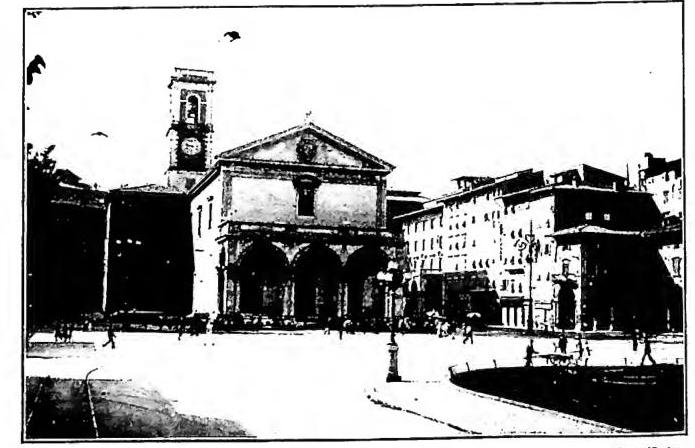
In a short time L. had become a flourishing city of commerce and trade, thanks in part to the granting of franchises, concessions, and hospitality to people of other nationalities, religions, and even Eastern rites, both Catholic and schismatic, granting them their own quarters, churches, and cemeteries. The community had repeatedly asked to have a bishop, or at least for the archbishop of Pisa to take the name of bishop of L., but this was not granted. Privileges were nevertheless granted to the provost, so that in insignia and sacred functions he would not be at a disadvantage, as a matter of ceremonial display, in comparison with the ministers of other cults and rites; thus, in addition to being a domestic prelate, he was granted the use of pontificals (privileges that he retained until 3 May 1949, when, after the care of souls was removed from the provost of the cathedral Chapter, he was reduced to a domestic prelate). The diocese was finally established by a bull of Pius VII on 25 September 1806, comprising the city, which at that time had the parish church and six vice-parishes, as well as six other benefices, over an area of 290 sq. km. The first bishop was Msgr. Filippo Ganucci.
Various pontiffs visited and stayed in this city, especially on account of their journeys, above all to France. The following are remembered: Innocent II, Alexander III, Urban V, Gregory XI, Urban VI, Eugene IV, Adrian VI, Clement VII, Pius VII, Pius IX.
Among the people of Livorno worthy of remembrance are: Msgr. Girolamo Gavi (1775–1869), who, as provost of the city and, after being elected bishop, receiving the title of Milto, remained (for 21 years) apostolic administrator and provost of L. and devoted the revenues, savings, and his estate to works of charity and to the construction of the seminary, which is accordingly called «Gavi»; and Fr. Pio Alberto Del Corona, a Dominican, distinguished writer and preacher, bishop of S. Miniato and later titular archbishop of Sardica (1873–1912).
L. possessed no great works of art, and even what was noteworthy there, although not of the highest value, was disfigured by the destruction caused by the bombardments (170), which fell particularly heavily upon the sacred buildings. There nevertheless remain: the Sanctuary of Montenero and, once they have been repaired, the churches of S. Ferdinando, S. Giovanni, S. Caterina, S. Sebastiano, and the Madonna, all possessing a certain degree of internal architectural value, as well as the Cathedral, now a national monument.
SANTAIO DELLA MADONNA DI MONTENERO. - The most noteworthy event, which continues to have lasting significance, is the discovery, on 15 May 1345, by a pious shepherd near the little river and locality of Ardenza, of a valuable painting depicting the Madonna with the Child. The Blessed Virgin is said to have told the old man, who immediately found himself cured of his lameness, to carry her image to Montenero, where she desired a shrine dedicated to her to be erected.
A great devotion to this Madonna delle Grazie, called Madonna di Montenero, immediately developed, not only among the people of Livorno but also in the nearby cities and communities,
so much so that Pius XII proclaimed her patroness of all Tuscany on 15 May 1947. The present artistic shrine, rich in marble and valuable works, may be considered an eighteenth-century building. It was raised to the rank of basilica in 1818. It is entrusted to the care of the Vallombrosan monks. L., which has always received so many graces and such protection from its Madonna, on 27 January 1742 (the Feast of the Vow), having been delivered from the earthquake and tidal wave, made a vow (which it still keeps) to postpone Carnival until that date, to fast on that day, to offer the shrine, at the expense of the municipality, 10 pounds
of wax, and to hold a solemn thanksgiving service every year. - Vedi tav. XCIX.