
MATILDE di CANOSSA. - In the great struggle between Papacy and Empire in the eleventh century, the female element is represented in the noblest and purest manner by Countess M., commonly called of Canossa. She was the last representative of the house of the Attonidi, which in the eleventh century had united in its hands the two marches of Lombardy-Emilia and Tuscia. M.’s father was Bonifacio III, the most powerful member of the dynasty; her mother was Beatrice of the dukes of Lorraine; her birth must be placed about 1045-46. After the disappearance of her father, assassinated about 1052, the young M. was betrothed to Goffredo of Lorraine, whose father, Goffredo il Barbuto, at the same time married M.’s mother. The two princely houses, thus united, formed a territorial bloc which could be dangerous to the Empire: the consequence was that Emperor Enrico III intervened vigorously in Italy, and while Duke Goffredo escaped by flight, Duchess Beatrice had to appear before the feudal tribunal in Firenze and was taken prisoner to Germany by Enrico III together with her daughter M. The latter was now the sole heiress of the ancestral dominions, since in those years her elder brother Federico and her other sister Beatrice had died. The death of Enrico III in 1056 enabled the margravial family to return to its states of Emilia-Tuscia. M. grew up beside her mother and stepfather, being initiated into the art of government; politics, however, did not prevent Beatrice and M. from living a life wholly dominated by a profound religious sense.
The family was entirely bound to the Church: the uncle of Duchess Beatrice was Pope Leone IX; the brother of Duke Goffredo was Pope Stefano IX; intimate with the ducal court was the bishop of Lucca, Anselmo da Baggio, who became Alessandro II. Duchess Beatrice, as a letter of St. Pier Damiani states, on marrying her cousin Goffredo in a second marriage for reasons of political necessity, made with him a pact of mutual continence; it appears that M. had aspirations to a monastic life. The demands of dynasty and state compelled her in 1069 to marry her stepfather’s son, Goffredo called il Gobbo, and from 1069 to 1071 she lived in Lorraine with her husband. The marriage was not very happy. About 1071 a child was born who soon died, and immediately afterwards M. returned to Italy to her mother, who had lost her second husband in 1069. M., urged by her husband to return to Germany, refused, and the journey Goffredo made to Lombardy in 1073 was of no avail. The conflict was not merely personal but political: M. and her mother pursued a policy of absolute devotion to the movement of religious reform centred upon Pope Gregorio VII; Duke Goffredo, abandoning the promises he had initially made to the Pope, had become one of the most vigorous supporters of Emperor Enrico IV.
In 1076 Countess M. was freed from concern over her husband, who was assassinated that year by an enemy, but she also lost her mother Beatrice, who was buried at Pisa. Thus the countess remained alone to govern the vast state. She was effectively supported by Gregorio VII, who considered M. a faithful disciple: she was advised by the bishop of Lucca Anselmo, nephew of Alessandro II: “she exercised power, he governed,” says Anselmo’s biographer. M. had blind trust in Anselmo, as the man of God placed at her side by Gregorio VII and Providence.
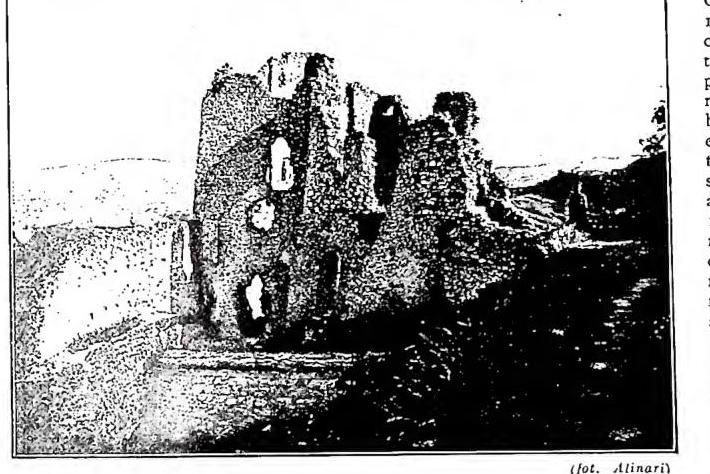
When the conflict between Gregorio VII and Enrico IV became violent, the countess remained faithful to the Pope, although she did not wish to break completely with her supreme feudal lord, the Emperor. M.’s influence may perhaps have been felt by the German princes at the Diet of Tribur, which she attended, obtaining decisions of delay. When, consequently, Gregorio VII decided to go to Germany to the Diet of Augusta, in order to examine as supreme judge the question of the Emperor and the princes, the countess supported him, assisted him on his journey through her states, and received him in her Apennine castle of Canossa when, in January 1077, it was announced that Enrico IV had descended into Italy with intentions that were not altogether clear. The negotiations conducted between Gregorio VII and Enrico IV during the last days of January had authoritative mediators in M. of Canossa and her cousin Adelaide of Torino, mother-in-law of the Emperor: in a meeting between Enrico IV and Countess M., held at the chapel of S. Niccolò near Bianello, reconciliation was prepared; M., urged by Enrico IV to fulfil her feudal duty by interceding with the Pope, acted accordingly. Gregorio VII accepted Enrico’s assurances because they were guaranteed by the assurances of the two princesses. After the agreement of Canossa (28 January 1077), the Pope remained for several months as guest of the Matildine residence. The crisis in Matildine policy began when the rupture between Enrico IV and Gregorio VII became definitive and, while the Pope once again excommunicated the prince, an anti-king was elected in Germany. M. adopted an attitude ever more decidedly favourable to the anti-imperial Gregorian policy, and at some undetermined time, while in Rome (1078-1080), she made a donation to St. Peter, into the hands of Gregorio VII, of all her allodial possessions which she had or might have, whether by rights of inheritance or otherwise, both on this side and beyond the Alps, while retaining their usufruct for life.
(phot. Alinari)
to the Church of Rome. When, in 1111, the new emperor Henry V came down into Italy, he sought to establish cordial relations with the old countess: an agreement was reached, the content of which is unknown. It seems that Henry V granted the countess the office of his representative in the Italian Kingdom; that M., as was conjectured, promised in some way to leave her possessions to the Emperor is doubtful. It is probably to be assumed that the Emperor recognized the countess’s personal authority over the two marches, relinquishing the right to impose his own representative as margrave.
(photograph by U. Orlandini)
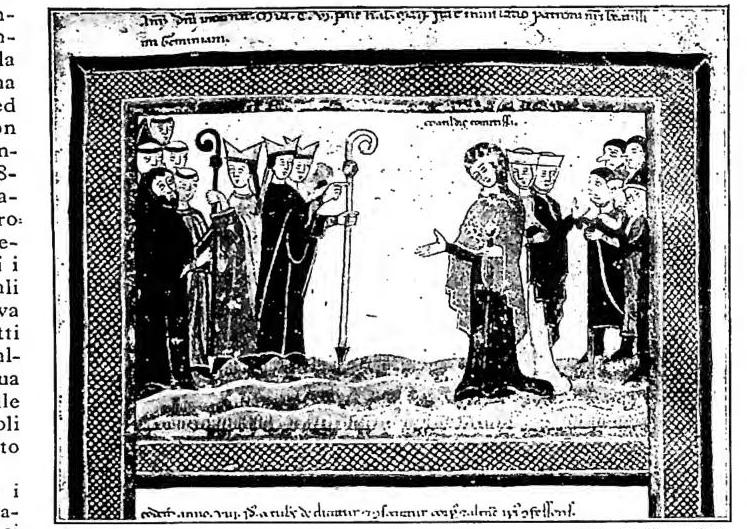
MATILDE DI CANOSSA - M. di C. assists at the examination of the body of s. Geminiano. Thirteenth-century miniature from the Relatio translationis Corporis Sancti Geminiani - Modena, Capitular Archive.
and that she is the female figure idealized by Dante in the Earthly Paradise.
BIBLI: after L. Tosti, Vita della contessa M., 3rd ed., Rome 1886, attempts were made to narrate the countess’s life: M. Huddy, Matilda counties of Tuscany, London 1905; N. Duff, Matilda of Tuscany, ibid. 1910; L. Tondelli, M., Rome 1915; 2nd ed. ibid. 1926; N. Grimaldi, La contessa M. e la sua stirpe feudale, Florence 1928; but with mediocre results. Studies on the countess appeared in a Miscellanea per l'VIII centenario della morte, Reggio Emilia 1915. A critical edition of the monk Donizone’s Vita Mathildi has now been prepared by L. Simconi (RIS, V, II), Bologna 1930, pp. 1–128, who also studied the Vita Mathildi and its historical value in Atis e memorie della R. Deput. di Storia patria per le prov. modenesi, 7th series, 4 (1927). An examination of all the countess’s documents was undertaken by A. Overmann in his volume Griffin Mathilde von Tuscien, Innsbruck 1885. On the castle of Canossa v.: A. Ferretti, Canossa, Turin 1884; N. Campanini, Canossa, 2nd ed., Reggio Emilia 1915. On M.’s relations with Gregory VII, v.: L. Simconi, Il contributo della contessa Adelaide al papato nella lotta per le investiture, in Studi gregoriani, collected by G. B. Borino, I, Rome 1947, pp. 253–71. On the plaque containing the text of M.’s donation, v.: A. Ferrua, La donazione della contessa M., in Civ. Catt., 1943, I, pp. 122–23; Il millenario di Canossa, edited by A. Tondelli, Reggio Calabria 1951. Francesco Cognasso