
PIER DAMIANI, saint. — Doctor of the Church, born at Ravenna in 1007, died at Faenza on 23 February 1072. After a troubled childhood (v. the sad episodes narrated by St Giovanni da Lodi, Vita b. Petri D., 1: PL 144, 115–16), he found in his sister Roselinda a second mother (Ep. Agneti imp., ed. A. Wilmart, in Rev. bénéd., 44 [1932], p. 128), and in his elder brother Damiano (perhaps the source of his second name) guidance and support in the
niache, against that of Cardinal Umberto of Selva Candida (cf. L. Saltet, Les réordinations..., Paris 1907, p. 190 ff.).
When his companion in the Milanese legation, Anselmo da Baggio, was elected pope under the name Alexander II (1061–73), he vigorously supported his cause against the antipope Cadalus (Ep., I, 20, 21: ibid. 144, 237–54), although, in his zeal, he also took steps that were disapproved by his own party (Ep., I, 16: ibid. 144, 235). As is also evident from the Disceptatio Synodalis, his most directly political work, written in 1062 (in MGH, Libelli, I, ed. cit., pp. 76–94), he believed that harmony between the Papacy and the Empire had to be maintained at all costs, whereas the greatest difficulties for the longed-for reform derived precisely from the Empire and the laity. Disappointed, he longed for the peace of the cloister, and first succeeded in obtaining permission to return to his hermitage at Avellana and later permission to resign the see of Ostia. From time to time, however, he was summoned for new missions: in 1063 to Cluny, to defend the privileges of the Congregation against Dragone, bishop of Mâcon (De gallica profectione: PL 145, 863–80); shortly afterward (1063) to Florence, to investigate Bishop Pietro, accused of simony and acquitted by him for lack of evidence (Op., 30: ibid. 145, 523–30); in 1069 to Mainz, to dissuade Henry IV from divorcing Berta of Turin, a mission crowned with temporary success; in 1071 to Montecassino for the consecration of the church; in 1072 to Ravenna, to reconcile it with the Apostolic See, after the interdict imposed on the city because Archbishop Enrico had taken the side of the antipope. On his return he died at Faenza, in the monastery of S. Maria fuori Porta, during the night of 22–23 February. He was universally venerated as a saint from the moment of his death. Leo XII honored him with the title of doctor (1 October 1828, constitution Providentissimus Deus, in Decreta auth. Congr. S. Rit., Rome 1898–1912, no. 2663). Dante places him in the seventh heaven among the contemplatives (Pared., XXI, 43–99). Some Dante scholars have wished to find, perhaps not entirely without justification, in certain passages of the works of St P. D. one of the Poet’s sources for the De Monarchia and the Divine Comedy (cf. E. Anzalone, Dante e P. D., saggio, Aciresle 1903; P. Amaducci, La diretta dipendenza della Divina Commedia...S. Marino 1934; L. Cicchitto, Alcuni riscontri tra s. P. D. e Dante, Rome 1948).
D. the writer arouses interest as a philosopher (though an enemy of dialectic applied to dogma), and greater interest as a theologian (especially in the question of reordinations, in sacramental questions in general and in Mariology) and as a jurist; but above all as an ascetical writer (he is the theoretician of eremitical life), and as a historical source for his times. Taken as a whole, in his century, so poor in writings and writers, he must be regarded as the greatest in the various fields of theological learning, despite not having produced works of great length. His writings, often polemical, consist of several Vitae Sanctorum (the most famous being the Vita Romualdi), numerous letters and opuscula, which constitute the most substantial part; several Carmina et Preces, and various Sermones.
The authenticity of the latter is much debated: 19 are regarded as certainly spurious and attributed to Nicola of Clairvaux (cf. I. I. Ryan, St Peter D. and the sermons of Nicholas of Clairvaux: a clarification, in Medieval Studies, 9 [1947], pp. 151–61). It is also known that St P. D. had been urged by his friend Ildebrando to compose a Collectio canonica to document more fully the truth and antiquity of the privilegium Romanæ Ecclesiae, that is, the primacy and sovereign independence of the Roman Pontificate (Op., 5: PL 145, 89–90, 92).
It may be held that this work is the Collectio known as LXXIV Titulorum, which Michel, on purely internal grounds, claims for Cardinal Umberto of Selva Candida (cf. A. Michel, Die Sentenzen des Kard. Humbert..., Leipzig 1943).
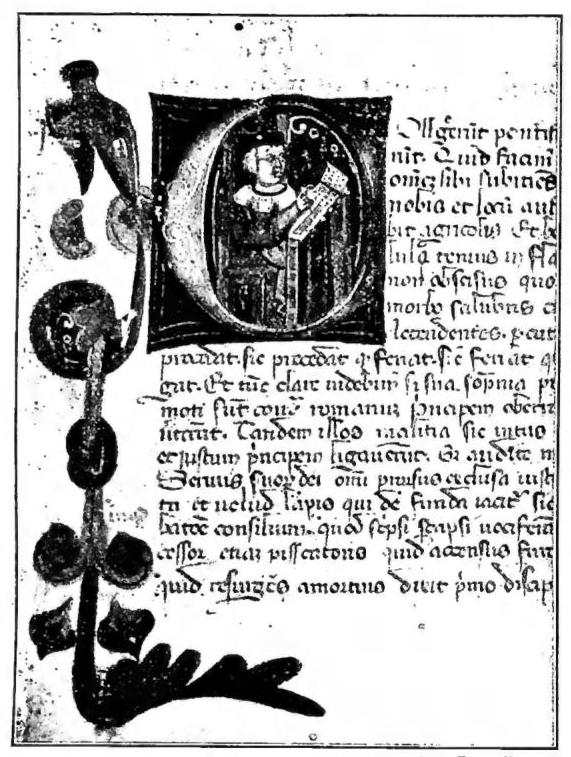
(photo Enc. Cott.)
PIER DELLE VIGNE (de Vineis) — P. d. V. in the chair. Illumination of cod. Ottoboniano lat. 1101, f. 1 (14th century), containing the letters of P. d. V. — Vatican Library.
The principal source for the biography is the Vita, written by the disciple Giovanni da Lodi: PL 144, 113–46. The most notable work on his life is F. Neukirch, Das Leben des Petrus D., Göttingen 1875; on the chronology of the works: F. W. E. Roth, Der hl. Petrus D. nach den Quellen neubearbeitet, in Studien und Mitteilungen aus dem Benedictiner u. dem Cistercienser-Order, 7 (1886), fasc. I, pp. 110–34; fasc. II, pp. 357–74; fasc. III, pp. 43–66; fasc. IV, pp. 321–36; 8 (1887), fasc. I, pp. 56–64; fasc. II, pp. 210–16.
For the entire bibliography concerning the Saint prior to 1907, cf. U. Chevalier, Répertoire des sources historiques du M. A., Biobibliographie, II, 2e ed., Paris 1907, cols. 3708–10; cf. also under Gregorio VII, and in addition: R. Biron, S. P. D., Rome 1909; L. Kühn, Petrus D. u. die weltliche Anschauungen über Staat u. Kirche, Karlsruhe 1913; H. Schubert, Petrus D. als Kirchen politiker, in Festgabe von Fachgenossen u. Freunden K. Müller, Tübingen 1922, pp. 83–102; M. Mende, Petrus D., I, Breslau 1933; S. Baldassarri, La marialogia in s. P. D., in Scuola cattolica, 61 (1933), pp. 304–12; J. Denis, Les théories politiques de Pierre Damien, Paris 1934; P. S. Leicht, In locum quendam Petri D.,
in Acta congr. iuridici int., II, Roma 1935, pp. 303-307; I. Cavigioli, De sententia s. Petri D. circa absolutionem complicis in peccato turpi, in Apollinaris, 12 (1939), pp. 35-39; J. De Ghellinck, Littérature latine au moyen âge..., II, Parigi 1939, pp. 69-73; A. De Girolamo, La teologia sacramentaria di s. P. D., Napoli 1942; V. Vailati, La devozione all'umanità di Cristo nelle opere di s. P. D., in Divus Thomas, 46 (1943), pp. 78-93; A. Glabbani, Lo spirito della regola di s. Benedetto e la vita monastica eremitica secondo s. P. D., in Benedictina, 1 (1947), pp. 135-36; O. J. Blum, S. Peter Damian, his teaching on the spiritual life, Washington 1947; P. Palazzini, Note di diritto romano in s. P. D., in Studia et documenta historiae et iuris, 13-14 (1947-48), pp. 253-68. Pietro Palazzini