
FAENZA, DIOCESI di. — In the province of Ravenna; it is a suffragan see of Bologna; the Cathedral is dedicated to St Peter the Apostle. The diocese covers 700 sq. km. and has 125,000 inhabitants, of whom 23,250 are in the city, 47,660 in the municipality, and about 80,000 in 10 other municipalities. It comprises 14 city parishes and 103 rural parishes divided into 25 vicariates. It has 247 priests, 536 religious men and women, distributed among 7 monasteries, 9 convents, or attached to the care of 14 colleges or educational institutions.
A communications centre between Tuscany and the Ravenna area, it owes its development from antiquity chiefly to this circumstance (it is mentioned for the first time in historical sources as an ally of Rome in the Second Punic War, 216 B.C.). We have no direct information about pre-Constantinian Christianity in F. (the Faentine martyrs Emiliana and Savino are legendary); nevertheless, at the Roman Synod of 313, its bishop Constantinus is already present at Faventia (Ottato Mil., CSEL, 26, 26), which suggests that Christianity had already become numerous and organized there for some time. No other diocese of Emilia has yielded such ancient reliable evidence. About 60 years later, St Ambrose addresses a bishop, also named Costanzo, (PL 16, 879) as a bishop very close to Imola, entrusting him with the temporary care of that church. It is reasonable to suppose that he was a bishop of F., the city nearest to Imola; the objections raised in this regard by Lanzoni (p. 770) are based on a peculiar geographical misunderstanding into which the distinguished scholar fell. The ancient Cathedral corresponded to the present S. Maria vecchia (important remains of sixth-century masonry can still be seen there) and was a three-naved cemetery basilica situated outside and west of the city. With the Lombard wars (A.D. 740), this church passed to the monks, taking the name of S. Maria foris portam, and the Plebs S. Petri, in the centre of the city, became the cathedral. This too was a three-naved basilica, with its façade facing east; after various fires and destructions, it was rebuilt by Bishop Federico Manfredi (1474).
The sixth to eleventh centuries mark the development of the pievi and monasteries in this diocese. A bull of Pope Celestine II (Kehr, Italia Pontificia, V, Berlin 1911, p. 148) states that in 1243 the diocese of F. comprised no fewer than 22 pievi and 6 monasteries, and extended from the crest of the Apennines to the gates of Ravenna, with considerable expansion also downstream from Imola and upstream from Forli. Among these pievi, those of S. Pietro in Silvia and S. Giovanni in Ottavo are particularly ancient; among the famous monasteries were that of S. Maria foris portam (where St Pier Damiano died in 1072, now buried in the Cathedral) and that of S. Benedetto in Alpe (for which, in 1021, St Romualdo obtained a diploma from Henry III). From the eleventh century onward, chaplaincies or parishes arose around the pievi; in the city alone there were already 27 in 1200, and the Rotta Decimarum of 1301 (Studi e Testi, 60 [Vatican City 1949], pp. 199–221) lists 237 for the whole diocese, together with 12 monasteries. Even during the period of the struggles between the Guelfs and Ghibellines (until the establishment of the lordship of the Manfredi, 1313), the revival of religious life in F. was notable, due chiefly to the development of the mendicant Orders. In 1223 there was the first Dominican convent, and in 1224 that of the Poor Clares (St Francis was still alive). The Faentines b. Novellone (d. 1280), St Umiltà (d. 1310; in 1266 she had founded her monastery of Vallombrosan nuns), and b. Filippo Giacomo Bertoni (d. 1483) belong to this period. In the sixteenth century, however, the city was infested by the doctrines of the innovators, and throughout Italy it acquired a reputation as a Lutheran city: the trials of 1547 (in which the young baker Fanino Fanini was condemned and later executed in 1552) and of 1567–69 were particularly notorious.
Nevertheless, there was no shortage of figures distinguished for culture, piety, and charity, and F. owes its salvation to them. Among the most celebrated were fra' Saba da Castiglione, knight of the Holy Sepulchre and commendatory abbot of the Magione (d. 1554); Bishop Rodolfo Pio da Carpi, the driving force behind the pre-Tridentine reform (1528–44); and his successor G. B. Sighicelli, who took part in the final sessions of the Council of Trent, issued the decree founding the seminary (1569), and directed the entire Tridentine Counter-Reformation in the diocese. Other great names in the Faentine episcopate were Cardinal Carlo Rossetti (1643–81), Cardinal Antonio Pignatelli (1682–86, later Pope Innocent XII), Marcello Durazzo (1679–1710), and Antonio Cantoni (1742–67). During this period, great development was given to institutions of culture and assistance for the poor, orphanages, schools, hospitals, and religious confraternities, and above all to the seminary, inaugurated in 1576. In the last two centuries it became one of the principal centres of Romagnol neoclassicism (Vincenzo Monti was a student there in the years 1766–1771), and its new monumental headquarters is now being built according to a design by the architect Dante Fornoni. Other distinguished figures in the Catholic life of F. during the most recent period were Bishop Gioacchino Cancagli (1884–1912), the historian Francesco Lanzoni (d. 1929), the jurist Cardinal Michele Laga (d. 1936), the moral theologian Emilio Berardi (d. 1916), the seminary spiritual director Paolo Taroni (d. 1912), and Count Carlo Zucchini, president of the Opera dei Congressi (d. 1928).
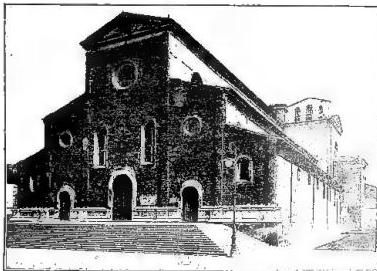
The sacred monuments of F. suffered extremely serious damage during the war of 1940–45: 50% of the churches were completely destroyed and 20% seriously damaged, while almost all the bell towers disappeared. Fortunately, some of the most precious monuments remained standing, with lighter damage: the Cathedral, by Giuliano da Maiano (1474; its interior was completed by Lapo Portigiani the Younger in the first decades of the sixteenth century, and it was consecrated in 1381), in which one can admire the tomb of S. Savino, by Benedetto da Maiano (1442–97), the altar of S. Terenzio, by Agostino di Duccio (1418–98), paintings by Ferravi Penzoni (d. 1613), etc.; the church of the Commedia, from the eleventh century, with an apse fresco by Girolamo Tarvisano (d. 1544) and another fresco on the tomb of fra' Saba di Castiglione by the Minzocchi (d. 1564); S. Ippolito, by Gioacchino Tomba (1771); S. Maria dell'Angelo (1621), designed by the Roman architect Girolamo Rainaldi; S. Domenico (1759), with its precious wooden choir by Paganelli; S. Bartolomeo (ninth century); and sixteenth-century ceramics and canvases later transferred to the municipal Pinacoteca and the Museo delle Ceramiche, etc.