
EMILIA. – I. GEOGRAPHY – Region of continental Italy, bounded by the Po, the Adriatic (122 km. of coastline), and the Apennine watershed. In this broader and more general sense it also includes Romagna, corresponding to its eastern part; together with Romagna it constitutes the E.-Romagna region established by art. 131 of the recent Italian Constitution.
The country is divided more or less equally between the hills and mountains of the northern Apennine slope (54% of its area) and the plain on the right bank of the Po (46%). Its economy is essentially based
The country is divided more or less equally between the hills and mountains of the northern Apennine slope (54% of its area) and the plain on the right bank of the Po (46%). Its economy is essentially based
on a flourishing agriculture, which employs three-fifths of the population and provides Italy, among other things, with its highest yields of wheat, sugar beet, hemp, tomatoes, etc., as well as a rich production of wine and fruit; it is supplemented by no less flourishing livestock raising (cattle and pigs) and related activities. Mineral resources (sulphur and petroleum) are modest but not negligible. Alongside the food industries (dairy products, cured meats, sugar refineries), which are of predominant importance there, the textile, mechanical, and chemical industries have developed particularly in E. Its geographical position encourages intensive traffic and consequently active commerce, which benefited from an excellent road and railway network (severely damaged by the recent war).
| Provinces (and resident population in the provincial capital on 1 January 1949) | Area in sq. km. | Population (1 January 1949 in 1990) | Density per sq. km. |
|---|---|---|---|
| Piacenza (805888) | 2586 | 299 | 116 |
| Parma (125155) | 3452 | 388 | 112 |
| Reggio E. (106323) | 2291 | 381 | 166 |
| Modena (114934) | 2690 | 484 | 180 |
| Former Duchies | 11019 | 1552 | 141 |
| Ferrara (136403) | 2620 | 411 | 156 |
| Ravenna (86839) | 1862 | 282 | 151 |
| Forlì (74946) | 2910 | 475 | 163 |
| Bologna (331444) | 3702 | 748 | 202 |
| Former Legations | 11103 | 1016 | 172 |
| E.-Romagna | 22122 | 3368 | 156 |
Giuseppe Caraci
II. HISTORY
The name derives from the Roman road which the consul M. Emilio Lepido had constructed in 187 B.C.; this road crossed the entire region from Rimini to Piacenza, thus linking the Via Flaminia with Liguria. The province of E. had separated from Liguria between 370 and 381 and does not appear to have possessed ecclesiastical autonomy. Christianity entered its cities at different times, organizing itself hierarchically, first at Ravenna, then at Ariminum, and thereafter inland at Faventia, Bononia, Claterna, Placentia, Parma, Forum Popilli (Forlimpopoli), Forum Livii (Forlì), Forum Cornelii (Imola), and Mutina. Taken together, they formed Region VIII. In 378 Parma was already directly dependent on Rome. In 379 Constantius, elected bishop of Claterna, received from s. Ambrogio directives for the governance of his diocese and an exhortation to watch over the Church of Imola, which was then without a bishop (Ep., 2: PL 16, 917-26). In 381 the bishops Eusebius of Bologna and Sabinus of Piacenza were present at the Council of Aquileia (Gesta Concilii Aquileiensis, ibid., 979). At the end of 386 s. Ambrogio addressed to the bishops per Aemiliam constitutis a letter concerning the date for the celebration of Easter (Ambrogio, Ep. 23: ibid., 1070-78). This shows that, both because of the civil importance of Milan, the metropolis of Upper Italy, and because of the personal authority of s. Ambrogio, the bishops of E. were at that time under the jurisdiction of the bishop of Milan.The dioceses of Regium Lepidum (Reggio Emilia), Brixellum (Brescello), Vicohabentia (Voghenza), and Ficaulae (Cervia) should be assigned to the 5th century; Cesena to the 6th.
But already in the second half of the 5th century Ravenna’s preeminence over the Churches of the province began, as demonstrated by the letter of Pope Simplicius dated 30 May 482 to Giovanni, bishop of Ravenna, in which the consecration of Gregorio, bishop of Modena, is censured, a payment is enjoined upon the bishop of Bologna, and finally the title «Ecclesiae Ravennatis sive Aemilianae» is given (Simplicio, Ep., 2: ibid., 58, 35-37).
The boundaries of the province were altered, however, in 568 by the Lombard invasion. Paolo Diacono then lists Bologna, Parma, Reggio, and Imola among the most flourishing cities. In that period the abbeys of Bobbio and Nonantola were founded.
In the 8th century the episcopal sees dependent on Ravenna were: Sarsina, Cessena, Forum Popilli, Forum Livii, Faentia, Forum Cornelii, Bononia, Mutina, Regium, Parma, Placentia, Brixellum, Vicohabentia, and Atria. Brescello soon disappeared; Ferrara succeeded Vicohabentia; in 948 Agapito II placed Cervia under the jurisdiction of Ravenna, and Gregorio IX added Montefeltro to it, which then immediately became directly subject. In the 10th century the bishops assumed the government of the cities; in the following century the prelates of Parma and Piacenza became counts.
In the Gesto pauperis scolaris Albini, E. is recalled as a province, but the dioceses are all listed «in provincia Flaminea»; the metropolitan see is Ravenna, with 15 suffragans: Piacenza, Parma, Reggio, Forlì, Adria, Forlimpopoli, Ferrara, Modena, Bologna, Faenza, Imola, Cesena, Cervia, Comacchio, and Sarsina (Le Liber Censuum, ed. P. Fabre-L. Duchesne, II, Paris 1903, pp. 96-102).
Subsequently, however, Ravenna’s supremacy rapidly declined, until Gregorio XIII erected Bologna as an archdiocese in 1382, assigning to it as suffragans Imola, Cervia, Modena, Reggio Emilia, Parma, Piacenza, Crema, and Borgo S. Donnino. Clemente VIII placed Rimini and Ferrara under Ravenna; Ferrara became an archdiocese and immediately subject in 1735.
The metropolitan see of E. is today Modena; its archbishop held in commendam, from 15 December 1820, the «nullius» abbey of Nonantola, which was united in perpetuity on 1 May 1926. The suffragan sees of Modena are the dioceses of Carpi, Guastalla, and Reggio Emilia. The dioceses of Fidenza, Parma, and Piacenza are immediately subject.
It comprises the territories of the ecclesiastical province of Modena and Nonantola, and of the dioceses of Fidenza, Parma, and Piacenza.
The capital is Modena; and in this city is located the regional ecclesiastical tribunal for cases of matrimonial nullity. Appeals against the decisions of this tribunal may be lodged with the regional tribunal of Romagna (Bologna) or with the S. Rota (cf. Pio XI, motu proprio Qua cura, 8 December 1938, in AAS, 30 [1938], pp. 410-13). Pio Ciprotti
III. SACRED ART
The first expressive accents of the art that flourished luxuriantly in the Emilia region and in neighboring Romagna, similar to it in many respects, are to be sought in Ravenna, in the church buildings of the age of Theodoric (6th century), where Byzantine structures and decorations are combined with elements such as rhythmic arcades, polygonal apses, and external decorations with pilasters and little arches, which already foreshadow what would become the Romanesque style in the Po Valley. Subsequently, during the period of the Exarchate,new simplifying structures in building construction decisively prepared the advent of that style, as can be seen in the so-called Palace of Theodoric, likewise in Ravenna (8th century), and in the many round bell towers of that area, between the 6th and 9th centuries.
Although it first developed in Lombardy, the Romanesque style soon found in E. highly representative expressions of sacred architecture, beginning with the cathedral of Modena (early 11th century) and ending with the cathedral of Ferrara, the most imposing of the series, which was to assume ogival features in its upper part (13th century). That period was also represented in civil buildings by typical forms, such as the two daring towers of the Asinelli and the Carisenda (12th century) in Bologna. Sculpture, in the service of architecture, underwent a marvelous development in the 12th century at Modena, through the work of Viligelmo; at Ferrara, with Niccolò and his follower Guglielmo; and thereafter at Parma, with Benedetto Antelami and his school (between ca. 1380 and the mid-13th century), rising to European importance. In the field of painting, after the splendid mosaic flowering of Byzantine Ravenna, there followed a long stagnation, until the art of illumination began to develop in Bologna toward the end of the Duecento, with a certain freedom of movement.
The subsequent Gothic period produced religious architecture with local materials and features: in Bologna (the churches of S. Francesco, S. Domenico, and S. Petronio), in Piacenza (S. Francesco and S. Sisto), and in Cesena (the Cathedral). Civil architecture also flourished in Bologna (the Palazzo dei Municipio, the Palazzo dei Notai, and the Palazzo di Re Enzo), in Piacenza (the municipal palace in stone, brick, and terracotta), and in Ferrara (the Palazzo Estense and the Palazzo della Ragione), while feudal strongholds and fortifications arose everywhere, among which it will suffice to mention the famous Castello Estense at Ferrara, and the castles of Gradara and Castellarquato. Fourteenth-century sculpture in E. appears tributary to the neighboring regions, as shown by the exquisitely refined marble altarpiece by the Venetians Dalle Masegne in S. Francesco at Bologna; but notable painters were active in that city, such as Vitale, Andrea, Lippo Dalmasio, and Simone dei Crocifissi; at Rimini, an outstanding group of fresco painters gathered around the best known of them, Giovanni Baronzio, partly within the orbit of Giotto; at Modena, the delicate Barnaba, under the influence of the Sienese, and the keen and already realistic Tommaso, heralding fifteenth-century types and tonalities. Among the manifestations of the decorative arts, the Bolognese miniatures stand out in the late Gothic period, especially those of Niccolò di Giacomo; the goldwork of Jacopo Roseto, also a native of Bologna; and the wood inlay work of Giovanni di Basso, who left us an authentic masterpiece, composed of pure geometric and vegetal motifs, in the choir stalls of S. Domenico at Ferrara.
di Paris worked, while at Modena the local sculptor Guido Mazzoni established himself with a spirit of popular realism, in polychrome terracotta. From him derived, likewise at Modena, the graceful sixteenth-century artist Antonio Bagarelli; at Ferrara, Alfonso Lombardi grafted Tuscan forms onto native tendencies, and was highly active in Bologna. Nucleo sem-
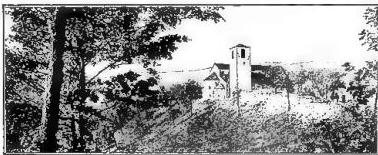
(from T.C.I., Attoretto l'Italia Emilia e Romagna, XVI, Milan 1956, fig. 290)
EMILIA - Romanesque parish church of Sasso (12th century).
Emilian architecture of the Baroque and Rococo periods does not display strongly regional characteristics, but, especially in Bologna, it produced opulent fruits, almost always sustained by an inner classical balance, and it will suffice to mention the Bolognese Bartolomeo Provaglia, Giovanbattista Bergonzoni, Carlo Francesco Dotti, Alfonso Torregiani, and Antonio Bibbiena (a theatrical and scenographic architect), the foremost representative of a dynasty esteemed throughout Europe; the Ferrarese Giovanbattista Aleotti, known as l'Argenta; and the already neoclassical Faentine Giuseppe Pistocchi. The most fervent follower of Borromini was a native of Modena, namely the Theatine Guarino Guarini, who left his most significant works in Turin; and Cosimo Morelli lived for a long time at Imola, the restrained author of the Palazzo Braschi in Rome. The greatest Emilian sculptor of the seventeenth century should be considered the Bolognese Alessandro Algardi, who, also as an architect, competed worthily with Bernini in Rome, conferring a mature dignity upon Baroque forms. In Bologna, the following then distinguished themselves: Giovanbattista Barberini, Camillo and Giuseppe Mazza, and Angelo Pio; and in Ferrara, Andrea Ferreri, who had received a Bolognese education. Above all in painting, the city of S. Petronio was to impose itself during those centuries on the attention of the artistic world with the eclectic school of the three Carracci, a powerful figurative instrument of the Catholic Reformation, from which emerged the region’s noblest masters: besides the Bolognese Guido Reni, Domenichina, Albani, Tigrini, Andrea Donducci, known as il Mastelletta, and Carlo Cignani, the Guercino from Cento, the Parmese Lanfranco and Badalocchio, the Modenese Schedoni, Caredoni, and Luna, and the Ferrarese Carlo Bonone. In the following century, the uninhibited genius of Giuseppe Maria Crespi, known as lo Spagnolo, shone in Bologna, while the talents of Marcantonio Franceschini and of the Tiepolo-inspired Ubaldo and Gaetano Gandolfi established themselves; meanwhile, the Piacentine Giovanni Paolo Pannini pleasantly anticipated the Venetian vedutisti. In the decorative arts, mention should be made of the exuberantly cheerful Bolognese furniture and hangings, the maiolica
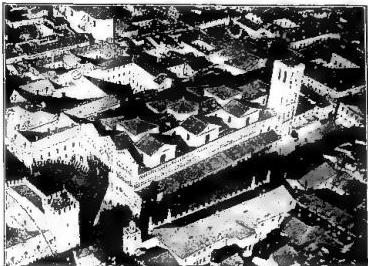
(phot. Emil)
EMILIA - Aerial view of the cathedral of Ferrara (1133–1300).
exoticizing majolica wares of the Ferniani manufactory at Faenza, the wrought-iron work of the eighteenth-century Modenese artist Giovanbattista Malagoli; the engraved prints of the Carracci and their school, and the popular prints of Giuseppe Maria Mitelli, also a Bolognese.
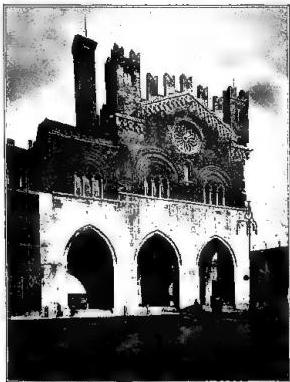
(fot. Emil)
EMILIA – Municipal palace of Piacenza, begun in 1281.
EMILIA - EMILIA M. GUGLIELMA DE RODAT
While the most striking and picturesque expressions, such as traditional forms of dress, have long since disappeared, popular customs and festivals of rural origin and significance have instead been preserved; urban life has often given them a more lavish character and greater importance. Of particular note are the Mid-Lent festivals, whose central feature is a large effigy representing an old woman entirely adorned with necklaces of dried fruit; at the end of the festival she is sawn apart, while the fruits fall and are fought over by the street urchins, and the people give themselves over to carnival revelry. The festival is therefore called that of the Segavecchia, and is celebrated with particular splendour at Reggio Emilia, Cotignola (Ravenna), and Forlimpopoli (Forlì). Notable survivals, likewise of rural significance, are the March fires lit on the eve of calendimarch, around which children dance, leaping over the flames; even more important are those for calendimaggio, preserved especially in various villages of the Emilian Apennines: groups of young people go from house to house, carrying flowering branches decorated with ribbons and singing quest songs announcing that “May has arrived.” In addition to the lyrical maggi, composed predominantly in stanzas of eight-syllable lines, there are also dramatic maggi, that is, genuine performances on epic-chivalric, sacred, or historical subjects, staged in the open air with the accompaniment of an organetto or violin; these maggi are sometimes repeated during the summer season amid the woods. Also connected with the cycle of agricultural work are several famous traditional fairs, such as that of St. John (24 June) at Ravenna, that of St. Peter (29 June) at Faenza, and that of St. Lawrence (10 Aug.) at Cervia, which give rise to original popular festivities (tombolas, pinwheels, competitions, etc.). A festive character is also assumed by some of the principal agricultural tasks, such as husking corn and scutching hemp, which provide an occasion for the beginning or announcement of engagements among the rural youth. Thus the feast of St. Martin (11 Nov.), held at the time of the racking of the wine, remains ever lively and rich in comic motifs.
Rural life is also abundantly reflected in the monostrophic lyrical songs which in E. often take the form of a quatrain (sometimes with ABCC rhymes) and which in certain places, especially in the lower Ferrarese region, are called romanelle, a name dear to Carducci. The traditional store of proverbs concerning the weather and agricultural work is also very rich; these subjects are nourished by the popular almanacs that have been printed for centuries in various cities such as Reggio Emilia and Faenza (“Luneri di smembar”, etc.). - Vedi tavv. XXV-XXVI.
tettura ferrarese nel Quattrocento a nel Cinquecento, Roma 1942; E. Bodmez, Il Correggio e gli Emiliani, Novara 1943; U. Nebbia, La pittura italiana del Seicento, there 1946, pp. VII-XX.