
MODENA, ARCIDIOCESI di. — It is situated on the consular Via Emilia, in a fertile region between the Secchia and Panaro rivers. Provincial capital and metropolitan see since 22 August 1855, with Reggio Emilia, Carpi, and Guastalla as suffragan sees. Seat of the regional ecclesiastical tribunal of Emilia. Nonantola (v.) has been united to it in perpetuity since 1 May 1926; it had previously been held in commendam since 15 December 1820. Area: 2,200 sq km, with 340,500 inhabitants, of whom 340,000 are Catholics. Parishes 218, diocesan priests 354, religious priests 80; 14 male and 26 female communities; five seminaries: the major seminary, formerly with a theological faculty, at M.; the minor seminaries at Nonantola and Fiumalbo. Its patron is the most venerated bishop of M. and thaumaturge, St Geminianus.
I. CIVIL HISTORY. - It begins with the Boii of Cisalpine Gaul. In the third century B.C. it passed to the Romans. From 88 B.C. it was the scene of sieges and struggles between Pompeo and Bruto, Bruto and Marcantonio, Marcantonio and Ottaviano, giving Cicero occasion (Philippica V, 9, 5) to call M. “the most steadfast and most splendid colony of the Roman people.”
It too declined during the barbarian invasions, but began to revive through the efforts of Bishop Leodoino (891) and Matilde di Canossa. A free Commune from 1135 to 1228, it then came under the almost uninterrupted rule of the Estensi, first with the title of imperial vicars and then as dukes, who, having lost Ferrara in 1598, made M. the capital of the Duchy. In 1860 it was annexed to the Kingdom of Italy.
II. CHRISTIANITY AND PRINCIPAL BISHOPS. - Of the ancient bishopric of M., certain information is available only from the 4th century, dominated by the figure of the great bishop s. Geminiano, friend of the exiled s. Atanasio and almost certainly identical with the “Geminianus” present at the Council of Milan in 390. Other bishops were: Teodulo, rebuilder of the Cathedral (4th century); Guidone, archchancellor of King Berengario II and of Ottone I; Dodone, who attended the translation of the body of s. Geminiano to the new Basilica (1106); Ardizzone, during whose episcopate Lucio III consecrated the Duomo (1184); Alberto Boschetti, distinguished for learning and piety (d. 1264); Egidio Foscherari, an eminent member of the Council of Trent; Giovanni Morone, cardinal, who founded the seminary and was the last president of the Council of Trent; Roberto Fontana, who published the Synod held in 1647; Francesco Emilio Cugini, first archbishop of M.; Natale Bruni, who held and published the Synod of 1913 and built the monumental church dedicated to the fallen (d. 1926).
III. ABBEYS AND SANCTUARIES
Nonantola (v.), the Abbey of S. Pietro, in the city of M., was important; its first record dates from 983, when Bishop Ildebrando granted to the priest Stefano the place «ubi iam Ecclesia beati Petri Apostoli fuit aedificata» in order to build there an oratory. To this, in 996, Giovanni, bishop of Parma, added a monastery, which he entrusted to the Benedictine Order. The monastery prospered, received donations and churches subject to it, then declined. In 1434 Eugenio IV entrusted it to the Congregation of S. Giustina in Padova, and it thus temporarily flourished again. In 1476 the dilapidated church was replaced by the present one, consecrated in 1518, rich in fine paintings and sculptures by Begarelli. Today the monastery depends on the Congregation of S. Paolo fuori le mura.The sanctuary of Fiorano, 20 km. from M., is artistically noteworthy. It arose in 1634 in honour of an ancient miraculous image of the Virgin, to a design by L. B. Avanzini, within the ancient castle of the same name, of which there is record from 1108. The façade is sober and soaring, with two bell towers and a central dome; inside, the church, in the form of a Greek cross, was repainted by Malatesta (1866).
IV. ILLUSTRIOUS MEN
The humanists card. Sadoleto (v.) and Giovanni Pico, count of Mirandola (v.); the heroicomic poet A. Tassoni (v.); the critic Lodovico Castelvetro (1505-71), the anatomist Gabriele Falloppio (1523-62), and the musician Orazio Vecchi (1551-1605). The architects Iacopo Barozzi, Vignola (v.), from his birthplace in the province of M., Guarino Guarini, Theatine (1624-83), and Luigi Poletti (1792-1869), restorer of S. Paolo in Rome. The painters: Barnaba and Tommaso da M., Bartolomeo and Agnolo degli Erri, among the primitives; between the 15th and 16th centuries, Francesco Bianchi, Bartolomeo Bonasia, and Domenico Carnevali; in the 1500s, Niccolò Dell'Abate and Francesco and Ercole Setti; in the 1600s, Bartolomeo Schedoni and Sigismondo Caula; in the 1700s, Francesco Vellani; Adeodato Malatesta and Giovanni Muzzioli in the 1800s. Sculptors: G. Mazzoni (d. 1518) and A. Begarelli (d. 1565). Historians: the philologist C. Sigonio (d. 1584) andthe eminent L. A. Muratori (v.). Archaeologists: the priest Celestino Cavedoni (1795-1865; v.) and Pietro Bortolotti (1818-94).
V. ARCHIVES AND LIBRARIES
State Archive; Municipal Historical Archive, established in 1888; Chapter Archive of the Cathedral, with 71 codices (the oldest from the 7th century) and 1,200 parchments, beginning in 750; Notarial Archive dating back to 1271.The Biblioteca Estense is among the richest in Italy in illuminated codices, manuscripts, and rare books. It originated from the Este Library which, formed in Ferrara in the first half of the 15th century and increasingly developed thereafter, was transferred in 1598 to M., where Muratori and Tiraboschi served as distinguished librarians. Its principal collections are: the Este manuscript collection and the Campori collection, comprising more than 11,000 volumes and 142,000 autographs and documents; the Muratorian Archive; and the Music Section. Printed works: 1,660 incunabula, more than 300,000 volumes, and 60,000 pamphlets. Of particular interest is the Permanent Book Exhibition, divided into 4 sections: miniatures, woodcuts, copper engravings, and artistic bindings, with the Bible of Borso (15th cent.) at its centre. Attached to it is the University Library, with 65,000 volumes, 30,000 pamphlets, 5 incunabula, and 51 manuscripts.
VI. CULTURAL INSTITUTIONS
1. University: information about the ancient Studium exists from as early as the 12th century; in the 13th, Ruggiero Beneventano and Guido da Suzzara made it famous. The merit for founding a «Universitas Studiorum», however, belongs solely to Francesco II d'Este, with its seat in the Collegio dei Nobili (1663). In 1774 Francesco III restored it to flourishing condition and erected the present University Palace. It now has Faculties of medicine, pharmacy, physical and natural sciences, law, and mathematics. 2. Academy of sciences, letters, and arts in M., founded in 1680. In 1841 it began publishing the Memorie, which have exceeded 50 volumes. 3. Deputation of homeland history for the provinces of Modena. Established in 1860 in union with Parma and autonomous from 1892, it has published 22 volumes of Monumenti and 7 series of Atti e memorie.VII. MONUMENTS
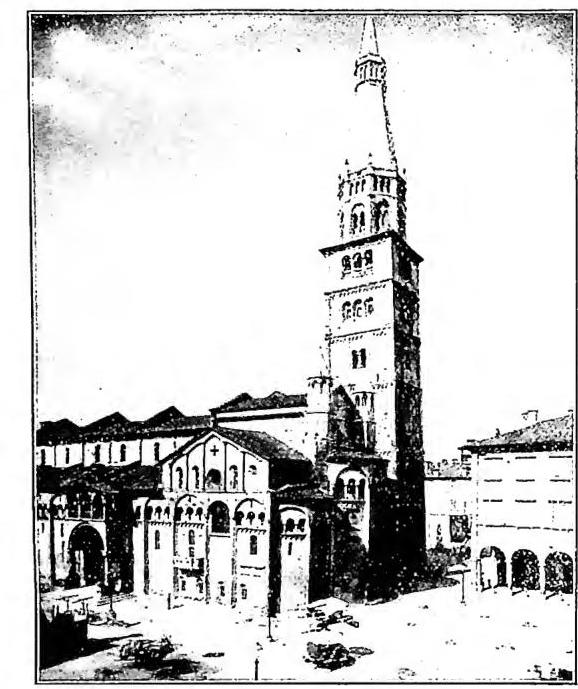
The Ducal Palace, seat of the Military Academy; the Collegio S. Carlo; the Palace of the Museums, housing the Lapidary Museum, the Estense and University Library, the coin collection, the Municipal Historical Archive, and the Estense Gallery, rich in paintings by the Carracci, Tintoretto, Veronese, and Velasquez, etc. The Palazzo Campori is noteworthy for its Gallery of the same name. Artistic churches include S. Domenico, S. Agostino, S. Bartolomeo, and S. Pietro, but especially the Cathedral: in Lombard Romanesque style, it was erected at the expense of the people of M. and of Countess Matilde on the site of the ancient Basilica of the fourth century. Begun in 1099 according to the design of the architect Lanfranco, «mirabilis artifex, mirificus edificator», as early as 1106 Pope Paschal II consecrated in its crypt the altar of S. Geminiano, as attested by contemporary inscriptions on the Cathedral and by the precious Relatio published by Muratori (RIS, VI, p. 85 ff.). Belonging to this period are the papal door, with a propylaeum supported by two Roman lions and bas-reliefs by Wiligelmo; other bas-reliefs by Wiligelmo on the façade and on the princes’ door; and the famous one by Niccolò on the fishmongers’ door, with legendary scenes from the Breton cycle of King Arti. On 12 July 1184 the Cathedral was consecrated by Pope Lucius III, as recorded in a contemporary inscription. In the time of the Campionesi Masters, the Basilica was embellished with the rose window on the façade and the grand royal door (Anselmo da Campione, thirteenth century). Inside, in basilican form, with three naves and three apses, a crypt and presbytery, the pontile, parapet, and ambo stand out, with sculptures by the Campionesi brothers (1170–1220). The choir, in inlaid work, is by Cristoforo and Lorenzo da Lendinara (1465). The crypt, supported by 60 marble columns with carved capitals, mostly Romanesque, contains the marble tomb of the greatly venerated Geminiano, whose painting, by Bartolomeo Schedoni (1600), is located there. By his brief of 20 July 1934, Pius XI declared the Cathedral a minor basilica. Ghirlandina: the artistic tower of the Cathedral, 86 m. high, built of large blocks of marble, has its first five sections in Romanesque style; the octagon with spire is Gothic, begun in 1261 according to a design by Arrigo da Campione and completed in 1319. Until thesixteenth century it was called the tower of s. Geminiano, then Ghirlandina, perhaps because of the garland-like mouldings that surmount it toward the apex. The Capitular Archive and the treasure of the Cathedral were kept in the tower (including the arm of s. Geminiano and the Staurotheca of Panterio from the eleventh century); they are now located near the sacristy. Still kept there, however, is the «secchia rapita», taken from the Bolognese in 1325, also mentioned in an inventory of the Cathedral furnishings from 1502 and made famous by Tassoni’s poem. - Vedi tav. LXXVIII