Machine translation of the 1948–1954 Italian original. The original text is authoritative.
PAOLO VERONESE. – Painter, born in Verona in 1528 to Gabriele Caliari, a stonecutter of Lombard origin; died in Venice on 9 April 1588. His first teacher was Antonio Badile, whose niece Elena he later married.
The Veronese tradition which, through Badile, reaches back to Caroto, Cavazzola, Girolamo dai Libri, and hence to Mantegna, is therefore the primary foundation of P.’s formation, with its preferences for a tartish colour, metallic tones, and a confident, precise draughtsmanship within a clear and exact vision. These preferences also explain his singular position in Venetian painting of the period and his contacts with the more provincial—or rather mainland—currents, such as those of Brescia and Bergamo, as well as certain affinities with the highly original art of Lorenzo Lotto. At the outset of his career (1548), the Bevilacqua-Lazise altarpiece (Verona, Castelvecchio) displays clear signs of this training (e.g., in the characteristic half-length portraits of the donors), alongside a new genius for loosening and animating the composition, giving it lively movement through arrangements of shadow and light (the angel’s figure, in shadow). The commission from Cardinal Ercole Gonzaga for an altarpiece in Mantua Cathedral (the Temptations of St Anthony, 1552, now in Caen) gave the young painter the opportunity for a more direct acquaintance with Tuscan-Roman (Giulio Romano in Mantua) and Emilian (Parmigianino) Mannerism, leading to a more intense interest both in problems of “action,” that is, in the study of the human body in movement, and in scenic composition. Thus the way was opened to his prodigious activity as a composer, in the decoration of churches, palaces, and villas, for the most part designed by Sanmicheli or Palladio. In the decoration carried out, already the previous year, together with Zelotti, at the “Soranza” in Treville near Castelfranco, those highly complex schemes of scenographic and illusionistic inventions were already taking shape: walls and ceilings opened up and pierced through, with glimpses of sky, views of landscapes populated by figures, framed by architectural settings rich in ornaments and statues, and even with the occasional playful “trompe l’oeil” of slippers or brooms abandoned in a corner. Through experiments and variations, such as that of Palazzo Trevisan in Murano (1556–58), these schemes reach the
PAOLO VERONESE - A lady and an elderly maidservant. Fresco - Maser (Treviso), Villa Giacomelli.
their most harmonious and complete fullness in the Villa Barbaro at Maser (c. 1560), with a triumphant sonority of timbres and a sunlit luminosity of tones, which miraculously fuses the extraordinary richness of motifs and invention and harmonizes it with the breath of the surrounding landscape through an unheard-of freshness of pictorial interpretation, in swift, assured, exposed brushstrokes, and in an extraordinarily refined and intricate colorism of iridescences, reflections, and subtle variations, as on a scale that is continually shifting by fractions of a tone. Motifs of inspiration and their frank and coherent pictorial realization, which find expression not only in the relatively rare and precious easel paintings, such as the portraits (among the hundred, one should recall the Bella Nani in the Louvre), or the small Martyrdom of s. Giustino in the Museum of Padua, or the Deposition in Castelvecchio, or the Venus and Adonis in Darmstadt, but also in the great canvases for ceilings or the walls of halls, for altarpieces or the sides of presbyteries. As early as 1553, having transferred the center of his activity to Venice, P. had begun, at the moment when the Mannerist «fashion» was spreading widely there, to receive important commissions and to achieve growing success: in the Libreria, in the Palazzo Ducale, and in the church of S. Sebastiano, which was «his» church, where he devoted his passionate work at various periods of his life (sacristy, organ, ceiling, presbytery) and where he was buried. And here are the great sacred, biblical, historical, or mythological compositions, from the Madonna of the Cuccina family (in Dresden) to the Family of Darius (in London), from the repeated Findings of Moses to the various Rape of Europa paintings; from the Centurion (at the Prado) to the many Cenas or Banquets, which perhaps became the most sensational subject of his fame. The most sensational and famous among these is the Wedding Feast at Cana in the Louvre; yet it is perhaps not the most organic and «realized» and, indeed, because of a certain uncontrolled dispersal of episodes, the only one that, despite splendid passages of painting, appears somewhat congested and labored and reveals some signs of fatigue unusual in the luxuriant ease of Paolo’s creativity. One might almost therefore consider this more celebrated Banquet to belong to a moment of less fervent inspiration than those At Emmaus (Louvre) and In the House of Simon (Turin), both splendid for their richness and spontaneity of compositional invention and their pictorial vividness (both from the exceptionally happy period around 1560); and than the equally well-known In the House of Levi (Venice) of 1573, which was the occasion
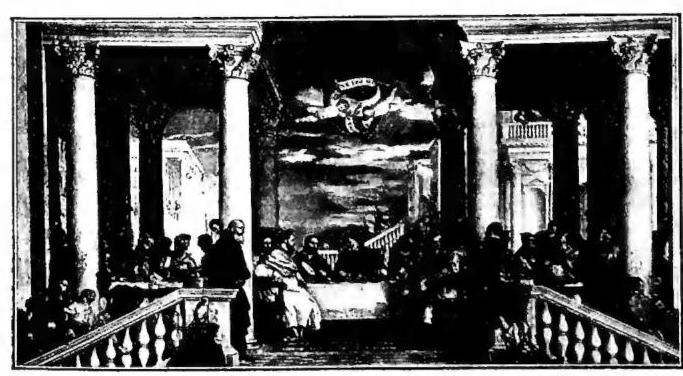
PAOLO VERONESE - Supper of St. Gregory the Great - Vicenza, Sanctuary of Monte Berico.at the inquisitorial trial against P.: “We painters take liberties, as poets and madmen do” was P.’s justification, a candid claim to the artist’s freedom and proof of his good faith in the face of suspicions of heterodox intentions. And in any case, it does not seem that the Holy Office itself attached much importance to the matter, since not all the requested modifications were carried out. A few years after this judicial episode, a genuine transformation can be discerned in P.: richer and denser psychological interests, a more penetrating and deeply felt religiosity, a warmer human drama; this found its expressive path in a simplification of compositional schemes, in an intensification of the range, distilled into accords of extreme refinement and inflamed by the contrast of a vigorous chiaroscuro, almost the incandescent glow of a gem in the night. Thus, after the prelude of the tranquil, burnished lunar silvery quality of the Adoration of the Magi at Corona in Vicenza (contemporary with the Supper of Levi), there came the “sublime” and “captivating” chromatic lyricism of the small Agony in the Garden in Brera, the impassioned fervor and radiant luminosity of St. Pantaleon in the church in Venice, the agony of the whitened face in the exquisite amethyst and emerald harmonies of the Lucretia in Vienna. The last example of his “sumptuous” style, and not among the finest, also because of the extensive intervention of that group of collaborators and relatives who, after his death, continued to produce paintings signed “Haeredes Pauli,” is the enormous central panel of the Hall of the Great Council in the Doge’s Palace, with the Triumph of Venice. That style, on the other hand, which might be called “spiritual,” was asserting itself and becoming increasingly well defined approximately during the last fifteen years of the Master’s life, cut short by a very brief illness, in a series of masterpieces among the greatest, if not among the most celebrated, whose value has been recognized especially by more recent criticism. This evolution of the mature, though not yet very old, P. was analogous to that of the very old Titian, at approximately the same period. And in both it is highly probable that the example of Tintoretto’s luminous and chromatic language, so suited to the expression of these new emotional situations, contributed to the clarification of their own final language: an example that, in P., can sometimes also be recognized in certain compositional attitudes, as, among a few other works, in the Crucifixion of the Accademia in Venice. - Vedi tav. LVII.
BIBL.: G. Fiocco, P. V., Bologna 1928; id., P. V. (coll. «Valori Plastici»), Firenze 1934; id., s. V. ENOCH. Ital., XXVI, pp. 242-45; Venturi, IX, pp. 745-953; R. Pallucchini, P. V., Bergamo 1950. Luigi Coletti
Cite this article
“PAOLO VERONESE.” Enciclopedia Cattolica, vol. IX (1952), p. 475. Azione Romana digital edition, https://azioneromana.com/article/paolo-veronese.