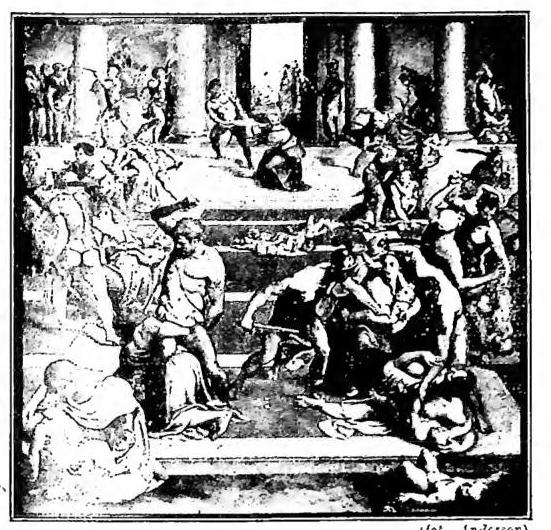
MANNERISM. – The value of the term, much debated and variously restricted by recent art historiography, is linked to that of “maniera.”
For Vasari, who lived in the full flowering of mannerism and was one of its leading exponents, “maniera” is the method employed by painters in idealizing nature, that is, in making art. Yet already in the 17th century “maniera” came to mean little more than a stylistic habit or formula, and it is from this meaning that the judgments passed even by modern criticism on mannerism implicitly derive. Over time, mannerism is confined between two new developments of greatest interest that occurred during the 16th century within the realm of visual conception and that offered Italian painters—apart from what happened in Venice—a new pictorial poetics: the discovery of the vaults of the Sistine Chapel (1512), that is, the revelation of Michelangelo’s pictorial style, and the emergence of Caravaggio’s personality and the Carracci academy.
This temporal limitation—though mannerism extends in many of its aspects into the first decades of the 17th century—also serves to characterize mannerist taste initially as a “common, extravagant, anticlassical restlessness,” which, by the end of the 16th century, resolves or settles into an extensive expressive convention, one that engages painters throughout Europe, almost an academization of the pictorial modes practiced by the leading artists of the early years of the century. On these fundamental themes, countless variations unfolded, as many as there were artists living in that era, so rich in ferment and poetic inspiration of the most diverse origins. Thus mannerism, which began with the elaboration of forms or preliminary classifications deriving from humanist culture, was destined to reflect ideas and sentiments that, increasingly alienated from humanist ideals, deeply unsettled the spiritual landscape from the first half of the 16th century onward. Characteristic exponents of mannerist taste were Daniele da Volterra, Francesco Salviati, Giorgio Vasari, Domenico Beccafumi, Taddeo and Federico Zuccari.
The term mannerism, generally used to denote the manifold aspects of the above phenomenon in the field of painting, can easily be extended to sculpture and architecture, where it assumes analogous features. – See pl. CXXVII.
MANILA, ARCHDIOCESE OF. – An archdiocese and the capital city of the Philippine Islands, on the western coast of the island of Luzon, at the mouth of the Pasig River. It comprises the provinces of Bataan, Bulacan, Cavite, and Nueva Ecija.
It has an area of 2,233 sq. km. and a population of 2,120,590, of whom 1,749,316 are Catholics. It has 117 parishes served by 157 diocesan priests and 332 regular clergy, one seminary, 27 male religious communities, and 76 female (Annuario Pont., 1951, p. 263).
The Pasig River divides the city into two parts; the southern part was founded in 1575 by the Spaniards, who occupied it after its discovery by Magellan and fortified II. It was attacked several times by the Dutch, who even attempted to blockade it in 1624. Later it was harassed by the English (1762). At the end of the 19th century, under the leadership of J. Rizal, the natives revolted; in 1896, following the Spanish-American War, the Spaniards surrendered in August 1898, and independence was proclaimed with Manila as the capital. After guerrilla warfare, the United States occupied the city; with the Constitution of 1935, amended in 1940, the Philippines became independent on 4 July 1946.
The first bishop of Manila was the Dominican Domingo de Salazar (1579–94), succeeded by the Franciscan Ignacio de Santibáñez (1595). The diocese was erected by Pope Gregory XIII on 6 February 1579 as a suffragan of the archdiocese of Mexico, from which it was separated by Pope Clement VIII on 14 August 1595, raising Manila to metropolitan status. Pope Pius XI, with the apostolic constitution *Ad Christi regnum* of 15 July 1932, erected the new diocese of Bacolod as a suffragan of Manila (AAS, 25 [1933], pp. 357–360); with the apostolic constitution *Ad maius religionis incrementum* of 20 January 1933, he also made the new diocese of Cagayan a suffragan of Manila, later transferred to the ecclesiastical province of the Name of Jesus (ibid., p. 360); with the apostolic constitution *Romanorum Pontificum* of 28 April 1934, he dismembered the ecclesiastical province of Manila, creating the new province of the Name of Jesus (AAS, 27 [1935], pp. 263–64). Pope Pius XII, with the apostolic constitution *Probe noscitur* of 11 December 1948, separated part of the territory of the archdiocese of Manila to erect the new diocese of San Fernando (AAS, 41 [1949], pp. 400–402). Currently, the suffragan sees of Manila are Lingayen, Lipa, Lucena, Nueva Cáceres, Nueva Segovia, San Fernando, Tuguegarao, and the prelatures *nullius* of Batanes and Babuyan, and Infanta. The cathedral has been dedicated to the Immaculate Conception since 1595. Other notable churches include the Dominican church (1888), the Augustinian church (1599–1614), the Jesuit church (1878–99), the Capuchin church (1898), San Sebastián, Santa Maria del Rosario, and the convent of Santa Chiara.
**The Catholic University of Manila.** – Archbishop Miguel de Benavides founded in the city in 1611 the College of Our Lady of the Rosary (known as the “Colegio de Santo Tomás”), which in 1619 received from Urban VIII the faculty to grant academic degrees, later recognized by Philip IV of Spain with a decree of 6 September 1624; and in 1645 the brief *In supereminenti* of Innocent X declared it a university in perpetuity. In 1734 the statutes (*Estatutos de la Pontificia y Real Universidad*) were codified, renewed in 1785, 1843, and 1936, and the faculties of canon and civil law were established, approved by Clement XII. Placed under Spanish protection in 1680 and 1785 and elevated by Leo XIII (1902) to a pontifical university, the Ateneo has borne since 1947 the official title of *Universidad de Santo Tomás, “The Catholic University of the Philippines.”* The ancient university, destroyed during the wartime events of 1941 and 1945, was rebuilt and now comprises 16 buildings. The ecclesiastical faculties are three (theology, 1611; canon law, 1734; philosophy, 1896); the civil faculties are five (law, 1734; medicine and surgery, 1871; pharmacy, 1871; engineering, 1907; philosophy and letters, 1896); there are four colleges (liberal arts, 1923; education, 1926; commerce and administration, 1933; architecture and fine arts, 1930 and 1935). In addition, there is the music conservatory (1946), the schools for teachers (1941), nurses (1946), secondary schools (1923), and the graduate school.

The Pasig River divides the city into two parts; the southern section was founded in 1575 by the Spanish, who occupied it after its discovery by Magellan and fortified II. It was attacked several times by the Dutch, who even attempted to blockade it in 1624. Later, it was harassed by the English (1762). At the end of the 19th century, led by J. Rizal, the natives rose in revolt; in 1896, following the Spanish-American War, the Spanish surrendered in August 1898, and independence was proclaimed with M. as its capital. Due to guerrilla warfare, the United States occupied it; with the Constitution of 1935, amended in 1940, the Philippines became independent on July 4, 1946.
The first bishop of M. was the Dominican D. di Salazar (1579–94), succeeded by the Franciscan I. de Santisbans (1595). The diocese was established by Pope Gregory XIII on February 6, 1579, as a suffragan of the archdiocese of Mexico, from which it was later separated.
---
But also the other stars associated with the zodiacal signs can exert partial influences; the fourth describes the influences emanating from each star, both on individuals (temperament, aptitudes, profession, fortune or misfortune) and on the earth (climate, race, civilization, seasons, tides, etc.); the fifth is devoted to the extra-zodiacal constellations that rise together with a zodiacal sign: e.g., with the zodiacal sign of Leo rises the constellation of the Dog, and whoever is born under this sign will be violent and quarrelsome.
The entire poem is fundamentally pantheistic and rigorously deterministic in inspiration. Events govern the world by an immutable law, and the fate of men is fixed from the moment of birth: “nascente morimur, finitis ab origine pendet” (Astron., IV, 14–22).
According to M., therefore, rather than useless rebellion, it is better to immerse oneself in astronomical science, the only discipline that, by teaching submission to the cosmic law, will free us from the burden of fate.
It is understandable that such inexorable determinism, contrary to the hope that always lives in the human heart, could not find acceptance among the people, who sought escape from fate’s grip either through prayer to the divinity that can aid individual distress or through magical practices that claim to