Machine translation of the 1948–1954 Italian original. The original text is authoritative.
MANILA, ARCHDIOCESE of. — Archdiocese and capital city of the Philippine Islands, on the western coast of the island of Luzon, at the mouth of the Pasig River. It comprises the provinces of Bataan, Bulacan, Cavite, and Nueva Ecija.
It has an area of 2,233 km² and a population of 2,120,590 inhabitants, of whom 1,749,316 are Catholics. It has 117 parishes served by 157 diocesan priests and 332 religious priests, one seminary, 27 male and 76 female religious communities (Annuario Pont., 1951, p. 263).
The Pasig River divides the city into two parts; the southern part was founded in 1575 by the Spaniards, who occupied it after its discovery by Magellan and fortified II. It was attacked several times by the Dutch, who also attempted to blockade it in 1624. Later it was harassed by the English (1762). At the end of the nineteenth century, the natives rose up under the leadership of J. Rizal; in 1896, following the Spanish-American War, the Spaniards surrendered in August 1898, and independence was proclaimed, with M. as its capital. Following the guerrilla war, the United States occupied it; with the Constitution of 1935, amended in 1940, the Philippines became independent on 4 July 1946.
The first bishop of M. was the Dominican D. di Salazar (1579–94), who was succeeded by the Franciscan I. de Santisbanes (1595). The diocese was created by Pope Gregory XIII on 6 February 1579 as a suffragan of the Archdiocese of Mexico, from which it was separated
by Pope Clement VIII on 14 August 1595, who raised M. to metropolitan dignity. Pope Pius XI, by the apostolic constitution Ad Christi regnum of 15 July 1932, created the new diocese of Bacolod as a suffragan of M. (AAS, 25 [1933], pp. 357–360); by the apostolic constitution Ad maius religionis incrementum of 20 January 1933, he likewise made the new diocese of Cagayan a suffragan of M.; it later became a suffragan of the Name of Jesus (ibid., p. 360); by the apostolic constitution Romanorum Pontificum of 28 April 1934, he dismembered the ecclesiastical province of M., creating the new province of the Name of Jesus (AAS, 27 [1935], pp. 263–64); Pope Pius XII, by the apostolic constitution Probe noscitur of 11 December 1948, separated part of the territory from the Archdiocese of M. in order to erect the new diocese of S. Ferdinando (AAS, 41 [1949], pp. 400–402). At present, the dioceses of Lingayen, Lipa, Lucena, Nuova Cáceres, Nuova Segovia, S. Fernando, and Tuguegarao, and the nullus prelatures of Batanes and Babuyan and Infanta are suffragans of M. The Cathedral, ever since 1595, has been dedicated to the Immaculate Conception. Other noteworthy churches are: that of the Dominicans, from 1888; the church of the Augustinians (1599–1614); that of the Jesuits (1878–99); that of the Capuchins (1898); S. Sebastiano, S. Maria del Rosario, and the convent of S. Chiara.
BIBL.: Eubel, III, p. 234; IV, p. 320; F. M. Finegan, s. V. in Cath. Enc., IX, pp. 597–601; anon., s. V. in Enc. Eur. Am., XXXII, pp. 876–92. Enrico Josi
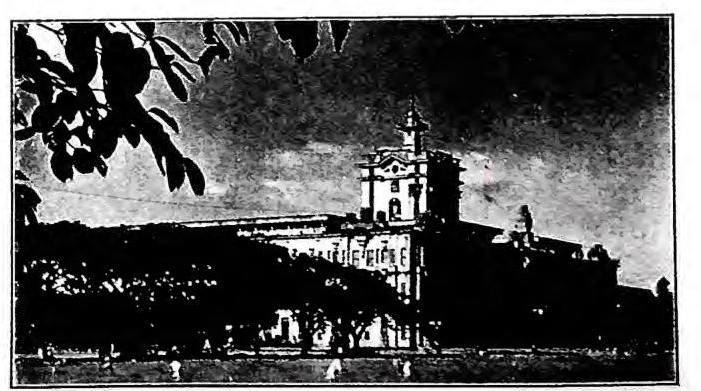
THE CATHOLIC UNIVERSITY OF M. — The Dominican archbishop of M., Michele de Benavides, founded in the city, in 1611, the College of Our Lady of the Rosary (soon called “Colegio de S. Tomás”), which in 1619 received from Urban VIII the faculty of conferring academic degrees, subsequently recognized by Philip IV of Spain by decree of 6 September 1624; and in 1645 the brief of Innocent X In supereminenti, which declared it a university in perpetuum. In 1734 the Statutes were codified (Estatutos de la Pontificia y Real Universidad), renewed in the years 1785, 1843, and 1936, and the Faculties of canon and civil law, approved by Clement XII, were established. Placed, in 1680 and 1785, under the protectorate of Spain and elevated by Leo XIII (1902) to a pontifical university, the Manilan Athenaeum has, since 1947, borne the official title Universidad de S. Tomás, “The catholic University of the Philippines.” The ancient University, destroyed by the events of the war in 1941 and 1945, was rebuilt and now comprises 16 buildings. There are 3 ecclesiastical Faculties (theology, 1611; canon law, 1734; philosophy, 1896); 5 civil Faculties (law, 1734; medicine and surgery, 1871; pharmacy, 1871; engineering, 1907; philosophy and letters, 1896); and 4 colleges (liberal arts, 1923; education, 1926; commerce and administration, 1933; architecture and fine arts, 1930 and 1935). In addition: the music conservatory, 1946; schools for teachers, 1941; nursing schools, 1946; secondary schools, 1923; and the graduate school.
The teaching staff consists of 556 professors, 35 of them Dominicans. Among the most celebrated are cited: the theologians
MANILA, ARCIDIOCESI di - Catholic University.
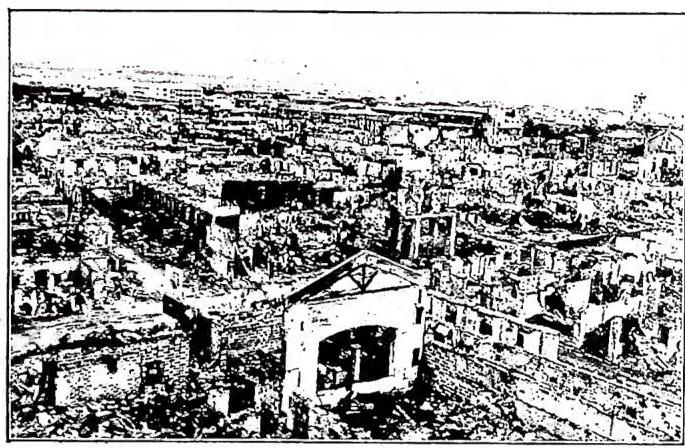
(courtesy of mans, A. P. Frutaz) MANILA, ARCIDIOCESI di - The city of M. after the bombardments in February 1945.N. del Prado (d. 1918) and Fr. Marin Sola (d. 1928); the canonists G. Noval (d. 1936) and A. Blat (d. 1942); the philosopher T. Gonzalez, later a cardinal (d. 1894); the historians G. Ferrando, J. Fonseca, E. Bazaco; the bb. A. Gonzalez and G. Courtet, martyrs of Japan (1637), and M. Garcia Sampedro, martyr of Tonkin (1858). From among the student body came the first president, Quesón, various ministers, and numerous magistrates. The number of students, which had been greatly reduced during the revolution of 1898–99 and under the Japanese occupation (1941–45), rose in 1949–50 to 14,193. The annual academic announcements and notices are found in the General Information and in the Announcements of the Faculties, schools, and colleges. Beside the University, the central pontifical ecclesiastical Seminary was established, approved by Pius XI on 27 November 1928; the Museum, begun in 1682, has sections of natural history, ethnology, numismatics, archaeology, and bibliography; the Library, with rare books, after the serious losses caused by the war (1941–1945), now contains 60,000 volumes; the printing press, dating back to 1593 and being the oldest in the Far East and the first in the Philippines, has rendered distinguished service through the printing of doctrinal, missionary, and journalistic texts in Latin, Spanish, and English and in Asian languages and scripts, and of the Boletín eclesiástico (since 1872), the Unitas (since 1921), and 7 other journals; the hospital has medical and surgical departments with free and paying beds; the spacious Chapel is a center of religious services.
BIBL.: J. Ferrando-J. Fonseca, Hist. de los pp. Dominicos en las Islas Filipinas, I, Madrid 1870, pp. 583-91; II, there 1840, pp. 438-39; El tricentenario de la Universidad de S. Tomás de M. (1611-1911), Manila 1912; J. S. Sanchez y Garcia, Sinopsis historica documentada de la Univers. de S. Tomás de M., there 1928; A. Walz, Compendium historiae Ord. Praed., 2nd ed., Rome 1948, pp. 436-37, 609. Angelo Walz
Cite this article
“MANILA, ARCIDIOCESI DI.” Enciclopedia Cattolica, vol. VII (1951), p. 1163. Azione Romana digital edition, https://azioneromana.com/article/manila-arcidiocesi-di.