
MAGELLANO, FERDINANDO. – In Portuguese Fernão de Magalhães, Portuguese navigator, b. in 1480 at Villa de Sabrosa in the province of Trazos-Montes to a noble family, d. on the island of Matan on 27 April 1521.
As an adolescent he was at the court of King Manuel as a page and was probably instructed in mathematics, geography, and nautical sciences; at the age of 25, wishing to make a name for himself, he enlisted as a volunteer in the great expedition to the Indies led by Francisco de Almeida (1505), in which, although without a prominent position, he distinguished himself in many military engagements, including the battle of Diu, where he was wounded. In 1509 he was with the small squadron of Diego Lopez de Sequeira exploring the Malay Peninsula, took part in the capture of that city, and then remained in Malacca under the government of Albuquerque. By then having become familiar with the senior commanders (Antonio de Abreu, Francisco Serrão, etc.), he acquired extensive knowledge of the countries of Southeast Asia, Indonesia, and the Spice Islands. Certainly few were better informed than he when, in 1513, he returned to Lisbon—but not to rest, since the following year he was in Morocco at the capture of Azamor, where he was wounded once again. Having become the object of accusations that later proved unfounded, he nevertheless alienated the court, which he believed, perhaps rightly, had treated him with little regard, and withdrew into private life, devoting himself to studies in cosmography under the guidance of the astronomer Ruy Faleiro. But the information he had received from Serrão about the prodigious riches of the Spice Islands—the Moluccas—rekindled his spirit, all the more so because, since the position of these islands was still uncertain, it was not known precisely whether they fell within the Portuguese or the Spanish hemisphere (according to the demarcation established by the Treaty of Tordesillas, 1494); indeed, Faleiro’s calculations tended rather toward their belonging to Spain. M. and Faleiro then left Portugal (1517) and presented the Spanish government with a plan to reach the Moluccas by way of the Atlantic, a plan that had in fact already been formulated by others. This plan was initially rejected by the Casa de Contratación of Seville, which had supreme direction over all maritime enterprises, but was viewed favorably by the young King Charles I; the relevant capitulations were concluded on 22 March 1518. Most of the expenses were assumed by M., Faleiro, and the merchant Christobal de Haro; but Faleiro did not take part in the expedition. Five ships, all of small tonnage, were equipped, with 265 men, for the most part
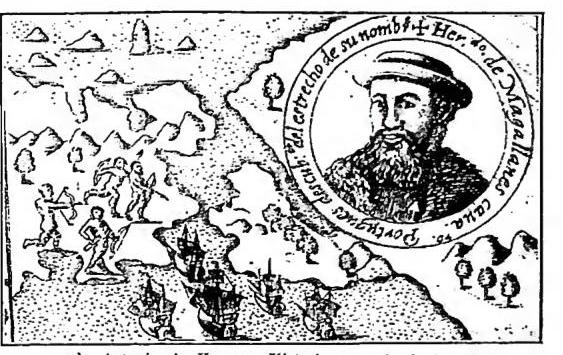
The expedition departed from S. Lucar on 20 September 1519, crossed the Atlantic, followed southward the coasts of present-day South America, in search of a passage to the South Sea (the report that M. already knew its location is unfounded), and arrived on 31 March at S. Giuliano in Patagonia, where 5 months of the austral winter were spent; during this period one ship was lost, while another later deserted, returning to Spain. The three surviving ships, which had resumed the voyage at the end of August 1520, reached the mouth of the eagerly sought strait only on 21 October and emerged from it on 28 November: the strait, named de Todos los Santos, quite rightly thereafter retained the name of its discoverer, M.
M., who well knew that he had descended too far south, first retraced his course along the South American coasts as far as approximately 37° south latitude, then, on 15 December, turned northwest and had to cross the entire Pacific Ocean, whose immense extent no one could have suspected, following a very long diagonal and encountering no land except two small, resource-poor islands. The privations and sufferings of the unexpected crossing were atrocious; the exhausted crew reached the Island of Guam in the Marianas only on 6 March 1521, and from there proceeded to the archipelago of S. Lazzaro (Philippines), taking possession of it in the name of the king of Spain; but here, unexpectedly, M. became involved in a conflict with the indigenous inhabitants on the Island of Matan, after fighting with great determination. The two remaining ships (one had been burned for lack of a crew) reached the Island of Tidor in the Moluccas after many adventures and loaded spices there; but one of them, damaged by breakdowns, was captured by the Portuguese. In the end, only the flagship, the «Victoria», under the command of the Spaniard Sebastiano del Cano, was able, by crossing the Indian Ocean and then rounding south of the Cape of Good Hope, to return to Spain, to S. Lucar, on 6 September 1522, with only 18 survivors.
This first circumnavigation of the globe was important above all from the scientific point of view; the map of the world was thereby utterly revolutionized. The principal direct sources are the account by Antonio Pigafetta, the Roteiro of the pilot Albo, and another diary attributed to Leone Parcaldo of Savona. M. was wrongly judged a traitor for entering the service of Spain; such transfers were then commonplace. He was a man of great nautical competence and courage, energetic to the point of cruelty, accustomed to demanding of others what he required of himself; his much-debated and questionable errors were washed away by his truly heroic death.