
MAGEDDO. – Formerly a powerful city of Palestine (Heb. Mëghiddō[n]; Septuagint Μαγεδώ or Μαγεδδών; Egyptian M'ktj; el-'Amärnah Makiddu; Assyrian Magidü), identified with Tell el-Mutesellim, on
the spur of the eastern range of Carmel, 30 km south of Haifa, overlooking the caravan route that led from Egypt, through the pass of M., into Mesopotamia.
Beneath its walls Thutmosis III defeated the coalition of the kings of Syria and Palestine, and the city, as appears from the letters of el-'Amärnah, subsequently remained faithful to pharaonic sovereignty. Giosuè killed its king (Ios. 12, 21), but M., although assigned to the Manassites (Ios. 17, 11; I Par. 7, 29), remained Canaanite until the battle of Sisara “at the waters [Cison] of M.” (Iudc. 5, 19). Fortified by Salomone (I Reg. 9, 15), it became the administrative seat of a prefecture (ibid. 4, 12). Two kings of Judah, Ochozia and Iosia, met their deaths there (II Reg. 9, 27; 23, 30).
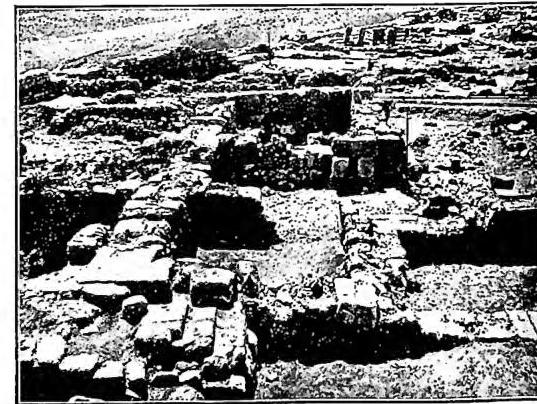
(from R. S. Laman - G. Shipton, Magiddo I, Chicago 1928, p. 31, Re. 61)
MAGEDDO — Excavation area; building 338 seen from the north; on the second floor, the city walls.
Armageddon, the battlefield of the kings of the earth against the Almighty (Apoc. 16:16).
The tell, of irregular oval shape (385 m. by 230), with an area of more than 5 hectares, partially explored by a German society in the years 1903–1905, was systematically excavated in numerous campaigns from 1925 to 1939 by the Oriental Institute of the University of Chicago. Through the plans of 20 archaeological strata, the historical development of the city has been traced, with greater or lesser certainty, from its foundation (end of the fifth millennium) to its extinction (350 B.C.), through the various occupational phases of Canaanite, Hyksos, Egyptian, Philistine, and Israelite civilization. Besides the earliest troglodytic dwellings and the first archaic village, represented by the remains of floors with curious drawings of animals and hunting scenes and by a small temple (stratum XIX), the architecture of the massive stone walls built in the third millennium and the city enceinte with its gates dating from the second millennium are of the greatest interest.
In an area called sacred, three other temples, equal in dimensions and plan, succeeded the primitive temple, near a large circular stone altar with steps. In the Governor’s Palace, five different periods were likewise identified, and beneath the fifth was discovered the rich collection of precious objects, with more than 200 ivories bearing engravings and designs. On one of these a prince is represented, perhaps the king of M., celebrating his victory on a chariot drawn by horses and escorted by naked prisoners.
The Israelite city, with its massive walls and its pincers gate with three recesses, and with a perfect hydraulic system for obtaining water from the spring outside the walls, is particularly significant because of the discovery of a complex of stables capable of holding approximately 400 horses. There is a central corridor, flanked by stalls with pillars at the entrance, serving the dual purpose of supporting the roof and securing the horses to them; stone mangers stood between the pillars, and in the floor was a drainage channel for refuse. In the Governor’s Palace, a graffito was observed bearing the so-called knot or star of David. A fragment of a stele recalls the passage of Pharaoh Sesac, who in his inscription in the temple of Karnak boasts of the capture of the city of M. The rich and abundant material, collected especially in the necropolis, permits a very precise knowledge of the metal industry in the various periods of Canaan, the classification of pottery, and the study of scarabs grouped by strata.