
CARMELO. — Chain of hills (Heb. karmel, “orchard,” “garden”; Arab. Gebel Karmel or *Gebel Mär Eljas”), predominantly limestone in formation, which, branching off from the central mountain system of Palestine toward Genin, from southeast to Sahel
'Arrābeh, extends toward the northwest, leaving the plain of Esdraelon to the southeast and ending in a promontory overlooking the sea south of the Bay of S. Giovanni d'Acri. It is 30 km. long and 12 to 16 km. wide, maintaining an average elevation of 500 m. ('Esfijā, 536; el-Muḥraqah, 514). The chain marks the boundary between Galilee and Samaria.
Intersected by frequent valleys, pierced by numerous caves that provided safe refuge for the persecuted (Am. 9:2-3), and its slopes covered with rich vegetation, C. is often recalled in Holy Scripture as a symbol of grace and prosperity because of its fertility, or as a symbol of desolation because of its deforestation (Is. 33:9; Ier. 4:26; 50:19; Am. 1:2).
The Phoenicians were its first inhabitants, as attested by the archaeological remains of the cities around the mountain. In the division of the Promised Land, it came to lie within the territory of the tribes of Aser, Zabulon, and Issacar (Jos. 19:26). In the ninth century B.C. it was famous as a place of worship for the Phoenician religion and for the Jewish monotheistic religion. On one of its level summits (el-Muḥraqah, 514), the sacrifice of the prophet Elijah was immortalized (I Reg. 18:19-46). In vain did the priests of Baal invoke fire from above to consume the victim placed upon the altar; at Elijah’s prayer, however, the holocaust was completely consumed upon the altar erected on twelve stones.
The God of the Israelites was worshipped there continuously: the new moon and the Sabbath were celebrated there, and the prophet Eliseo resided there (II Reg. 4:23).
The place is venerated by Christians, Jews, and Muslims. The Carmelites have a small church with a convent
and the Muslims the el-Qurbān mosque. The Phoenician occupation of the mountain is made evident by the name vafa qudatu (= “the holy head”), which the lists of Tuthmosis III (1479 B.C.) apply to the promontory of C. Worship of the Baal of the mountain is also attested in the periplus of Scylas (fourth century B.C.), where C. is identified as a “mountain sacred to Zeus,” with all the characteristics of the Phoenician Baal. According to Iamblichus (fourth century A.D.), the biographer of Pythagoras, the philosopher had gone to C., “a mountain sacred and inaccessible to the profane” (Vita Pyth., III, 14), and Tacitus (Hist., II, 28) states that “the god C. has neither statue nor temple, but, in accordance with the prescriptions of the elders, only an altar and worshippers.” Ve-
spasiano went there to consult the oracle, and the priest Basilides, having examined the entrails of the victim, gave him a favorable response (Pliny, Nat. hist., II, 17).
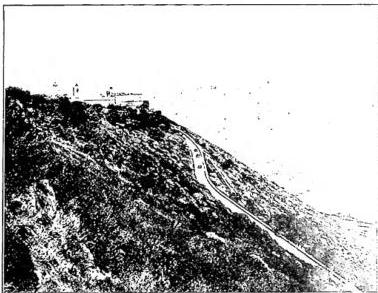
(courtesy of the Discalced Carmelite Fathers — Rome) CARMELO — General view — Palestine.
stellum,” with a nearby church of S. Margherita, which Sanudo says was served by Greek monks. On the ruins of this Greek monastery, the sanctuary of Our Lady of C. arose in the seventeenth century, together with the large Carmelite convent on a terrace 50 m. high, from which one can enjoy a broad and varied panorama.