
LEVIATHAN (Heb. livojāthān). - A fabulous aquatic monster, akin to the tannin, or tannim, to which it is paralleled synonymously in Is. 27:1 (cf. DRAGON), applied to the crocodile (Job 40:25 [Vulg. 40:20]; cf. Is. 27:1) and to a generic large cetacean (Ps. 104:26; 74:14; cf. Am. 9:3).
The Hebrew word derives from livojāh, "twisting" (hence "crown": Prov. 1:9; 4:9; Hebrew and Arabic root lāh "to twist," Assyrian lamā, -wū "to surround"), with the nominal ending -ān; the Septuagint renders it "dragon" (v.) and once "large cetacean" (Job 3:8 μέγα κῆτος); the Vulgate has L. (Job 3:8; 40:20 [Heb. 25]; Is. 27:1) and draco (Ps. 73 [74]:14; 103 [104]:26; new Vulg. version).
The originally popular fabulous character of L. is shown by its mention in a Ugaritic text of Līu (probably to be read Lōtān), as a being to be "struck, destroyed" (cf. Job 3:8, alluding to the monster's baleful nature), "twisted serpent... crooked; the accursed (?) of the seven heads"; this discovery has partly reduced, partly confirmed the mythographic hypotheses previously advanced by H. Gunkel (cf. P. Heinisch, Teologia del Vecchio Testamento, Turin 1950, p. 167).
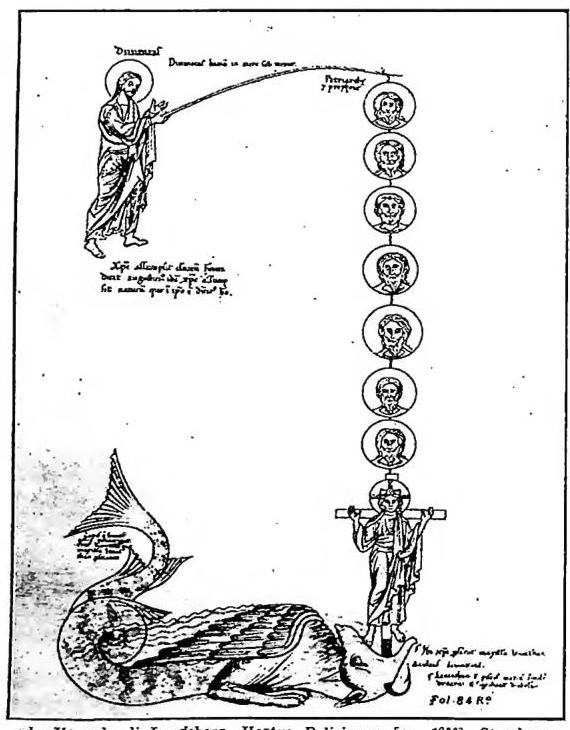
(from Herrade of Landsberg, Hortus Deliciorum [ca. 1830], Strasbourg 1901, pl. 15 bis)
LEVIATHAN — L. near the hook of the Cross.
Here there is already an implicit reference to river monsters. In Ps. 74:14, where it is presented as a many-headed monster — Vaccari: “hydra”; cf. the cited Ugaritic text — the L. is similarly an image of the Egyptian power of the Mosaic age. In Ps. 104:26 it is usually translated simply as “whale.” A fabulous character especially belongs to the L. of Job 3:8, a monster (according to some authors, the personification of the darkness of the clouds) that is summoned for evil purposes by sorcerers. In Job 40:25 it denotes the “crocodile,” of which it gives a proud description that is deservedly celebrated.
The monster tannin also has its counterpart in the Tnn of Rās Samrah, where it is mentioned in magical contexts (Gordon, Ugaritic Literature [V. BIBLICA.], p. 49).