
SEVENTY, VERSION of. — The oldest Greek version, and the oldest of all the versions of the Old Testament. The name, in its full form, “version of the seventy-two interpreters” (Tertullian), derives from the pseudonymous Letter of Aristeas (v.), which attributes the Greek version of the 5 books of Moses to 72 Jewish scholars, called for short “the S.”
These men were supposedly summoned by King Ptolemy Philadelphus (285–247 B.C.), who wished to have a copy of the Mosaic law in his Library at Alexandria in Egypt, and they are said to have translated it in the extraordinarily short time of 72 days. Philo (v.) also recounts this legend, adding that, although each of them translated separately, they all produced precisely the same version. Later, the name “S.” was extended to the other books as well, which were translated subsequently. This term, though legendary with regard to the number of translators and inaccurate in its application beyond the Mosaic law, nevertheless serves just as well as a conventional name as, for example, “Alexandrian version.” Today, analogously to the expression “the Bible” (τὰ βιβλία), it is used as a feminine singular, “the S.” (abbreviation: LXX), to denote the version itself.
The legendary character of the Letter of Aristeas, clearly inspired by the desire to exalt the Jewish people and its literature in the eyes of the pagans, was recognized as early as the 16th century and is now universally admitted. Nevertheless, a historical basis must be acknowledged in it, since the S. was undoubtedly translated in Egypt, chiefly at Alexandria (v.), as is shown by the distinctly Egyptian character of the vocabulary employed and by other indications. Nor is there any reason to doubt that the Pentateuch, given its supreme authority among the Jews and its importance in their liturgy, was the first part to be translated. The period suggested by the Letter of Aristeas is also approximately correct.
It is true that the first certain information about the existence of the S. dates from the 2nd century B.C., namely from the grandson of Jesus son of Sirach, who, some time after his arrival in Egypt (132 B.C.), translated into Greek the book Ecclesiasticus of his grandfather, stating in the prologue that Greek versions of the “Pentateuch, the prophetic books, and the other sacred books” already existed, without specifying them individually. Taking into account the difficulties inherent in so extensive and difficult a translation, it is by no means implausible that it had been begun much earlier. Indeed, the Jewish writer Demetrius, a contemporary of Ptolemy Philopator (221–204 B.C.), uses terms drawn from the S. in describing biblical events. It may therefore be regarded as certain that substantial portions of the Greek Old Testament already existed in the second half of the 3rd century B.C.
The S. is neither a single, unified work nor entirely the work of the same translators. As early as 1705, Humfrey Hody, guided by conclusive linguistic criteria, demonstrated that the various books had been translated by different authors; more recently, even within individual books several hands have been detected, for example, in the books of Jeremiah, Ezekiel, Kings, and the Minor Prophets. Two translators were also thought to be distinguishable in Isaiah, but this assertion was subsequently challenged on the basis of more exact and detailed studies. Not only does the technique of translation vary from book to book, but the version’s varying degree of fidelity, sometimes greater and sometimes less, also reveals the plurality of the translators. While the S. follows the Hebrew text closely in the Pentateuch, in other books it is freer and even paraphrastic, in the manner of the Aramaic Targum. Some of the translators handle the Greek language with a certain skill, whereas others frequently do violence to II. Thus the version itself reveals something of the manner in which it developed.
The earliest origins of the S. lie in obscurity. It is quite possible, and even probable, that before the plan of creating an integral version of the sacred books had been conceived, attempts had been made both by private scholars and by teachers on the occasion of instruction. Even then, the most important concepts of the Old Testament had probably been partly formulated and coined in Greek, and certain passages had also been translated for public reading in the synagogues. These were subsequently used, when the idea of undertaking a systematic version arose, above all to make the Old Testament accessible to Hellenistic Jews who did not understand Hebrew. Thackeray (1921) rightly insists on the requirements of the liturgy as a motive for the version. It is possible that the translation was also intended for the gentiles. It then grew through the slow and prolonged labor of generations, until there emerged the monumental work that became the pride of the Hellenistic Jews and was celebrated every year at Alexandria with a festival.
It is not easy to assess the merits of the translators. Their knowledge of Hebrew and their greater proximity to the age of the Old Testament must have made their task easier. But considering the profound difference between Hebrew and Greek, the lack of linguistic resources and models, and the different cultural environment in which they lived, the result of their efforts must be highly appreciated.
This change, however, did not take place all at once, as is shown by the text of the Greek fragments of the Minor Prophets discovered in 1952 in the Judaean desert (cf. Revue biblique, 60 [1953], pp. 18 ff. and 85). It is a rabbinic recension of the S. based on the Hebrew, produced between A.D. 70 and 100 and disseminated in the 2nd century in Palestine, Greece, and Egypt, since the versions of Aquila, Symmachus, and Theodotion are super-recensions of II. It agrees with the Jewish text cited by St. Justin (Dialogue with Trypho) and with Origen’s 5th version, and appears to underlie the Coptic versions.
(photo Enc. Catr.)
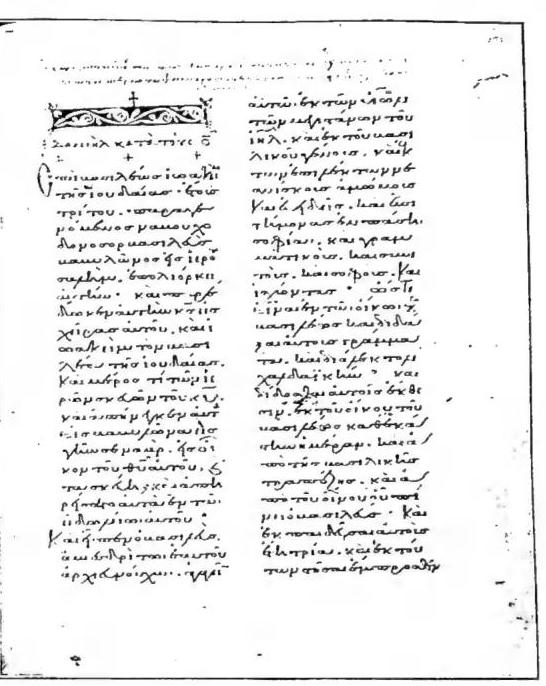
SEVENTY, VERSION of — Incipit of Daniel according to cod. Chigiano R. VII, 25, f. 135ʳ (10th century) — Vatican Library.
The S. thus passed entirely into the hands of the Christians and continued its triumphal progress in the Greek- and also Latin-speaking Christian world. It extended the range of its influence still further when, in turn, it was gradually translated into Latin, Coptic, Gothic, Ethiopic, Armenian, Georgian, Arabic, and Slavonic. In the East, the Syrians did indeed have their Péfilità, derived directly from Hebrew, but such was the authority of the S., the official text in the nearby Byzantine Empire, that the Syrians made three versions of the S.—the Philoxenian, the Heraclean, and the Palestinian—and the Péfilità itself was conformed to the S. in many passages. To this day the Christians of the East read the Old Testament either in the S. or in a version derived from II. In the West, the old Latin version succumbed to the Vulgate of s. Girolamo only after centuries of resistance. The Psalter, despite its many deficiencies, survived in the liturgy down to the present time. Certain inspired books, namely those composed from the outset in Greek (Wisdom, II Maccabees) and those whose Hebrew original was lost (Ecclesiasticus, Baruch, I Maccabees, Tobit, Judith, parts of Daniel), have been preserved only in the S.
(phot. Enc. Catt.)
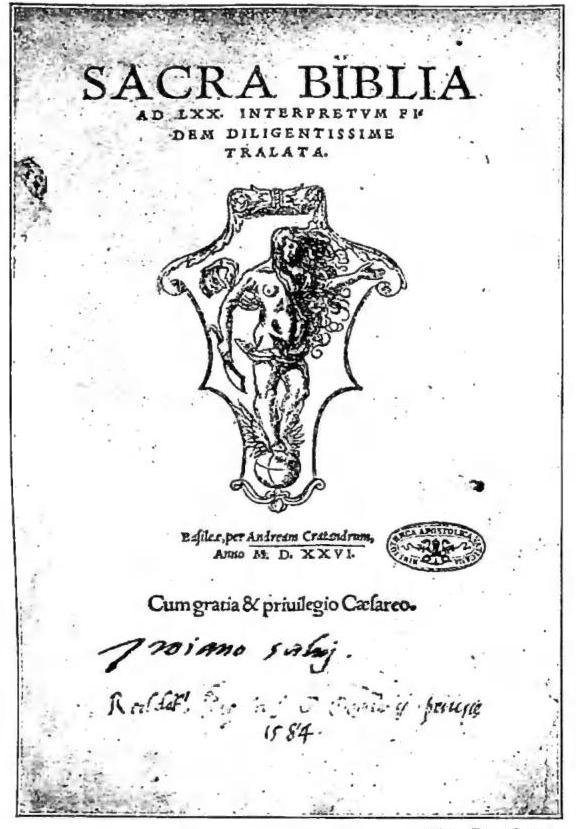
SETTANTA, VERSIONE dei - Frontispiece of the Sacra Biblia ad LXX interpretum fidem, Basel 1526. Copy from the Vatican Library, deposited at the Biblical Institute—Rome.
corruptions were introduced into its text, inevitable in every long text copied by hand: confusions of similar letters and words, incorrect division of words, erroneous understanding of abbreviations, and many other errors found in all ancient manuscripts. It was natural that the orthography, too, should have been modernized over the centuries or adapted to the new iotacistic pronunciation. A source of frequent and profound modifications was the fact that the S. was not an original work, but a version, and an imperfect version. This encouraged learned readers and scholars to adapt it to the Hebrew text wherever it seemed too free, and to correct its Greek wherever the style was unsatisfactory, sometimes sporadically, sometimes through methodical revision. All these factors altered the appearance of the version to such an extent that the various branches of transmission sometimes give the impression of being entirely different translations.
The best known of these recensions or adjustments of the text is the one Origene (v.) in Palestine in 230–40 in his Hexapla (v.), where he assimilated the Greek text as far as possible to the current Hebrew text, supplying especially the missing portions with the recent Greek versions (v.). Around A.D. 300 LUCINA (v.) made another recension at Antioch in Syria. According to s. Girolamo, a recension by Esichio (v.) was in circulation in Egypt. In modern times, examination and comparison of the text of the codices have revealed still other recensions, such as the one discovered by A. Rahlfs in the commentaries called “chains” (v.), which, according to him, was little later than that of Origene. All these great arrangements of the text, far from unifying it, as their authors intended, rather contributed to increasing still further the already great variety of textual forms. Moreover, the scroll form, used for centuries before and after Christ, since it allowed only a limited number of columns, compelled the various books to be transmitted more or less separately. This meant that not all the books underwent the same vicissitudes, and it also prevented a fixed order of the books from becoming established.
From the fourth century onward, the use of the codex, capable of greater breadth, prevailed; the first great manuscripts containing more or less the whole of the S. also date from that time: the Vatican (B), the Sinaitic (S), the Alexandrian (A), and the palimpsest codex of Ephrem (C). An accurate catalogue of the numerous manuscripts of the S. is that of A. Rahlfs (Verzeichnis der griechischen Handschriften des Alten Testaments, Berlin 1914). Worthy of special mention are Chester Beatty (v.) Scheide (v.) from the second to fourth centuries A.D. All these manuscripts are of Christian origin. Only the oldest fragments are by Jewish hands: papyrus (v.) G. 458 from the second century B.C. and Fu’ad papyrus no. 266 from the second–first century B.C.
The fact that the S. was the first version of an entire literature signified enormous cultural progress for humanity. It also compelled the Western world to become aware of Eastern ideas, to analyze them, and to take a position regarding them. Even today the S. is of great importance. Apart from the fact that it preserves the pronunciation of Hebrew proper names at that time and aids in understanding the Hebrew Old Testament, it is above all a precious instrument for repairing many textual corruptions in it, since, descending from a Hebrew text different from and older than, though less pure than, the Masoretic text, it has preserved numerous original readings which, with the necessary and methodical precautions, can in many cases be reliably recovered. It reveals the literary history of certain books, for example, Jeremiah, which has a different arrangement of the chapters and a shorter text than the Hebrew. Of particular value is the information it provides concerning the theological and religious ideas of Judaism in the transitional period from the Old to the New Testament, reflected in the free and paraphrastic manner of the version. For this reason, investigators of the origins of Christianity cannot dispense with a diligent study of the S., because, as has been said, it influenced the formulation of beliefs and the language of the first Christian writers and nourished their religious conceptions. Finally, the S. is an extensive document of the κοινή, the popular Greek language of the last centuries before Christ, to be exploited by philologists.
But all these critical, theological, literary, and philological investigations lack the necessary foundation unless the original text of the S. is ascertained, insofar as possible. It is therefore indispensable to eliminate the corruptions of the text. Immense efforts and works have already been undertaken in this direction, and they continue to this day. They cannot even be listed here in summary form. It may be noted that the first editions of the S. were those of the Complutensian Polyglot (1514–17) and of the Venetian printer Aldo Manuzio (1518 ff.). The most influential, however, was the Sistine edition (1586–87), prepared on the orders of Sisto V in execution of the recommendation of the Council of Trent: it was based on the fourth-century Vatican codex (B) and subsequently became the Greek “Vulgate.” The edition of Grabe (1657) made the text of codex A accessible to scholarly investigation. But the decisive impetus for scientific research on the S. was provided by the work published at Oxford by R. Holmes and J. Parsons, who, reproducing the text of the Sistine edition, added variants collected from approximately 20 uncial codices, more than 300 minuscules, the Holy Fathers, and the ancient versions derived from the S. A new step was taken by P. Lagarde (v.) when, in 1863, he called for the publication of a critically restored text and set out the problems inherent in such an undertaking and the principles to be followed; he also published many preparatory works for this task. Subsequently, with the aim of…
to provide “clearly and with relative fullness the material for a future reconstruction of the text,” A. E. Brooke and N. Mc Lean began in 1906 at Cambridge to publish, together with the text of cod. B, a careful and well-selected critical apparatus, without using the same reconstruction. By 1940, the Pentateuch and almost all the historical books had appeared. The spiritual heirs of Lagarde at Göttingen, for their part, decided to undertake the arduous task of producing a critical text with an apparatus containing the various readings of all accessible manuscripts. Since no manuscript contains a pure text, the only rational course is, in each case, to select from all the variants that which, according to sound principles resulting from the facts themselves, has the greatest probability of being genuine. Of the Göttingen Septuagint there appeared the Psalms (A. Rahlfs, 1931), I Maccabees (W. Kappler, 1936), Isaiah (J. Ziegler, 1939), and the 12 Prophets (J. Ziegler, 1943): in many cases the emendation adopted is certain, in others more or less probable. In any event, the editor of the text provides the reader less competent in the subject with his well-founded judgment, and specialists with a basis for further research.
An interesting theory concerning the origin of the S. was advanced in 1925 by F. X. Wutz (v.), who maintained that the S. had been made from a Hebrew text transcribed in Greek characters, and believed that he had found in it a new criterion capable of opening new possibilities for reconstructing the Hebrew prototype of the S. and of fundamentally reorienting the textual criticism of the Old Testament. But once the initial enthusiasm had passed, the theory did not withstand careful examination.
The ideas of P. Kahle (1941) are downright revolutionary. According to him, the Jews of Egypt never possessed a complete normative Greek version of the Old Testament, but only of the Pentateuch. The Egyptian Jews, imitating the practice of Palestine, where in every synagogue, after the reading of the sacred Hebrew text, an interpreter improvised a free Aramaic version on the spot, the basis of the future Targimim, would likewise have created parallel Greek versions, first oral and then written—Greek Targimim. Around 100 B.C., the Jewish authorities would have had a selection made from these versions and established an official translation of the Pentateuch. The Letter of Aristeas would have undertaken to recommend it and promote II. All the other versions of the Mosaic Law, and likewise versions of other books never officially recognized, would have continued to be used by many Jews and then also by Christians of the first and second centuries A.D., as the biblical quotations in Philo and in Matthew would show. In the third century the Church, choosing among the various versions, would have established a canonical version of the entire Old Testament, giving it the name “S.” The others would subsequently have been lost, and the quotations in Philo and in the New Testament, as well as the recensions of Lucian and Hesychius, would preserve their last traces. It would therefore be utopian to seek the original text of the S.
But this ingenious theory of Kahle raises serious doubts. If it was easy to improvise an Aramaic translation of the closely related Hebrew, it is altogether improbable that the same could have been done with Greek. It is true that in some books the Greek version may be called targumic, but only in the sense that it is paraphrastic. The quotations in Philo and in the New Testament do require an explanation, but Kahle’s is not the only possible one, even if it is probable, and therefore his conclusion is not compelling. If the S., the result of the common work of generations, is not homogeneous, this does not negate its unity, which derives from its purpose of forming a complete version. The imperative need therefore remains to reconstruct the primitive form that the S. possessed in pre-Christian times, when it became complete and acquired normative value, and when any other partial versions fell into oblivion.