
SAMARITAN PENTATEUCH. — The five books of Moses, which for the Samaritans constitute the whole Bible, restricted to the initial stage of the Canon, at the time of the secession of the Samaritans (ca. 400 B.C.). This tôrâh, the foundation of their entire religious and social life, has been transmitted with impressive conservatism. The script in which it is preserved is itself the ancient Hebrew or Phoenician script, somewhat evolved.
This is important in the textual criticism of the Old Testament. The Samaritans did not wish to admit developments or editorial purifications, nor the entire Masoretic “hedge” that fixed the sacred text; they had no need of it, inhabiting a restricted territory and being few in number. Had they possessed the true original text, there would be no Pentateuch text more genuine than theirs; the first editor of a manuscript of the S. P. in Europe (J. Morin, Exercitationes..., Paris 1631) would have been right to exalt it above the Masoretic text, after P. Della Valle (v.) had brought that manuscript, together with a targum of it, in 1616. But according to P. Kahle, the matter is far more complicated. Nevertheless, those who, influenced by dogmatic prejudices, exclude the S. P. from textual-critical research are wrong, as was G. Gesenius (v.), to whom we owe the most accurate classification of its variants.
On the whole, the Masoretic text is to be preferred, being based on manuscripts older than the S. P., free from later additions to the vulgar texts, and preferring, to a certain extent, more difficult but more original grammatical forms. Yet even the “learned” Masoretic recension is not free from dogmatic influences. The S. P., by contrast, is a popular text which, before and after the secession, was modernized within the Samaritan community according to the needs of its readers and hearers, just as today poets of the sixteenth and seventeenth centuries are presented in modern orthography. The following adaptations became necessary: an abundance of matres lectionis, similar to that displayed by the first scroll of Isaiah found in 1947 at Hírbet Qumrán; correction, or even emendation, of excessively archaic or insufficiently comprehensible grammatical forms. Quite a few intrusive passages from parallel passages remained in the text, as happens when the word of God is alive in the liturgy, in preaching, and in dogmatic instruction. Moreover, it is probable that the Samaritan manner of writing the sacred text reflects dialectal influences different from those of Jerusalem (Sperber); the simple Samaritan system of “vocalization” appears only after A.D. 1200, and then only in a few codices. From the spoken language, which increasingly became Samaritan Aramaic, similar to that of Galilee, a considerable number of Aramaisms were introduced. This explains the mass of more than 6000 variants in comparison with the Masoretic Pentateuch.
More controversial, however, are the variants that reveal the Samaritans’ particular dogmatics, especially those that arose around the biblical passages referring to Mount Garizim, where they built their temple. Here too, a fair judgment presupposes knowledge of the pre-Masoretic history of the Hebrew text. Certain apocrypha, ENOCH (v.) and the Book of Jubilees (v.), have, in Gen. 5, 10–11, figures for the patriarchs identical with those of the S. P. This can be explained only by admitting that, in Jewish circles, besides the type of text that later determined the Masoretic text, and besides the “half-popular” type (P. Kahle) underlying the Septuagint (v.), a third type close to the Samaritan was also in use. This is demonstrated by quotations from Philo of Alexandria and by references in the New Testament (e.g., Act. 7, 4; 7, 32; 7, 35; Hebr. 9, 3), which find their counterpart only in the S. P.
There was thus an anti-Samaritan tendency in the establishment of the Hebrew textus receptus, around A.D. 100, which gradually eliminated texts favorable to the Samaritans. A similar tendency already existed before their secession, and the curious fact may be observed that certain “anti-Samaritanisms” were transmitted by the Samaritans themselves because of their veneration for tradition, as additions to the text of Deut. 11, 29; 27, 12; Ios. 8, 33, which even today, in the Masoretic text, attribute to Garizim the function of the mountain of blessing, while assigning to Hebal that of the mountain of cursing. Historically, a sanctuary existed on Garizim, though it was not particularly famous in the time of the kings. The additions, however, not excluded from the S. P., insinuate that the sites in question were in the vicinity of Galgal, near the Jordan, in opposition to the Samaritan conception. Some exegetes maintain with considerable probability that it was not the S. who altered the text in their own favor by replacing “Hebal” with “Garizim” in Deut. 27, 4, but rather the Jews who replaced “Garizim” with “Hebal” in Deut. 27, 4 and Ios. 8, 30 (ed. Meyer, C. C. Torrey, R. H. Pfeiffer, and earlier B. Kennicott); God would thus have ordered an altar on the mountain of cursing rather than on that of blessing, which, according to the Masoretic text as well, is only Garizim. But in another 19 passages (removing the prefix j from the verb “to choose”), it was rather the Samaritans who altered the text in favor of their dogmatics.
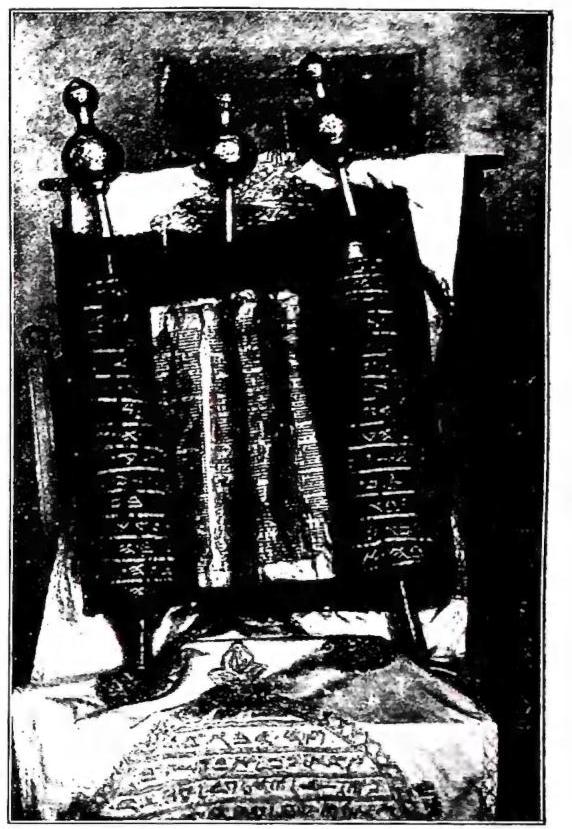
(from Judisches Lexikon, IV, 2, Berlin 1918, color plate at the entry Samaritanes)
SAMARITANO. PENTATEUCO - The codex of the Pentateuch, written in Samaritan letters (12th cent. A.D.) - Nabulus.
to examine and emend it in a considerable number of cases. Even within the sphere of its most pronounced Samaritanisms, its testimony requires serious examination. In 1,900 of its variants, the P. S. often has the support of the Septuagint; it is not, however, possible to establish mechanical rules of preference.
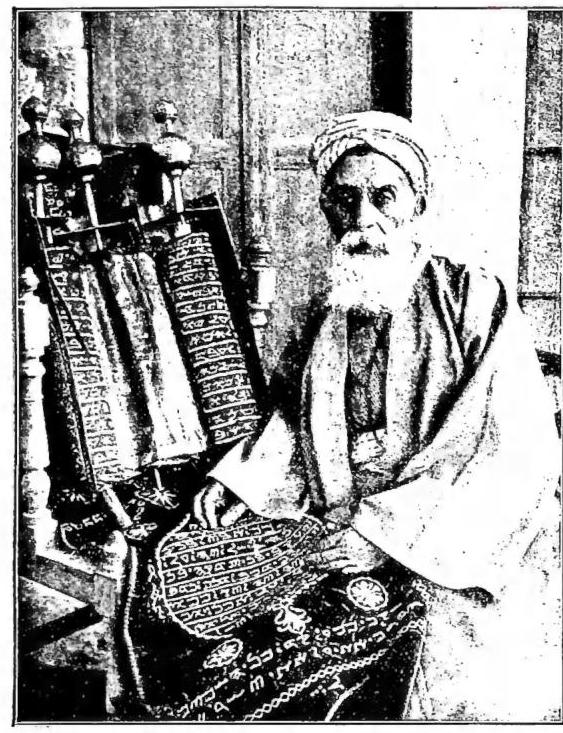
(from Jüdisches Lexikon, IV, 2, Berlin 1936, cols. 69–78, entry Samaritaner)
SAMARITANO, PENTATEUCO - Gran Sacerdote (fot. del 1925) innanzi al veneratissimo P. S. (sec. XII d. C.) nella sinagoga di Nabulus.