
PENTATEUCH. - A major narrative and legislative work, occupying the first place among the books that form the Bible, composed of "five volumes": Genesis (v.), Exodus (v.), Leviticus (v.), Numbers (v.), Deuteronomy (v.).
CONTENTS:
I. Name and subject matter
II. Author
III. Criticism
IV. Ecclesiastical directives.I. NAME, SUBJECT
Already in documents dating back to the 4th century B.C., the book is called Tôrâh, hat-Tôrâh "(the) law" (Neh. 8:2), a name that remained in common Hebrew usage (Lk. 10:26); less frequently "Book of Moses," "Moses" (ibid. 8:1; 13:1; Lk. 16:29). In Greek ecclesiastical usage, from as early as the 2nd century A.D. (Origen, In Io., 13, 16), the name (hē) Pentáteuchos prevailed, which in itself is an adjective meaning "the (book, bíblos) in five parts" (teûchos, "case" for preserving a scroll and "volume"); thus among the Latins Pentateuchus, already from Tertullian (C. Marc., 1, 10).In the biblical canon of the Council of Trent (Denz-U, 784), it is stated: "5 (books) of Moses." This is because the work has been divided into 5 parts since antiquity, which among the Jews were named after the first words of each, while in the Greek version (and from there in the Vulgate and modern languages) they were designated based on their content.
(Ist. Exc. Catt.)
PENTATEUCH - Coptic P. Moses before the burning bush with a scroll in hand. Coptic miniature and script from the 9th-10th century. Arabic script from the 13th-14th century - Vatican Library, cod. Vat. copto 1, f. 97.
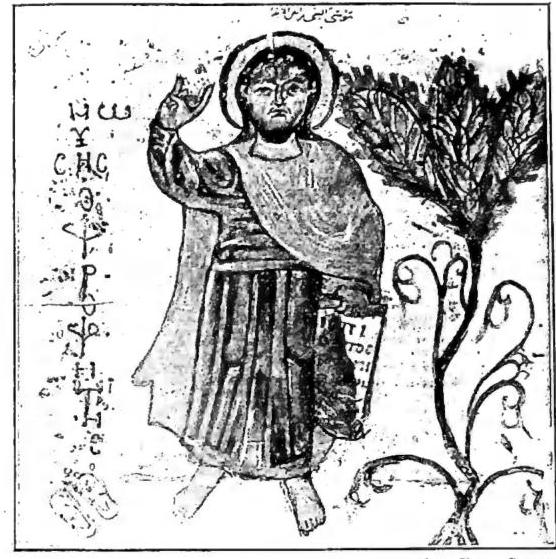
The historical material, with few exceptions, is arranged chronologically. From Exodus 20 onward begins the series of laws, which, in large and small sections, are interspersed with the narrative: they form one of the most imposing juridical complexes of ancient Oriental antiquity, in which the entire life of a people in civil, economic, judicial, and religious-cultural matters is regulated, on a moderately conservative basis, immensely superior to the prescriptions of all other codes of the East for the recognition of the rights of the person in relation to those of the community and for a certain sense of humanitarian moderation in the penal sphere, with notable provisions of an assistential character for the destitute and the weak.
II. AUTHOR
Already the name "book," or "Law of Moses," or simply "Moses" (v.), which the ancients gave to the Pentateuch, reveals their opinion regarding its author.Within the book itself, explicit attribution to Moses of certain parts is occasionally found: after the victory over the Amalekites, Moses received from God the command to "put this in a book as a memorial" (Ex. 17:14); later, he "wrote" (ibid. 24:4) the laws of the "Covenant Code" and the "terms of the Covenant" (ibid. 34:27), "recorded" the stages of the advance into Transjordan (Num. 33:2), "wrote" and "delivered to the Levites" a "law," which in context appears to be the entire Deuteronomy (Deut. 31:9, 24); he "wrote" the "song" that bears his name (ibid. 31:22). The aforementioned designation of the book as
Moses' work, in various forms, is found throughout biblical tradition: "Book of the Law of Moses" (Josh. 8:31; 23:6; II Kings 14:6); "Book of Moses" (II Kings 2:3; II Chr. 35:12; Ezra 6:18; Neh. 13:1); practically equivalent are those of "Book of the Law of the Lord given through Moses" (II Chr. 34:14), "Law of Moses" (II Chr. 23:18; Bar. 2:2; Dan. 9:11, 13); a particular prescription of the Pentateuch (Lev. 26:14; Deut. 28:15) is recalled as "the law which God had Moses write" (Bar. 2:28-29).
The same situation is reflected in the New Testament: Jesus speaks of the "Book of Moses" (Mk. 12:26), of the "Law of Moses," etc.; he refers to prescriptions of the Pentateuch as commands of Moses (Mt. 8:4; 19:8); he declares that Moses "wrote of him," but the Jews do not believe in him because they do not believe even in the "writings" (γράμματα) of Moses (Jn. 5:46-47). Prescriptions of the Pentateuch are likewise attributed to Moses by Christ's contemporaries: the Pharisees (Mt. 19:7; Jn. 8:5; Acts 6:14), the Sadducees (Mt. 22:24), the disciples (Jn. 1:45). The conviction passes to the Apostles (Acts 3:22; Rom. 10:5, 19; I Cor. 9:9, etc.) and to the early faithful (Acts 7:37; 28:23).
The Fathers also speak in a manner that implies their adherence to the common belief that the first five books of the Bible are by Moses; nor do they suspect that it could be otherwise. The rejection of the Mosaic authenticity of the Pentateuch by some heretics (Nazarenes, Manichaeans), for doctrinal rather than critical reasons (cf. Homil. Ps.-Clementinae, 3, 47; St. Epiphanius, Adv. haer., 18, 1; 33, 4; 66, 42), seemed a ridiculous extravagance. The statement of St. Jerome (C. Helv., 7): "sive Moysen dicere volueris auctorem Pentateuchi, sive Esdram eiusdem instauratorem operis, non recuso" does not in the least call the question into doubt, as does the legend (the apocryphal II Ezra 14:18 ff.) to which it refers.
The value of these testimonies, including those of Christ and the Apostles, is primarily of a historical-critical nature: they provide evidence of the continuity of a tradition that extends back to the time to which the book is attributed, and thus they deserve serious consideration even from the standpoint of historical methodology. The categorical and unquestioned character of the common conviction is noteworthy, without hesitation or contrary assertions, even though it was well known that the end of Deuteronomy, which narrates Moses' own death, is by another inspired author (without the text feeling the need to declare it), and that other small parts are by other authors.
It is advisable to set aside all expressions whose validity might be undermined by alternative explanations: for example, when one speaks of the "Book of Moses," but evidently means the Pentateuch, the book known under Moses' name (II Chr. 34:14). What remain are the passages in which the conviction that Moses wrote certain specific sections is explicitly expressed: in these cases, it is not a matter of the sacred writer adapting to current modes of speech, but of accepting and approving the statement: Moses wrote this. That a proposition "of faith" arises from this seems undeniable. This is the case for Ex. 17:14; 24:4; 34:27; Num. 33:2; Deut. 31:9, 24, for the respective passages (Ex. 17:8-13; 20-23; etc.), particularly the "Song" (Deut. 31:22).
If the extent of the Mosaic writing is broadened, strictly critical rigor requires proceeding with greater caution: this is the case for Deut. 31:9 in favor of "this law": the entire Deuteronomy? As it now stands? In other cases, there is a generic guarantee: the words of Jesus in Jn. 5:45-47, affirming the existence in the Pentateuch of some messianic prophecy (direct or typological, it is not specified), state that such prophecy is testimony for Jesus himself from Moses (who is paired in the same passage with two other witnesses, to whom books certainly cannot be substituted: John
PENTATEUCH - Prologue and incipit of Genesis from the so-called Bible of Remigius of Autun. In the frieze between the columns, eight roundels: in the first three, the creation of heaven and earth; in the fourth, the fish; in the fifth, terrestrial animals; in the sixth, Adam and Eve; in the seventh, the Pantocrator; in the eighth, the Crucifixion. Miniature from the French school (14th century) - Vatican Library, cod. Urb. lat. 7, f. 3°.
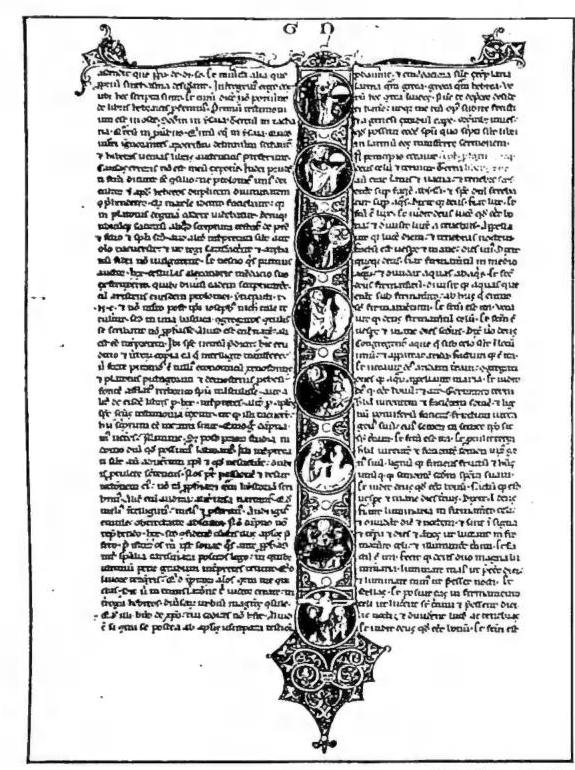
However, it is evident that something is also taught by the synthetic observation of the entire tradition as testimony in favor of the proposition « the P. is the work of Moses ». Faced with the difficulties posed by criticism, Catholics have had to seek what limits can be placed on the obvious meaning of that assertion. When the Jews and later Christians associated the name of Moses with a citation from the P., they more or less intentionally invoked an authority. The Jews, speaking of the « Law », referred to its juridical content (religious and civil). But the book is also, in its narrative parts, a religious document, a norm and source of monotheistic religion, an authentic text of the teachings revealed by God: and it was to this especially that Christianity referred. Therefore, the traditional conviction of the attribution of the P. to Moses has a « necessary and sufficient » reference to the condition of this book as a « text containing such revelations guaranteed by way of hagiographic inspiration by Moses ». Special attention should be given to the « sufficient » aspect. The testimonies require that Moses be credited with such collaboration that he may be considered responsible for the assertions made in the P., but they do not require that he be recognized as having personally and directly written it, except for the particular points already mentioned. However, the difficulties encountered by Catholics in the face of the modern critical problem do not consist in this (Responses of the Pontifical Biblical Commission of 27 June 1906 On the Mosaic authenticity of the P., N. II: Ench. Bibl., Rome 1927, n. 175).
At the time of the decree of the Pontifical Biblical Commission, while it was admitted that Moses could have used collaborators who worked under his guidance, expressing all and only what he intended, reference was implicitly made to the P. as a single work. Today, it is a common view that it would not be in contrast with theological principles to admit that at Moses' death there was not yet the P. in the current sense, but that there existed writings, the work of Moses (in the strict or broad sense mentioned above), which later flowed, entirely and substantially on their own, into what became the P. What is important is that the content of the P. be recognized as Mosaic, the revelations it contains based on the authority of Moses.
To this conclusion, always in a « necessary and sufficient » sense, also lead the internal proofs for the Mosaic authenticity of the P., authenticity of substance and to some extent of form, which scholars have gathered (e.g., A. Bea [V. BIBLICA.], pp. 21-24), and which are continually increasing thanks to archaeological and literary studies: that is, the complex of indications that reveal the hand of the writer contemporary with the events and often of the protagonist himself, Moses, and uncover the adherence of the narrative to the course of events, as is natural to expect in a report that is continually updated (e.g., the abundance of documents for periods of prosperity and their scarcity for difficult ones: V. NUMERI).
The error of criticism lies not so much in the search for sources or distinct literary units in the P., but in the refusal to trace the book, or its « sources », back to Moses himself, thus emptying the tradition of all its content, which attributes the fundamental revealed doctrines of that book to the authority of the great Leader and Prophet.
BIBL.:
A. Bea, De Pentateucho, Rome 1933; H. Cazelles, Introduction à la Bible, I, Paris 1957, pp. 1-120; P. Heinisch, Geschichte des Alten Testaments, Bonn 1934, pp. 1-100; A. Vaccari, La questione del Pentateuco, Rome 1936; and the works cited in V. BIBBIA, V. MOSÈ.
III. CRITICISM
Criticism of the Pentateuch has been one of the central problems of biblical scholarship for about a century, as shown by highly instructive overviews (A. Bea, J. Coppens). The Protestant B. Witter (1711) and the Catholics J. Astruc (1753) and A. Geddes (late 18th century) noted certain differences in the text of Genesis that pointed toward the distinction of "documents."However, systematic criticism with significant deductions only emerged with the appearance of the "theory of (two) documents" (J. G. Eichorn, d. 1827: he distinguished two documents in Genesis, roughly corresponding to the future J and P), the theory of "supplements" (M. C. De Wette, d. 1843: among other things, he attributed the composition of Deuteronomy to the reform of Josiah), and the theory of "fragments and complements" (G. A. Ewald, d. 1875, who changed his opinion several times; then Fr. Bleck; J. F. C. Tuch, etc.), with a tendency for the first to prevail, thanks to numerous adherents who subsequently revised it in various forms (H. Hupfeld; A. Kuenen; K. H. Graf; etc.).
In its "classical" form, it is associated with the name of J. Wellhausen (d. 1918), who expounded it especially in the works Die Composition des Hexateuchs (the Hexateuch [V. HEXATEUCH] is the Pentateuch plus the book of Joshua, involved in the same fate), the 3rd edition of which is from 1899, and Prolegomena zur Geschichte Israels (6th ed. 1927).
To formulate his theory, Wellhausen drew on ideas from fields beyond exegesis and historical criticism. From Hegelian philosophy, then universally professed, he derived the principle of cultural and religious evolutionism, according to which Israel, like all other ancient peoples, "had to" pass from the nomadic phase to the agricultural phase and then to that of commercial and artisanal activity, and, correspondingly in terms of religion, from a complex of animistic and fetishistic practices to polytheism, then to monolatry, which was later theorized into true monotheism. Almost entirely skeptical about the historical value of the biblical books and ancient traditions in general, Wellhausen refused to consider in the historical development any intervention that escapes documentary control.
These principles, applied to the historical-literary development of the Bible and the religious civilization it outlines, together with the "evidence" of criticism, expressed with great philological and historical-comparative erudition, led to a representation of ancient Israel entirely different from the traditional one. The initiators of Israelite monotheism would have been the prophets, and their writings the oldest texts of the Bible. The Pentateuch, attributed to Moses through a not entirely disinterested fiction by the dominant class, is a semi-legendary figure about whom history can say almost nothing. It results from the fusion of four different writings, from different periods, none earlier than the 9th century, in addition to minor redactional parts and the "Covenant Code" (Ex. 20:24-23:19) of the 9th century: the Yahwist history (J) from around 850 and the Elohist history (E) from around 770 (so called from the names Yahweh and 'Elōhim with which they respectively designate God), combined around 650 (JE); Deuteronomy (D), composed at the end of the 7th century, promulgated as "rediscovered" (a pious fraud) in 620, becoming the norm for a vast revision of the already existing writings, including JE itself; the "Priestly Code" (P = Priesterkodex), a narrative and legislative book containing various groups of stories and cultic laws, among which the oldest is the "Holiness Code," now in Lev. 17-26, merged with JE through a long process that, around 445, at the time of Nehemiah's reform, culminated in what was then the Tôrāh.
Wellhausen also described the character of the individual "sources," which in the current Pentateuch are scattered in fragments here and there. The narrative of J, which begins from the origins, is simple and primitive; the account of E is more reflective and begins with Abraham. D represents a religious and legislative deepening compared to J and E, the fruit of prophetic preaching, but a product of "Deuteronomic" activity is, beyond the current book, a general revision of the already existing writings, including the one that previously contained J and E fused together. From the activity of priestly circles during the exile, who worked in view of the future restoration on new foundations, arose the vast historical-legislative work P, which was essentially the basis of the future Pentateuch, with the complex JE inserted into it as into a framework; this represents the height of speculation and also formally appears evolved (schemes, genealogies, technical formulary of religion and cult).
In distinguishing the sources, various internal criteria were applied, especially the following three:
a) The difference in the use of the divine names Yahweh and 'Elōhim: in Genesis and Exodus up to chapter 6, the two names appear with a slight prevalence of the second (145 J, 165 E, 20 JE); in the rest of the Pentateuch, almost only the first (1244 J, 20 E, 1 JE), with certain regularities in distribution. The interpretation given by Wellhausenism regarding Genesis is that J, assuming the name Yahweh was known from the beginning of humanity (Gen. 4:26), uses it throughout the narrative, while E and P, before the revelation of Ex. 3:14, assume that name was unknown and therefore use 'Elōhim.
b) Language and lexicon: the various documents show different lexical, grammatical, and stylistic preferences and reveal Aramaic linguistic influences to varying degrees (the lists offered by Wellhausen were complicated and extended by later scholars): for example, "I" is mostly expressed with 'anōkhī in the older documents, always with 'ānī in P; "servant" is šifḥāh in J, 'āmāh in E; the pre-Israelite inhabitants of Palestine are "Canaanites" for J, "Amorites" for E; "to beget" is yālad for J, hōlīd for P, etc. Proper to P are bārā' "to create," nepeš "person," etc.; P has Aramaizing forms to the greatest extent.
c) The "doublets": it is observed that there are passages or episodes repeated two (or three) times, with differences in details but not in substance: in the work of compilation, the two or three forms would sometimes have been preserved distinct (in immediate contact or not), sometimes fused together, but in such a way that analysis allows the recognition of the various distinct elements. As parallels that remained distinct, the stories of creation (Gen. 1:1-2:4a and 2:4b-24), of God's covenant with Abraham (Gen. 15 and 17), of the manna and the quails (Ex. 16 and Num. 11), etc., are indicated. The stories of the Flood (Gen. 6-8), the plagues of Egypt (Ex. 7-9), etc., result from the fusion of duplicates. These passages were offered by different sources, which had already collected them differentiated by tradition. This argument was indicated by criticism as decisive to demonstrate that the Pentateuch is not the work of Moses, because certainly Moses would not have used different accounts to report the events in which he himself had participated as a protagonist.
Wellhausen immediately found great consensus among scholars, many of whom collaborated to refine his doctrine, deepen it, and resolve difficulties. For example, the impossibility for Wellhausenism to explain how Yahweh "became" a transcendent, moral, universal deity, the unique God of the universe, compared to much more powerful colleagues like Marduk, Assur, Amon, soon presented itself: and K. Budde responded by appealing to the character proper to Yahweh as a deity not imposed but freely chosen by a people, as shown by the "covenant," one of those profoundly human acts that found the spiritual life of humanity; but already the conservative Protestant E. König refuted this paralogism, showing first of all that Yahweh is not chosen but is the one who chooses a people.
BIBL.:
Per la storia della critica del P.: A. Bea, De Pentateucho, Roma 1933; J. Coppens, L'hypothèse documentaire et les textes du Pentateuque, in Ephemerides Theologicae Lovanienses, 1942, pp. 5-46; H. Cazelles, Introduction à la Bible, I, Parigi 1957, pp. 173-240; per Wellhausen e la sua scuola: J. Wellhausen, Die Composition des Hexateuchs, Berlino 1899; Prolegomena zur Geschichte Israels, ivi 1927; W. Robertson Smith, The Old Testament in the Jewish Church, Londra 1892; A. Kuenen, Hexateuch, Lipsia 1886-1893; K. Budde, Die biblische Urgeschichte, Giessen 1883; per la critica cattolica: P. Heinisch, Der Pentateuch, Bonn 1930; A. Clamer, La Sainte Bible, I, Parigi 1949, pp. 1-100; J. Chaine, Le livre de la Genèse, Parigi 1948, pp. 1-50; per la critica conservatrice: E. König, Einleitung in das Alte Testament, Gütersloh 1893; R. Kittel, Geschichte des Volkes Israel, I, Stoccarda 1923, pp. 1-100.
A. P.
Great indeed was the influence that the theory exerted for several decades from its appearance, penetrating introductions (C. Steuernagel, C. H. Cornil, partially E. König), inspiring the commentaries of the time (W. Nowack, K. Marti, the Internat. crit. commentary, etc.), biblical theology studies (A. Schulz, W. Smend, B. Stade, E. Kautzsch, A. Bertholet), and histories of Israel.
Such full consent did not last forever: there were significant reactions, regarding general principles, such as that of religious evolution, and especially concerning the general reconstruction of ancient Near Eastern history (the great weakness of Wellhausen’s system—a typical "armchair scholar"—lay in its comparison with archaeological data) and the delineation of the biblical-Israelite religious and cultural development. In particular, scholars of various tendencies (among whom several great Catholic masters are honorably inscribed; cf. A. Bea, pp. 34-36; J. Goettberger [V. BIBLICA.], pp. 75-78) demonstrated that the presence of certainly Mosaic laws and memories in the Pentateuch was undeniable; many arguments advanced by Wellhausen were devoid of value, as the alleged facts had to be interpreted differently.
The insistence on the critical reading of the Bible and the absorption of all attention in these arid problems of origins and sources eventually reached saturation and engendered weariness. Some openly proclaimed this, both in the fields of general culture and among biblical scholars, calling for a return to spiritual and precisely religious problems and values. The possibility of reaping the fruits of a century of studies on the entire ancient Near East, its religions, and literatures, conditioned the rise of new exegetical currents, closely imbued with the methods of the "history of religions" and the "history of forms" (v.).
For several decades now, no one has professed Wellhausenism in its form of half a century ago. However, it has not been replaced by a substantially traditionalist system: fundamentally, non-Catholics remain Wellhausenian, though each in their own way. Among the living, Th. H. Robinson, J. Hempel, O. Eissfeldt, and W. Rudolph have brought even important retouchings to the system, reservations, explicit denials of particulars, but also further progress in the path of dissections. Thus, for example, after much discussion on the unity of J, it was ultimately divided into two (J¹, J²), called by Eissfeldt L (a "lay" source, devoid of "priestly" ideas, composed in the age of David, ca. 950, with older elements) and J (which includes parts once assigned to the additions of J and E). P (G. von Rad) and the remaining documents were also subdivided; meanwhile, a new absolute and relative chronology was studied (E. König places E at the head of the series). Much uncertainty reigns over the unity and date of D. More recently, it was denied that E contained narrative elements (P. Volz - W. Rudolph), with important anti-Wellhausenian consequences; individual studies attacked the validity of philological critical arguments. J. Engnell, with others of the "Uppsala school," rejects the old methods of literary criticism of the Pentateuch as "desperate."
A. Weiser and A. Bentzen essentially follow Wellhausen but diverge from him in not a few applications and conclusions. Bentzen prefers to speak of "strata" rather than "documents" in the Pentateuch and acknowledges that the new generation is skeptical before the documentary hypothesis.
It can be said that today the general conception of the history of Israel and its religious development has approached the traditional one in many points, thanks to archaeological documentation. Considering Israel by descending from its prehistoric origins, now better known, one forms a judgment quite different from that obtained by ascending backward, which was rather the mindset of older scholars: Israel appears in full historical light; beneath Deuteronomy and the Priestly Code lie archaic elements, which the discoveries of Eastern codes invite one to backdate in a manner fully favorable to tradition. As for the literary fact, however, one can only note a fervor of research, not reducible to unity. New analyses of the texts are made, new methods are attempted to trace their history, sometimes unfortunately chasing fleeting shadows of oral traditions and hypothetical religious ideologies of initiates, but often with excellent positive results. The work of W. F. Albright on monotheism from the Stone Age to Christianity (1940) is a sign of a profound revolution that has taken place in the minds of many scholars. Much progress has been made regarding laws: it is admitted that they result from the elaboration of an ancient fundamental text. For the narrative parts, however, the hypothesis of multiple parallel strands, which would best account for the structure of the Pentateuch, continues to prevail.
The division of sources and their chronology remains the true point of disagreement between the two opposing tendencies: integral Wellhausenism and rigid conservatism, and the field in which mutual attenuations and concessions have been recorded in attempts at rapprochement.
a) The conservative tendency has first sifted through the critical arguments mentioned, considerably reducing their importance. The criterion of divine names is greatly weakened by the objections offered by the state of the text (the distribution of the two names in Hebrew and in ancient translations is not uniform) and exegesis: the use of one name in preference to another is sometimes conditioned by psychological, linguistic, and theological motives (A. Bea, p. 54 ff.), so much so that many scholars today refer to this argument only as a confirmation. The criterion of linguistic differences has also been challenged. In other books, both within and outside the Bible, certainly by a single author, one occasionally finds insistent preferences for certain words. Often, the different subject matter (e.g., narratives with different purposes, different laws) imposed varied words; or the different words indicate differences in things, that is, apparent synonymies, precise expressions that it was necessary to distinguish (one thing are the Amorites, another the Canaanites; one thing is fīfīhāh, another 'āmāh). In this regard, many observations to be considered acquired are in the work of U. Cassuto (v. BIBLICA). Even regarding "doublets," exaggerations have been made, both in their assignment (sometimes they are different things, as in the case of the three wives of the patriarchs in danger: Gen. 12:1 ff.; 20:1 ff.; 26:7 ff.) and in their interpretation. Legislative doublets represent successive provisions that are repeated or modified. In the case of "fused" doublets, caution is needed for another reason: perhaps the distinction is unwarranted. In the account of the Babylonian flood in the Epic of Gilgamesh, Tablet XI, there are data that correspond to J and P (A. Šanda [V. BIBLICA.], p. 82).
b) Therefore, many authors do not adhere to the theory of the division of sources; instead, they think that the work remaining at the death of Moses was already unitary and that the noted differences are so limited that their explanation can be sought elsewhere than in a difference of origin. The decree of 1906, without expressing a doctrine on the matter (since it directly concerns Mosaic authenticity) and without imposing or suggesting any particular theory, implicitly directed the atte
c) There is also an intermediate position, represented with divergences by exegetes of different inspiration, which consists in distinguishing, so to speak, between a line of law and one of fact. E. Sellin, critic and archaeologist, after many fluctuations in a direction of increasing rapprochement with tradition, while still essentially maintaining the distinction of documents (with other scholars, he attributes importance to a hypothetical connection between the drafting of the Pentateuch's narratives and different cultural practices, sanctuaries, etc.), observes that these are not entities so individualized that they can be isolated: an isolation that must be established before proceeding to further conclusions. This idea can be compared to that of Catholic authors who, while not inclined to admit the existence of documents, do not deny its possibility; they do, however, deny that there is any means to recognize them fully (e.g., H. Höpfl, Introductio in Vet. Test., 1st ed., Rome 1921, p. 50). This intermediate position has allowed Catholic authors to adopt the theory of division as a working hypothesis and to consider its foundations and consequences from all perspectives: a task whose usefulness cannot be denied.
d) Nevertheless, it must be immediately noted that the position of those exegetes who, with certain specifications—avoiding, first of all, the impossible divisions into half-verses and limiting themselves to asserting as certain the distinction in passages with a well-defined character—have believed they could accept as demonstrated a distinction of sources for Genesis and the entire Pentateuch, is not contrary to Catholic requirements either.
Should the observations of factual data, disregarding erroneous reconstructions, lead to substantial agreement on the recognition of a certain number of truly distinct and well-defined documents, the authority of tradition with all the value it represents would not be contradicted. To advance this hypothesis, it will be necessary to determine the extent of Mosaic content recognized in each document ("authenticity"): this principle can never be abandoned, for the two reasons noted—the theological authority and the general value that, in a well-founded historical methodology, must be recognized in tradition. It seems that the thought expressed by J. Touzard in his well-known article (v. BIBLICA., col. 724 ff., condemned as containing uncertain doctrines on 23 April 1920) was precisely defective in this regard.
The system outlined by M.-J. Lagrange in the documentary hypothesis, limited to Genesis and harmonized with the Catholic requirements of respect for tradition, retains general indicative value for statements of principle. "Doublets" seem to be something congenital to the Hebrew spirit, which appears not to feel it has expressed itself well unless it uses different ways of saying the same thing; when it comes to laws, the obvious explanation is the combination of two texts of the same provision, varied in the legislator's effective will at two different moments; but if it concerns history, in cases where the double version must truly be proven, it is more natural to think of originally different writings, even if by the same author. To the difference between two historical-theological visions, one Elohist and one Yahwist, the Bible offers a parallel in the account of the introduction by revelation at a given moment of the name Yahweh, as a specification of the generic Semitic 'Elóhim, with which transition the documents can be related. The reasons that have led authoritative modern critics to raise the chronology of J and E to the time of David and Solomon—since it is natural that nationalist activity would seek support in ancient promises and divine rights—apply even more to the time of Moses, who led his tribes to the conquest of a homeland. There is no reason to deny Moses the other texts, with the reservations of developments and additions permitted by Catholic principles.
For this explanation, or others, within the documentary hypothesis, all theories that are not reconcilable with inspiration and that refer to objections which, though in different forms, also exist in the hypothesis of the pure and simple substantial authenticity of a single work written by Moses, must be avoided; for example, that the conception of the divine is opposed (though to a certain extent a difference may be admitted) in J, E, P; that the knowledge of Canaan shown by the documents (less markedly in E than in J) is that of people already residing there. This second difficulty is not insurmountable: the knowledge of Canaan in E, J, P is what can be had by neighbors who travel by camel or horseback. Even today in 'Ammān, local people are found willing to act as guides throughout the country on both sides of the Jordan. One must spend some time in Palestine to realize how small it is! Moreover, the Hebrews came from Egypt, where there was a long experience of expeditions to the north: Seir (v.), for example, is instructive, about which, according to the recent interpretation of an ancient hieroglyphic text, such information could be had in Egypt as to advise the Hebrews of Moses on the route mentioned in Deut. 2:8 ff. (cf. J. Janssen, in Biblica, 15 [1934], p. 538).
Once these general difficulties are overcome, it will be necessary to seek for each source a dating that allows the essential Mosaic content they contain to be recognized. Just as the path chosen by critics to explain the particularities of the documents, by considering them the work of different authors, is not unique and is false when compared to tradition, so the chronological differentiation among them can correspond to different periods of Moses' time. For this as well, one can proceed along the path left open by the 1906 decree: the leader's collaborators would have worked on different works at different times and with ever-new purposes. Emphasis must be given to the testimonies of the Pentateuch itself regarding the parts written by Moses; to the references of the earliest prophets to laws and traditions as known, recognized, and widespread (thus Hos. 8:12, which speaks of a great quantity of written Töröth; Amos 2:8, which clearly refers to Deut. 24:12; etc.). An attempt in this direction is that indicated in the aforementioned article by M.-J. Lagrange (for Genesis), which places the location of E and J in Moses' direct activity and shows that P must be attributed to Moses, first of all insofar as it is a reworking of the material of the two preceding ones.
PENTATEUCHAL CRITICISM
BIBL.:
Besides the works cited in the text, see: A. Clamer, La Sainte Bible. Le Pentateuque, Paris 1940; P. Heinisch, Geschichte des Alten Testaments, Bonn 1934; J. Goettsberger, Einleitung in das Alte Testament, Freiburg im Br. 1928; H. Höpfl, Introductio generalis in Sacros Libros Veteris Testamenti, Rome 1925; A. Vaccari, La S. Bibbia. Vol. I: Il Pentateuco, Florence 1936; E. Sellin, Einleitung in das Alte Testament, Leipzig 1935; M.-J. Lagrange, Études sur les religions sémitiques, Paris 1905; J. Touzard, L'hypothèse documentaire et la composition du Pentateuque, in Revue Biblique, 1907, pp. 721-747; J. Janssen, Le Seir des textes égyptiens, in Biblica, 15 (1934), pp. 537-544.
A. Bea
The most serious difficulties for dating within Wellhausenism were created by Deuteronomy, which was presented as the theoretical enunciation of the principles applied in Josiah’s reform (v.). However, precisely on this point, the system has received strong rebuttals from many scholars (W. Eichrodt, W. Staerk, A. C. Welch, T. Oestreicher, E. Sellin, G. Von Rad), who postulate at least earlier dates, deny that Deuteronomy is the code that served as the starting point for a reconstruction according to the priestly ideal, and reject the supposed close relationship between Deuteronomy and Josiah’s reform—so close as to consider the two phenomena perfectly coinciding.
IV. ECCLESIASTICAL DIRECTIVES
An important point of reference, not only theologically, for any doctrine concerning the problem of the Pentateuch remains the aforementioned decree of the Pontifical Biblical Commission of 27 June 1906 on the "Mosaic authenticity of the Pentateuch" (Esch. Bibl., op. cit., nn. 174-76). It comprises four points in the form of responses to doubts, but can be summarised in two: affirmation of the Mosaic authenticity of the Pentateuch, denying that the book in its entirety can be passed off as a collection of writings subsequent to Moses; clarification of the concept of Mosaic authenticity, stating that it does not imply personal and direct composition by the author, does not exclude the use of written and oral informational sources, nor does it exclude later modifications and even additions. On the current meaning of the decree and the unfoundedness of the accusations made against it cf. J. Coppens, Histoire... (v. BIBLICA), pp. 171-94. The current directives of the ecclesiastical magisterium are expressed in the letter of the Pontifical Biblical Commission (16 January 1948) to Cardinal E. C. Suhard, Archbishop of Paris, signed by the secretary J. M. Vosté (AAS, 40 [1948], pp. 45-48).The following problems remain debated, in large part even among Catholics themselves: the general conception of the historical-literary development of Israel as represented in the Bible; the meaning of Mosaic authenticity; the division and chronology of the sources; the historiographical method applied in the Pentateuch.
Reference to tradition must be specified in comparison with the notion of Mosaic authenticity, which recurs in ecclesiastical documents and in common Catholic studies. The 1906 decree, by defining that Moses is the author of the Pentateuch through the exclusion of theories that derive this book from writings posterior to him, and on the other hand admitting that Moses may have made use of the work of others, extends the notion of author to that of "responsible party." The same extension applies to any earlier literary units (written and oral traditions) included in the Pentateuch. Thus, the definition of authenticity is broadened well beyond the sense the term initially suggests. A rational application of this opens the way to resolving many problems, including that of the division of sources and their dating. For this reason, many authors have sought to explain and develop II. Some have concluded that the second and third responses intend a "substantial authenticity," or of content, rather than a "literary authenticity," or of formal procedures. The letter of the Pontifical Biblical Commission to Cardinal E. C. Suhard of 16 January 1948 (AAS, 40 [1948], pp. 45-48) invites Catholic scholars to delve deeper into the question. This document is authentically interpreted by the encyclical Humani generis (AAS, 42 [1950], p. 576). With regard to laws, it does not seem that this conception should present notable difficulties: many nations of Europe still have the "Napoleonic Code," yet it is known that to the Napoleonic foundation many new elements have been added, which update the law according to the libertarian principles that the famous leader wished to affirm in his legislation. Naturally, for the expression to be correct, it is necessary that the ancient foundation truly be preserved (in the Mosaic case, of this one is certain, if for no other reason than what tradition and comparative Eastern law teach) and that the new developments truly be deduced from the general principles conserved (of this, too, the internal coherence of Hebrew laws attests). What matters most, others have said, is the principle "of the fundamental character of Mosaicism and of the evolution of Israelite law in its spirit and in its line" (H. Dumeste, cited by J. Coppens [V. BIBLICA.], p. 187). In a broader sense, some would include even truly new developments, but entirely consistent with the traditional part, just as doctrines that are not found expressed in the works of Aquinas but are in strict harmony with his thought could be regarded as authentically Thomistic: the case of the Pentateuch is somewhat different, but one can also say that good legislation is always an ordered development of general principles and particular applications, as in a logical system of thought.
For narratives, the possibilities of a benevolent interpretation for criticism seem fewer, but they are not excluded. Among Catholics, the most progressive seems to be P. Heinisch: in his esteemed commentaries on the Pentateuch, he denies Moses an impressive sum of laws and even narrative sections; and he gives the judgment that was already G. Hoberg's and later A. Allgeier's: "The Pentateuch is the product of religious development within the people who were the depositaries of Revelation, from Moses until the time after the Babylonian exile, on the foundation of the dispositions fixed in writing by Moses" (Biblische Zeitgesch., Freiburg i. Br. 1937, p. 60; cf. pp. 49-66). Even in this, the Mosaic guarantee for some passages is direct, for others it is taught by internal characteristics, for reasons at least of coherence.
In the conception of the development of Israelite history within the framework of ancient history, the movement toward traditional theses has been continuous: the progress of archaeology has been an increasing confirmation of the historical data of the Bible. The thesis, expressed or latent in all Wellhausenian writings, of the historical-religious evolutionism of Israel, from an initial polydemonistic phase to the legalistic-cultic form, is not justified by the facts. It is not true that at the outset there is always a more backward religious form: indeed, the opposite is true, that all religious cultures more or less clearly show at the beginning the idea of a supreme God. Moreover, the Hebrews, at their historical origins, emerging from the Semitic stock, were not primitives.
In matters of religion, Israel was incomparably superior to its environmental conditions. In Hebrew, there is no trace of a nominal formation to say "goddess." The study of the religions of Babylon and Egypt has confirmed the unique character of the Hebrew religion. "Independent" scholars confess that at the origins there must be the "charism," the "inspired personality," and conclude with a reference full of reserve to Ex. 3:14 ff. and 19:5-22. No scholar, even non-Catholic, after the works, for example, of H. Gunkel on the prophets, could any longer attribute to prophecy the invention of Hebrew monotheism. Nor is it true that civilisation in general is in a constantly ascending line.
Studies in archaeology and ancient history have especially shown that Israel is not isolated in civilisation. Comparison with the traditions of other peoples confers the greatest confidence in those of the Bible. The discovery of Eastern codes, some several centuries earlier than Moses (in recent years, to the Code of Hammurabi have been added the older ones of kings Lipit-Ištar and Bilalama), has shown that the body of Mosaic laws, which Wellhausen dated to the exile (6th century B.C.), reveals archaic elements and is not at all anachronistic for the period to which the Bible assigns II. The discovery of the existence of alphabetic writing (v. ALFABETO) precisely in the Sinai region and in Canaan, and under such conditions as to suggest that it was widely diffused long before the end of the second millennium (the preserved specimens are accidental), shows the cultured Moses not only in the possibility but in the probability of having made use of II. And perhaps the use of writing by Moses is to be connected with the already existing use within the patriarchal family (which, it is worth remembering, was not made up of "primitive" people) from the time of the passage into Canaan and Egypt, a hypothetical use, but one that the circumstances mentioned render entirely plausible.
BIBL.:
J. Coppens, Histoire critique des livres de l'Ancien Testament, I, Parigi 1938; H. Dumeste, in Revue Biblique, 48 (1939), pp. 321-47; P. Heinisch, Theologie des Alten Testaments, Bonn 1940; G. Hoberg, Moses und der Pentateuch, Friburgo i. Br. 1905; A. Allgeier, Die Bücher Moses und der Pentateuch, Bonn 1911; J. M. Vosté, De mosaica authentia Pentateuchi, Roma 1933; Enchiridion Biblicum, nn. 174-76, 576-78.
A. P.
It would not have been attributed to Moses if at least the core were not in some way his; and on the other hand, the reference to the personality of a legislator, at least in its essentials, is imposed by the character of that code, strictly theocratic, which cannot be conceived as an anonymous systematization of existing customs. Regarding the ritual part, the judgments of critics are so discordant (cf. A. Bea, in Biblica, 16 [1935], p. 190) that they inspire no confidence; considering it also within the whole of the Törāh, as tradition does, therefore remains the best course.
All this justifies those scholars who, in biblical studies as well, as has already been done by scholars of classical and medieval philology, advocate an increasingly respectful return to patriarchal and Mosaic traditions (A. Bea, ibid., p. 199). Progress in this field will also have useful repercussions in the literary domain, where the question of the Pentateuch properly arises.
Regarding the method applied in the Pentateuch, as in all the most ancient historical books of the Bible, it can be said that important explanations have been acquired, which must be kept in mind for interpretation, whatever the answer to the question of origin may be: since the Pentateuch is a book of compilatory character even under the hypothesis of the strictest Mosaic authenticity, due to the use of information from various sources (Pontifical Biblical Commission Decree, n. III). In judging the historiography of the Old Testament, the "limits and cautions" recalled by the encyclical Humani generis (AAS, 42 [1950], p. 576 ff.) must be kept in mind.
Catholic principles on inspiration affirm a human role in the composition of the sacred book and attribute to the hagiographer the true condition of author. This human role is recognized in everything that serves to express divine thought: thus the language with its possible idioms, the complex of ideas that form a custom or civilization, and, what matters here, literary technique. The procedures that in current mentality an honest and truthful historiography must follow were not judged in the same way by the ancient Orientals, who, when they found a written account and approved of it, could incorporate it without citing the source.
I. Guidi (L'historiographie chez les Sémites, in Revue biblique, 15 [1906], pp. 509-19) indicated the sources, which he identified, of Arabic narratives used at second hand with adaptations of details, sometimes made with admirable skill. The connection between different passages involves elements of cohesion that have more of a literary than a historical function. This consideration may be among those useful for illustrating point IV of the 1906 decree. A similar case is that of "doublets": when the Semitic writer found himself before two accounts of the same event with different details, if he had no reason to prefer one, he would merge them, preserving the elements proper to each, or he would report both. But he did this precisely out of scruple for historical truth: attachment to tradition moved him to act thus. Respect for the written testimony led him to preserve what it reported: the teaching lies in the whole.
These criteria also serve to justify the "later additions," which Catholic exegesis admits in the Pentateuch and sometimes even in considerable extensions, groups of several verses with complete meaning. Some believe that in a documentary hypothesis the insertion of such phrases and passages by inspired men is easier to understand than in the hypothesis of insertion into a book already completed and recognized: unless one wishes to suppose that those passages were added to the book of Moses because there was no other containing the ancient traditions and laws. Examples suffice: Deut. 17:14-20 (royal law: cf. I Sam. 8, especially vv. 6-9, 18 and I Sam. 10:25, according to which the "statute of the kingdom" was written by Samuel); Ex. 16:35 (which if by Moses was added at the end of his life); Num. 32:41-42; Gen. 36:31-43 (cf. V. 31); Deut. 4:41 ff.; 19:7; elements of Deut. 14 and 26; etc.
Moreover, to these later additions, to which Catholic criticism devotes all its attention and diligence, out of respect for the sacred book "cum omnibus suis partibus", recognizing therein the guarantee of inspiration, are not entrusted those fundamental doctrinal data that make the Pentateuch the first great stage of written Revelation, the most distant foundation of faith, the necessary presupposition of the Gospel. Even the principal revelations of the Pentateuch are in a certain way in the light of Christ: the presupposition from which the messianism of Jewish expectation and Christian realization develops, and which gives to the mission of Christ the meaning of reparation and reconciliation, redemption, λύτρωσις, is in Gen. 3:15. Likewise, in parts exclusively Mosaic are found those primordial revelatory teachings of monotheism, creation, fundamental moral law, Decalogue (v.), from which in all its breadth appears the unique importance of this book for the faith of the Christian and its contribution to the religious development of humanity.