
NOAH (Heb. Nōah; LXX Nōe; cf. Old Babylonian Nuhija). — The tenth of the “antediluvian patriarchs” (Gen 5:28–31), son of Lamech, who lived to the age of 950 years (Gen 9:29). In anticipation of the flood (cf. v.), which occurred when he was 600 years old (Gen 7:6), he received from God the command to build, according to specific measurements and design, the ark in which he saved himself with his family and one or more pairs of every kind of animal.
In this aspect of the “hero of the flood,” Noah finds a counterpart in those who survived similar general punishments inflicted by a deity upon humanity, as recounted in ancient mythologies, especially the Sumerian Ziusudra (the Ξιούθρος of Berossus [cf. v.]), from whom the Utnapištim of the Epic of Gilgamesh (Tablet XI) derives. There are, however, notable differences; for example, in the Babylonian myth, Utnapištim becomes immortal after the flood and is transported to the blessed isles with the gods, whereas Noah remains a man among men; Utnapištim is saved because of the particular friendship that the god Ea has for him without any special foundation, whereas Noah is saved because he was righteous—a point frequently emphasized in subsequent biblical references to him.
Noah — Noah praying in the ark. Fresco from the 2nd century in the so-called Greek Chapel (recent photo) — Rome, Priscilla Catacomb.
After the flood, on the occasion of a sacrifice offered by the survivors as a sign of gratitude, God made a first promise never again to inflict upon the human race a punishment like the flood (Gen 8:21–22). This promise was later solemnly confirmed when God, after some time, entered into a “covenant” with Noah and his descendants (Gen 9:8–17; cf. Isa 54:9), which set a divine seal upon Noah’s role as the new progenitor of the human race. In this covenant, God renewed and expanded certain provisions already given to the first man, Adam (cf. Gen 1:28 with 9:1–7: the development of hunting and the carnivorous regime in the new historical phase of civilization). In Gen 10:1–32, Noah’s three sons, Shem, Ham, and Japheth, are associated with all the peoples that enter into his vision of humanity: broadly speaking, Asia Minor with Shem, southeastern Europe with Japheth, and northeastern Africa, including Canaanite territory, with Ham.
After the flood comes the episode of Ham’s disrespect (cf. v.) toward his father, who had fallen asleep drunk—an act due more to inexperience than malice—and the consequent curse that Noah pronounced upon Canaan (cf. v.), Ham’s son, as well as the blessing upon Shem and Japheth (Gen 9:18–27). Historical and ethnic significance attaches to the curse upon the Canaanites (now extinct), which ought not to be extended to all “Hamites,” and to the blessings upon Shem and Japheth. In the latter case, the patriarch’s words clearly also enter into the history of messianism (Gen 9:26–27), alluding to the acceptance by Japheth, who was demographically more widespread, of the religion of Shem.
In that episode, of general historical importance is the notice of the beginning, with Noah, of viticulture, a symbolic expression of the development and perfection of agricultural civilization. Perhaps through this aspect of Noah as an expert viticulturist, tradition sought—by the well-known method of assonance—to connect the etymology of his name: it is indeed read that at the child’s birth his father “called him Nōah, saying: ‘This one will give us relief (Heb. niham) from our toil and the hard labor of our hands because of the ground, which God has cursed’” (Gen 5:29); an allusion to the restorative effect of wine and to new agricultural methods.
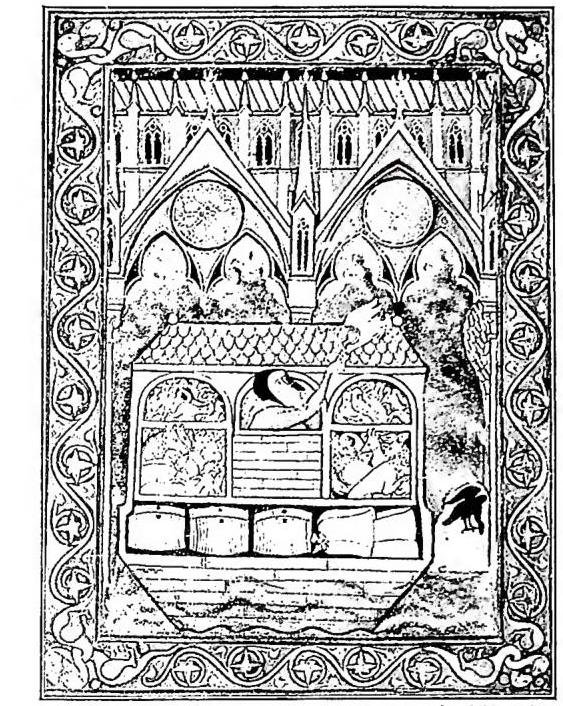
Noah — The ark of Noah, the raven, and the dove. Paris Psalter or Psalter of St. Louis (c. 1260) — Paris, Bibliothèque nationale, ms. lat. 10525, fol. 3v.
The ark of Noah is very frequently represented also on sarcophagi. According to Wilpert, the oldest is that on sarcophagus 119 (Sarcofagi, pl. 9, 3, p. 233).
In funerary art Noah represents the deceased and thus signifies a desire for salvation, as the patriarch was saved from the flood. Indeed, on a Lateran sarcophagus (dated 236), belonging to a woman named Iuliana, the deceased woman is shown praying in the ark instead of the patriarch. In the pavement of the synagogue discovered beneath the church of SS. Cosmas and Damian in Gerasa the scene is depicted of Noah with his family and the animals emerging from the ark after the flood (F. M. Biebel, Mosaics in Gerasa City of the Decapolis, New Haven 1938, pp. 297-351). The same scene is found on a sarcophagus from Trier, whose front shows a large open chest inside which is Noah with his wife, his three sons and their wives, quadrupeds and birds; outside, the dove flies aloft with an olive branch in its beak while the raven stands on the ground (E. Le Blant, Les sarcophages chrétiens de la Gaule, Paris 1886, pl. 3, 1). The scene of Noah in the ark is also found on not a few glass vessels used in burials (R. Garrucci, Storia dell'arte cristiana, III, Prato 1873-80, pls. 169-202) and on terracotta lamps. The ark from which Noah reaches out toward the dove returning in flight with an olive branch in its beak or talons is also common on Roman sepulchral slabs (see examples in H. Leclercq, Arche, in DACL, I, II, cols. 2721-22). Noah in the ark was also depicted in the mosaics of the mausoleum at Centcelles in the province of Tarragona (F. Camprubi, I musaici della cupola di Centcelles nella Spagna, in Riv. di arch. crist., 19 [1942], pp. 87-100); in the basilica of St. Ambrose (v. E. Soletti, Iscrizioni crist. di Milano, Codogno 1897, no. 208); and in a Spanish basilica, as attested by Prudentius in his Dittochaeum (no. 3). In the Ashburnham Pentateuch, fol. 9a, the ark is shown on the waves as a large chest bound with a door and three closed windows; on fol. 10b the door, windows and roof of the ark are open. Through the left window Noah sends out a first raven; through the right window a second raven; through the central window he receives the returning dove; through the wide-open door the family of eight persons is about to emerge, and they are also seen above under the raised roof of the ark. The animals are moving away from the ark; on the left Noah, surrounded by his family, offers a thanksgiving sacrifice (O. von Gebhardt, The miniatures of the Ashburnham Pentateuch, London 1883, pp. 1-5). In the Cotton Genesis Noah leans out of the window to send forth the dove (British Museum, Cotton 3, 6; E. M. Thompson, Catalogue of ancient manuscripts in the British Museum, I, London 1881, pp. 20-21). In the Vienna Genesis the ark has several stories (Von Hartel and S. Wickhoff, Die Wiener Genesis, Vienna 1895, pl. 4).
Certain coins of Apamea in Asia Minor from the time of Septimius Severus, Macrinus and Philip show on their reverses the representation of the open ark, with two persons inside and above it the raven and the dove with an olive branch; inside the ark is the inscription NOÈ (H. Leclercq, Apamée, in DACL, I, II, cols. 2515-16, figs. 825-27). The ark of Noah is also found on papal coins (see NUMISMATICS OF ROME, PAPAL, col. 2011).