
PAPAL ROMAN NUMISMATICS. - Within the framework of the coinage of the Italian peninsula from the fall of the Roman Empire to the present day, the coinage of papal Rome constitutes one of the longest-lasting groups, richest in emissions, most varied in pieces, and most interesting from every point of view among the series minted in Italy.
I. METALS AND ALLOYS
The coinage of papal Rome was minted in the metals and alloys used concurrently by other Italian and foreign mints (gold, silver, billon, bronze), depending on the periods and the monetary series themselves.1. Gold
It appears that the Senate of Rome established the ducat or Roman florin (imitated by the Venetian zecchino) around 1350, whose issuance was definitively suspended a century later by Eugene IV (1431-47) to replace it with his ducat, which inaugurated the true papal gold series of Rome. However, even earlier, Pope Giovanni XXII, around 1323, had minted in the mint of Ponte della Sorga the first gold florin imitating the Florentine one, whose issuance continued under his immediate successors Clement VI, Urban V, etc. Paul II (1464-72), alongside the papal ducat, minted the florin or ducato di camera, which was replaced by Paul III (1534-49) with gold scudi. With Alexander VI (1472-1503), the double ducato di camera first appeared, still minted by Julius II, Leo X, Adrian VI, Clement VII, and Paul III. With Paul V (1605-21), double and quadruple gold pieces were issued, minted alongside the scudo by Clement IX and X, Innocent XI, Alexander VIII, and Clement XI. With Benedict XIII (1724-30), the double zecchino, the zecchino, the half-zecchino, and the quarter-zecchino were added.The Roman Republic (1798-99) and the Napoleonic occupation (1799-1800) did not mint gold. Napoleon, however, minted the 20-franc piece. With Pius VII (1800-22), the series of doubles resumed. Gregory XVI minted pieces of 10 scudi, 5 scudi, 2.5 scudi, and 2 scudi; finally, from 1866 to 1870, the second coinage of Pius IX, on a decimal system, included gold pieces of L. 100, 50, 20, 10, and 5.
2. Silver. - The first coinage of papal Rome was in silver, represented by the denarii of Adrian I (772-795 A.D.), followed by the series of so-called antiquiores, silver coins that paired the name of the pope with that of the contemporaneously reigning emperor; they bear the monograms of the names from Stephen V to Benedict VII, paired with the monograms of the names of the emperors from Louis I to Otto III. After a gap of about two centuries, with Celestine V, silver coinage resumed in Rome, but in the name of the Roman Senate (1184-1439); these were the grossi and half-grossi, first anonymous, then with the names of the Roman senators Brancaleone d'Andalò and Charles I of Anjou, and later with the coats of arms of the families Caetani, Orsini, Colonna, Savelli, Annibaldi, and Stefaneschi, reaching approximately the mid-14th century. Meanwhile, the so-called anonymous sampierini of the Roman Senate were minted. During the Avignon exile, from Boniface VIII to Urban V, mints in Italy—under the pope’s name—operated in Ponte della Sorga, Viterbo, Macerata, and perhaps also Parma; and in France, Avignon. The activity of the Rome mint resumed with Urban V, with silver half-grossi and bolognini, which continued in Rome under Gregory XI, Boniface IX, and Gregory XII; the issuance of this coinage became regularized with Martin V Colonna, Eugene IV, etc. Julius II minted the giuli; Leo X also minted the triple and double giulio; Paul III minted the testone, the paolo, and the half-paolo; Sixtus V minted the piastra.
Scudi and testoni represented, from Urban VIII to Gregory XVI, with lower denominations, the silver coinage. The first Republic and the Napoleonic occupation minted scudi and half-scudi, and Napoleon, as emperor and king of Italy, minted the franc and the five-franc piece. The first coinage of Pius IX (1846-66) consisted of scudi, half-scudi, double giuli, and giuli; and the second (1866-1870) consisted of 5-lira pieces and lower denominations.
3. Billon-Bronze. - Beginning with the provisini of the Roman Senate (ca. 1184-1439), a good portion of Rome’s fractional coinage, of minimal real value and with a predominantly forced circulation, was minted in billon, a variable alloy of silver and copper. Thus, the denarii or cinque, the piccioli of the Roman Senate from the Rome mint (croceleone), the denari provisini of the Roman Senate (1184-1250; 1300-1404); the piccioli of Benedict XI, Giovanni XXII, Benedict XII, from local mints; the double denarii and obols of Urban V; the piccioli of Nicholas V, Callixtus III, Pius II, Paul II; and again the quattrini of Leo X, Clement VII, Paul III, etc.; the muraiole of Alexander VIII, the 4-baiocco, 2-baiocco, and 1-baiocco pieces of Clement XII, Benedict XIV, etc.; the carlini and muraiole of Clement XIV, the 60-baiocco, 25-baiocco, and 1-baiocco pieces of Pius VI.
Bronze was preferably used for the lower denominations of the local papal mints, active especially in the 17th and 18th centuries, beginning with the double quattrino of Alexander VI to the half-baiocco of Paul V. In bronze are the quattrini of Paul V, Gregory XV, Urban VIII, Alexander VII; the quattrini and half-baiocchi minted by almost all successors, up to the madonnine of five baiocchi and the sampierini of 2.5 baiocchi and the baiocchi of Pius VI and VII, Gregory XVI, and Pius IX.
BIBL.:
- A. Cappelli, Lexicon abbreviaturarum, Milano 1912;
- C. Cavedoni, Saggio di osservazioni sulle monete di Modena, Modena 1828;
- F. Ehrle, Roma prima di Sisto V, Roma 1932;
- L. Forrer, Biographical Dictionary of Medallists, London 1904-1930;
- F. Muntoni, Le monete dei papi e degli Stati pontifici, Roma 1972-1974;
- P. Grierson, Coins of Medieval Europe, London 1991;
- A. Sambon, Repertorio generale delle monete coniate in Italia e da Italiani all'estero, Milano 1912;
- CNI (Corpus Nummorum Italicorum), voll. XV-XVI, Roma 1932-1933;
- E. Martinori, La moneta: vocabolario generale, Roma 1915;
- G. Sambon, Les monnaies de la République romaine, Paris 1903.
II. LOCAL PAPAL MINTS
In addition to the mint of Rome, others operated within the Papal States in varying numbers, with more or less activity, and sometimes intermittently depending on the period.As early as the 13th and 14th centuries, coins from Viterbo bearing the inscription "Patrimonium beati Petri" are found, and during the Avignon captivity, in addition to Avignon and Pont de Sorgues, mints were also active in Macerata, Parma, and Bologna.
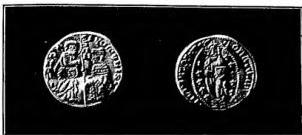
NUMISMATICS OF PAPAL ROME - Roman zecchino of Venetian type - Vatican Medal Collection.
III. GENERAL TYPOLOGY
The evolution and development of the typology of the vast array of coins in three metals minted by the papal mint of Rome for at least thirteen centuries, and which circulated on the peninsula for an equal length of time, follow only minimally the general directives of the typology of other major Italian series.The first period expresses the attempts at an autonomous silver coinage that sought to align with the current currency of more or less neighboring countries, all under the influence of the Carolingian denier or Byzantine coinage. These are the silver deniers of Adrian I (772-95), which strangely imitate the gold solidus of Benevento of Byzantine inspiration. Then come the deniers with monogrammatic types that pair the name (in abbreviation) of the emperor with that of the reigning pontiff: the so-called antiquiores, a distinct series neither well-defined historically nor politically, but which bears witness to an association on the same level of the two powers. The series spans the period and names of at least 36 pontiffs and at least 15 emperors and kings, from Leo III and Charlemagne (795-816; 801-14), and continues sporadically with and without the emperor’s name, up to Leo IX (1048-54). This is followed by the great parenthesis of the so-called senatorial coins (ca. 1184-1439), an emanation of the civic-senatorial government of Rome, represented by the provisini of mixed metal and foreign imitation, by the grossi with senatorial coats of arms and with types such as the passing lion of Guelph inspiration and Rome seated on a throne derived from the type of late antiquity, and finally by the gold ducats of Venetian imitation. The Avignon captivity period is marked by silver grossi featuring the mitred pope seated frontally on a throne, blessing, of Angevin inspiration, minted by various papal mints in Italy and abroad, and by silver bolognini with the frontal bust of the mitred pope, where the legend DE ROMA URBI or IN ROMA URBI unequivocally identifies the Roman mint.
There follows the more pronounced transitional period from the return of Urban V (1362-71) to Rome until the reform of Eugene IV (1431-47), whose rich group of coins still presents the type—denominated Avignonese—of the pope seated frontally on a throne with tiara and chasuble blessing, paired with the type of the two crossed keys, symbol of St. Peter and his authority in the kingdom of heaven. This period is also called one of conciliation between the two authorities, the papal and that of the senate or the people of Rome. With Eugene IV, the coin finally assumes an exclusively papal character; the coat of arms of the pontiff or his family, hitherto imposed on the coin only as an accessory of the reverse type (usually the two crossed and tied keys), becomes the true type of the coin itself, paired with the figure of St. Peter or St. Paul, or both, standing frontally with their respective attributes. The same typology is presented by the subsequent popes Nicholas V, Callixtus III, Paul II, etc., while the new type of St. Peter’s boat and some episodic scenes insinuate themselves. With Julius II, the first portrait of the reigning pope appears on the coin, which will be consistently present for each of his successors, albeit only on the most important and significant emissions. With Leo X, more episodic types and some emblematic types are inserted, and with Julius II, the first personifications (Roma-Concordia). Paul III presents St. Peter with the tiara seated on a cathedra. Sixtus V begins, with St. Francis, the not-rich series of saints. With Clement VIII, Paul V, etc., the large silver scudi allow increasingly complex and dynamic representations, various scenes with architectural backgrounds, panoramic views, monuments, etc. With Innocent XI, the epigraphic type begins to predominate on coins, widely exploited by his successors throughout the 18th century; even the copper, abundantly minted under Benedict XIV, bears the denomination of the nominal it represents (1 Roman baiocco, half baiocco, etc.) inscribed in a crown or cartouche. The typology of the 18th-century popes is limited to a few common types; already scarce for Innocent XIII, Benedict XII, etc., poor for the long reigns of Benedict XIV and Pius VI, it is exhausted in the 19th century with Pius VII, Leo XII, and Pius IX.
Little can be said of the art of coin engraving and stylistic evolution, which on coins can only be discerned in their general outlines and in an expression reduced to minimal terms. In the early Middle Ages, the coin reflects in its imitative types the artistic environment in which it originates, in every formal element, that is, in the treatment of types with dots and lines, in absolute schematism, in the frontal fixity of figures, in the rigidity of attitudes, in the complete lack of expression and individuality, so that only from accessories and legends can they be identified.
But, having passed the millennium and advanced into the late Italian Middle Ages, the frontal position of the human body is gradually softened by the slight lateral movement of the head; the corporeality of figures is accentuated, arms detach from the body, legs assume different positions to suggest movement, to determine a more normal ponderation, drapery softens into folds where light and shadow reappear and underline forms; thus the entire figure seems to move in an action and assumes increasingly natural attitudes corresponding to the conception of the 16th-century engraver. Finally, the details of the environment itself are emphasized, the waves of the sea beneath the ship, the floor beneath the figures of the scene, etc. When, in the 16th, 17th, and 18th centuries, the diameter of the large silver scudo permits, the law of proportions returns to prevail and dominate, with a depiction of realistic scenes of various kinds in the most diverse settings, with rich environmental details: churches and palaces, fountains, bridges and viaducts, backgrounds and panoramic views, etc. Then the advanced 17th century is reflected on the coin, where exaggeration transforms the qualities of the previous period into as many defects, in emphasis, strain, complexity, and culminates in the academic and most pronounced decadence.
The small disk of the coin, of any metal, almost never reveals the name of the engraver, who, by contrast, often signs his medallic production, since on the medal of larger diameter, first cast and then struck, he can display all his art with greater refinement. Of the initials found on coins, none can be assigned with any certainty to the engraver of the die; they belong to mint masters and more often to mint contractors, and constitute an element of production control for internal use by the coin administration. Martinori mentions a Corbolini, a Piermaria da Pescia (under Julius II), a Serbaldi (under Alexander VI), an Orfini (under Sixtus IV), to whom the dies of the famous gold multiples of this period are hypothetically and without any proof attributed; it is known that Cellini must have worked on various dies of Clement VII and Paul III; mention is also made of a Caradosso and a Camelio who worked under Leo X and signed the medals of the period, but regarding papal coinage, everything remains hypothetical, albeit plausible, even when one wishes to recognize from the style at least a minimal part of their respective monetary production.
BIBL.:
E. MARTINORI, La moneta – Vocabolario generale, Roma, 1915; ID., Annali della zecca di Roma, Roma, 1918; F. MUNAZZI, Le monete dei papi, Roma, 1896; C. CRISTOFANETTI, Le monete dei papi nella Biblioteca Vaticana, Roma, 1948; A. CAPPELLI, Dizionario di abbreviature latine ed italiane, Milano, 1912; V. anche MONETA (storia della), NUMISMATICA.
IV. PARTICULAR TYPES
1. S. Pietro; S. Pietro and S. Paolo. — Within the earliest group of Roman emissions, the various typological series are already initiated. Worthy of note are the silver denarii of Pope Adrian I (772-95), which imitate the Beneventan gold solidus not only in their types but also in their summary, schematic art, where the human figure is reduced to an appearance, a phantom in its frontality, and on the reverse is a Latin cross upon two steps.From around the year 800 onward, there emerges the series of silver denarii with monogrammatic types, already mentioned, where the lettering is carefully executed; it is precisely in this series that a bust appears, denominated as that of S. Pietro due to the epigraph extending vertically at its sides, in the Byzantine manner. It seems that the introduction of this human type—crude, schematic, frontal, composed of lines and dots—dates back to Giovanni VIII (872-82); with Sergio III (904-11), the bust assumes the conical mitre and alternates with a second bust intended to represent the pope. Agapito II (946-55) places the keys in the hand of S. Pietro, in addition to the Cross. To the second period of medieval Roman coinage belong the so-called anonymous sampierini of the Roman Senate, which already display the two frontal, nimbed busts of S. Pietro and S. Paolo on the two sides of the coin. On the gold ducats of Venetian type, the standing S. Pietro hands the banner to the kneeling Roman senator: S. PETRUS SENATOR URBIS; while on the other side is the figure of Christ, nimbed and blessing: ROMA CAPUT MUNDI SPQR. Finally, Eugenio IV, while placing the standing S. Pietro on the gold ducat, pairs S. Pietro and S. Paolo on the silver grosso. From this moment onward, with Niccolò V, Callisto III, Pio II, Paolo II, and others, the two standing saints appear constantly in frontal view, readily recognizable by their attributes (sword and book for S. Paolo, keys and book for S. Pietro). With Giulio II, they begin to vary their posture: at times they seem in conversation, at others they kiss; sometimes only S. Pietro is seated, at other times only the two busts appear. Significant are the legends: ECCLESIAE FUNDATORI, for S. Pietro; DOCTOR GENTIUM, for S. Paolo; LUMINARIA VERAE FIDEI - ROMANI PRINCIPES - FUNDATORES ROMANAE ECCLESIAE surrounding both. Paolo III favors and exalts the figure of S. Paolo VAS ELECTIONIS, to whom he gives martial poses, while S. Pietro appears seated in the act of reading from his open book. With Paolo IV, even S. Paolo...
NUMISMATICS OF PAPAL ROME — Gold multiple of Paolo II. Vatican Coin Cabinet.
appears standing with an open book. Gregory XIII (1572-85) presents St. Peter nimbate and standing, with his foot upon a stone and the open book resting on his knee, which he gazes upon: ET SUPER HANC PETRAM; the depiction is emphatic.
With the end of the 16th century, new types follow one another, and few emissions are now dedicated to these two saints. A testone of Paolo V (1605-21) presents a pictorial type: the two saints flank the Virgin Mary with the divine Son, seated frontally on a high base, as found in many paintings of the period. Urban VIII initiates the type of the two standing saints, between whom, above, is the radiant dove they gaze upon. Innocent XI (1676-89) presents a silver shield with St. Peter seated on a stool placed upon a predella, blessing: ERIT LIGATUM ET IN COELIS; the depiction is highly decorative but not appealing. Benedict XIV (1740-58) places the Hospital of Santo Spirito in the background of St. Peter’s figure: CURABANTUR OMNES; Clement XIII (1758-1769) on a testone places the two standing saints at the sides of a domed temple, surmounted by a radiant dove. Pius VI and Pius VII depict St. Peter with a radiant head seated upon the clouds. Pius VIII presents both: ISTI SUSET PATRES TUI VERIQUE PASTORES. Gregory XVI, on the gold double, inscribes around St. Peter, seated on a throne and blessing: TU REM TUERE PUBLICAM. The two saints Peter and Paul also appear as protagonists in a few episodic types. On the gold ducat of Paolo II (1464-71), St. Peter appears nimbate and standing (and not the Redeemer, as Serafini states), handing the keys to the Pontiff kneeling before him with the tiara: ACCIPE CLA(VE) RE(GNI) CELOR(UM). The tiled floor is meticulously rendered with receding squares, the first hint of localization of the scene, recalling the relief on the sarcophagus of Urban VI in the Vatican Grottoes. With Julius II (1503-1513), St. Peter appears nimbate and kneeling, receiving the keys from the standing, nimbate Redeemer before him: ACCIPE CLAVES REGNI CELORUM. The scene repeats similarly with Pius V, with the legend PORTAE INFERI NON PREVALEBUNT.
In turn, Clement VII (1523-34) presents the angel leading St. Peter out of prison; the angel, with large lowered wings, moves to the right but turns to look back at Peter, who follows hesitantly and fearfully: MEIST DOMINUS ANGELUM BUDA ET LIB(ERAVIT); this alludes to the Pope’s liberation from Castel Sant’Angelo (December 1527). The scene returns with Gregory XIII: SEQUERE ME. On the testone of Innocent XI, St. Peter is about to enter a temple but turns to lift a poor, half-naked, imploring cripple from the ground: QUOD HABEO TIBI DO. On the silver shield of Innocent XII (1691-1700), St. Peter stands nimbate, raising his right hand to address the crowds lying at his feet: GRATIA VOBIS ET PAX MULTIPLICETUR; the scene is dynamic, though Peter’s oratorical posture is jarring. Only two types of Paolo V (1605-21) concern St. Paul, both on testoni. With the legend MORTIFERA NON NOCEBUNT, St. Paul stands frontal, nimbate, holding two serpents; on either side are some standing and seated figures; at his feet is a scorpion. At the exergue, the waves of the sea localize the scene. With the inscription VAS ELECTIONIS, the conversion of St. Paul is depicted in essential but clearly Carracci-inspired elements, recalling the famous painting in the Pinacoteca of Bologna.
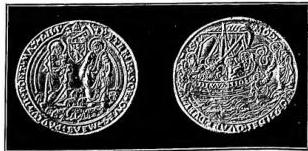
With Julius II (1503-12), the gold ducat shows the barque
accommodating St. Peter and St. Paul; it has a tall mast and a billowing sail; St. Peter is pulling the net while St. Paul holds the tiller as an oar. One of the last appearances of this type is on the testone of Clement VIII: NON PREVALEBUNT. It is a seventeenth-century edition of the old type with St. Peter alone. A new edition of the ship appears on the coins of Pius II: a large, semicircular galley with parallel elements and rich ornamentation; the ship’s silhouette on the frontal wall reveals the figure of the Pontiff with tiara and cope, seated at the stern blessing and holding a crusader banner. The Pope leans forward toward the altar, upon which stands the chalice surmounted by the Holy Host between two candelabra: DIRIGE D(OMINE) OBESSUS N(OST)ROS. This is perhaps the first type to clearly reflect a historical event, the Pontiff’s intervention in the Crusade against Mehmed II. Innocent XI (1676-89), in turn, depicts Christ radiant, standing on the left of the ship with his disciples in a grand composition on the silver shield: VENTI ET MARE OBEDIUNT EI; here, two consecutive moments of the drama are represented: on the left, where Christ gazes and extends his right hand, the waves have calmed and are safe, while on the right half, they are stirred by violent winds that have torn the sail from the mast and submerged many Apostles; these struggle among the waves and implore the Redeemer.
The theme of the ship in the storm has been treated more grandly and artistically on three exceptional gold multiples: the 10-ducat piece of Sixtus IV (1471-84); the 4-ducat piece of Paolo II (1464-71); and the 5-ducat piece of Alexander VI (1492-1503). The first is the most notable, both for its weight and because it is dated to the Jubilee of 1475. On the obverse, with the legend BIXTUS IIII PONT(IFEX) MAX(IMUS) AN(NO) IOBILEI - PETRE PASCE OVES MEAS, the Redeemer and Peter are seen standing in an open countryside shaded by groups of trees where a numerous flock grazes; on the reverse, with the inscription DOMINE ADIUNA NOS - MODICE FIDEI QUARE DUBITASTI, is a ship with a large sail upon the agitated waves of the sea; inside are the Apostles, and Paul holds the tiller. Outside the ship, amid the waves on the right, Christ appears standing upon the waters, extending his right hand to St. Peter, who is half-submerged. Above, from opposite sides, two wind heads blow upon the sail. The multiple of Paolo II presents on the obverse, with the legend PAULUS II PONT(IFEX) MAX(IMUS) AN(NO) I - PETRE PASCE OVES MEAS (1464), the Redeemer and Peter standing in an open countryside where a flock grazes; above is the Pope’s coat of arms; on the reverse, with the inscription MODICE FIDEI QUARE DUBITASTI, is a ship moving leftward with the same scene as above. On the ship’s edge is the invocation D(OMINE) ADIUNA NOS. The piece of Alexander VI bears on the obverse the inscription ALEXANDER VI PONT(IFEX) MAX(IMUS) BORGIA VALENT and the papal coat of arms surmounted by the tiara and keys, supported by two angels flanking it; on the reverse, the inscription MODICE FIDEI QUARE DUBITASTI, and again the ship on the stormy sea with the same scene as above.
These three exceptional pieces present a similar but not identical reverse, in which the inspiration from the Giottesque mosaic known as the Navicella in the portico of St. Peter’s is easily recognizable. For the obverse, two of them repeat the same motif,
C. M. CIPRIANI
PAPAL ROME NUMISMATICS - Gold multiple of Sixtus IV. Vatican Medal Collection.
(photo: Enc. Gati.)
NUMISMATICS OF PAPAL ROME - Gold multiple of Alexander VI. Vatican Coin Cabinet.
expanded and enriched with details, the type of the well-known ducat of Paul II: PETRUS PASCE OVES MEAS, where the Redeemer, recognizable by the cruciform nimbus and the long mantle, points to St. Peter at four little sheep grazing at their feet. The two types, common to two and to all three pieces, show an interdependence determined by the varying stylization of individual elements and the varying richness of details, from which it would appear that the chronology of the three pieces is not that of their respective holders, but the following: Paul II - Alexander VI - Sixtus IV; a strange fact also considering their respective artistic value, in any case exceptional for the three multiples. Of the epigraphic element, it should be noted that the phrase: PETRE PASCE OVES MEAS appears for the first time on the gold ducat of Paul II already mentioned, where that naive figuration without any landscape display shows itself to be a first attempt at an episodic scene and as such has all the freshness of an original artistic creation inspired by faith. The phrase DOMINE ADIUNA NOS will later appear on some medals of Clement VIII, with the beautiful figuration of the Apostles on the boat in danger due to a sudden storm, who implore the sleeping Christ, a type that derives precisely from the multiples now recalled, of which it is a variant. The phrase QUARE DUBITASTI will be inscribed on the giulio of Clement VII next to the episodic type of Christ standing on the surface of the waters saving St. Peter half-submerged by the waters themselves, which is precisely a part of the figuration of these multiple pieces or true medallions.
2. Noah's Ark
It appears on the gold double and then on the silver half-scudo of Innocent XII (1691-1700). On the first piece, the scene is more complex: the ark is a rectangular hut-like structure covered by a gabled roof, supported by an oval boat; it sails on calm waves from which a small island emerges; from the right, a dove appears in flight toward the ark bringing the olive branch: NUNTIA PACIS. On the half-scudo, only the ship with the ark, its hatch open, resting on the mountain emerging from the pacified waves is seen: FACTUS EST IN PACE.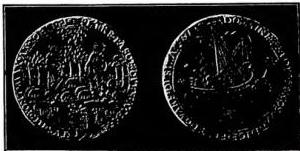
3. The Veronica
On the gold ducat of Paul II (1464-1471) appears a standing frontal female figure, veiled and nimbate, who holds with both hands extended before her the sudarium with the image of the Holy Face, recognizable by the cruciform nimbus: it is the Veronica in a rough and schematic style, yet impressive.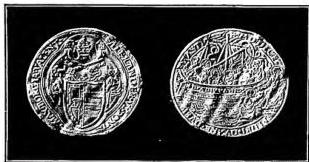
4. Papal Iconography
Already from the early period of coinage, on the silver denarius of Pope Adrian I is a frontal beardless bust with bare head, a crown of hair on the top of the head, and the pontifical mantle, which must be understood as the papal bust.In the rich group of monogrammatic emissions, the antiquiores, a beardless bust with a crown of hair and pontifical mantle is inserted, which the circular legend allows to identify as the bust of Pope Sergius III (898-900). This bust alternates with that of St. Peter, also duly named. The example will be followed by Benedict VI and others. Boniface VIII (1294-1303) on the silver grosso paparino of the Ponte della Sorga mint inserts another frontal mitred bust, with a cross fibula and oblique key in the right hand; the legend reads: DOMINI BO(NIFACI) PAPAE. No intent of iconographic realism, but the pontiff in his vestments and the insignia of his sacred and secular authority. The silver grosso of Clement V (1305-14) of the same mint follows, with the half-figure of the pope frontal, with conical mitre, mantle and fibula, oblique cross, blessing; finally, John XXII (1316-34) inserts the full figure of the mitred pope seated frontal on a throne and blessing. The type appears in Rome with the half-grosso of Urban V and the grossi of Boniface IX, Innocent VII, Gregory XII, etc. The figure of the pope is analogous to the figure of the king on the gigliati of Robert, Joanna, and René of Anjou and then on the Aragonese gold reali. Still, Martin V and Eugene IV present the same papal type.
But already with Eugene IV, at a certain point, the personal coat of arms of the pope begins to take stable residence on the coin, and then with Sixtus IV (1471-84) on an emission of silver grossi of the Roman mint, the true individual portrait of the Pontiff makes its first appearance: a bust to the left, beardless, with bare head, with floral stole and oval clasp. The iconographic type is well rendered in individual details, small nose and small closed mouth, open eye, well-drawn ear; the bust interrupts the circular legend below, reaching the outer peripheral line of the coin blank. Julius II, in turn, places his portrait on various gold and silver denominations; the bust is more developed, turns to the right, vivid and magnificent the portrait in all its individual elements. Thus do, but on few emissions, predominating the coat of arms, all successors with few exceptions (Paul IV, Gregory XV, Alexander VII, Clement IX do not have the portrait on the coins of Rome). Alexander VIII has magnificent and realistic portraits, bareheaded, with drooping mustaches on the pointed beard; on some pieces he assumes the camauro and mozzetta. Innocent X on the scudo of the Holy Year 1650 presents himself with the triregnum and cope. Pius VI places his portrait on various scudi and half-scudi of Rome; Pius VII on a single scudo.
Not many episodic types concern the figure of the pontiff. One of the most eloquent is that of Leo X (1513-21): PETRE ECCE TEMPLUM TUUM: the Pope with mitre and cope kneeling, who presents with both hands a temple to St. Peter seated on a throne before him, perhaps one of Bramante's or Giuliano da Sangallo's projects. Clement VII has a more significant type on a gold double ducat, likely a coinage by Cellini; on the obverse with the inscription: CLEMENS - UT OMNIS TERRA ADORET TE, is the bearded Pope, with tiara and cope, kneeling to the right, and Emperor Charles V, bearded, with imperial crown and mantle, kneeling to the left, in the act of lifting a heavy Cross placed obliquely between them: on the reverse with the legend UNUS SP(IRITU'S ET UNA FIDES ERAT IN EIS, Peter and Paul standing facing each other). This ducat commemorates the peace stipulated in June 1529 between the Pope and the emperor.
Pius V is the first pontiff who depicts himself praying and kneeling at the foot of the Cross: ABST NISI IN TE GLORIARI. The type will be repeated by Clement VIII. Urban VIII on a giulio depicts himself kneeling bareheaded before St. Michael, who, armed and winged, appears among the clouds with a scale in his left hand: TE MANE TE VESPERE.
Innocent XII (1691-1700) has three episodic figurations; on a large scudo, in a well-distributed scene with an effective background and adequately rendered environment, the Pope appears seated on a throne under a baldachin among standing guards near and behind him, and among prelates, in the assembly of cardinals all seated around the hall: LOQUETUR PACEM GENTIRUS. The scene is presented in two variants for its different distribution. On a half-scudo, Innocent XII appears kneeling with arms crossed on his chest and leaning on a prie-dieu, looking up at the radiant dove appearing among the clouds: FIAT PAX IN VIRTUTE TUA. Finally, on a testone, the Pope, with tiara and cope, seated on a podium between two cardinals, listens to the oration ROGATE QUAE AD PACEM SUNT that a priest reads from a pulpit; next to the reader are two trumpeters; it is the same scene as the medal of Clement VIII (1592-1605): IUBILEI INDICTIO.
BIBL.:
A. Sambon, Les monnaies pontificales, Paris 1910; F. Muntoni, Le monete dei Papi e degli Stati pontifici, Roma 1972-1974; P. Grierson, Coins of Medieval Europe, London 1991; V. MONETA (storia della); V. MEDAGLIA;
V. ICONOGRAFIA
A. M.Finally, Clement XI (1700-21) presents on a magnificent shield a complex scene designated by the phrase: VOS DE TIRONO; against the architectural backdrop of the interior of the Liberian Basilica, the Pontiff, seated on a throne, reads the homily from a book held open by a priest kneeling before him, assisted by cardinals and before a numerous populace. The scene is crowded to the point of implausibility, yet it retains the realistic character of solemn ceremonies.
5. The Magi
They appear only once, on the gold piece of 2½ ducats of Leo X: LUX VERA IN TENEBRIS LUCET. Crowned, with mantles over their shoulders, they ride toward the left, guided by the star that shines from above, which they regard. The horses descend from the interior, so that only the first is fully visible, while of the other two only the hindquarters are seen. Only seven legs are traced. The three riders are equal in height and posture, and their silhouettes are parallel; they visibly carry the three vessels of offerings. The composition is naive in its simplicity and parallelism of the various elements, and it is believed to allude to the comet that appeared in Europe at the end of 1513, considered a good omen for the Pope’s reign.6. The Nativity
It appears three times in the 16th century. Leo X inaugurates the type on a half-giulio from the mint of Pesaro; a small temple-like house on three steps, with a triangular pediment, occupies the left side: it is open at the front, revealing the heads of the two quadrupeds; above is a star. At the foot of the house lies the Infant Jesus on the manger; before Him are the Mother and St. Joseph, bent in adoration. The naive composition ignores the relationship of dimensions, so that the human figures exceed the height of the house: AD TE PISAURUM.A second time, the Nativity appears on the triple giulio of Clement VII, commemorating the opening of the Holy Year on the day before Christmas: MODIE SALUS FACTA EST. The Divine Child lies at the center on the manger; above Him converge the heads of the two quadrupeds, protruding from a stable; at the sides are the Virgin and St. Joseph in adoration, and above shines the star. The larger diameter of the piece and a more artistic conception of the type dictated to the artist a more logical, if simpler, distribution of the scene, which achieves great effect in its simplicity.
On the testone of Gregory XIII LETAMINI GENTES, perhaps also on the occasion of the opening of the Holy Year, a similarly designed scene returns schematically.
7. The Bust of Christ and the Figure of Christ in Episodic Types
Draped, with long, soft hair falling on the neck and a short, pointed beard, the bust of Christ appears initially on the gold shield of Julius III: VIA VERITAS ET VITA, evidently by the hand of Rossi, of whom there is a medal of Pius V signed with the same bust; the bust returns on a silver piece of the same Pius V: EGO SUM LUX MUNDI and again on the gold shields of Gregory XIII and Sixtus V: BEARE SOLEO AMICOS MEOS.Episodic types with the figure of Christ are not numerous. They begin with Julius II, who on the double giulio places the Redeemer handing the keys to St. Peter: ACCIPE CLAVES REGNI CELORUM. This type more adequately and logically interprets the first investiture of the dignity and authority of the papacy, transmitted from Peter to the Pontiff on the double of Paul II, as previously mentioned. The type seems inspired by the painting of Perugino. On a triple silver giulio of Leo X is the scene: DO VOBIS PACEM MEAM; the standing Redeemer, with long hair falling on His shoulders, a cruciform nimbus, and a long mantle, blesses the nimbed and kneeling Apostles. The scene is well rendered and is thought to allude to the pardon granted by the Pope to the dissenting cardinals for the schism of Pisa. To Clement VII is attributed the famous double gold ducat, known only from an impression by Scilla in the Vatican Library: ECCE HOMO - PRO ED UT ME DILIGERENT; Christ stands seminude, nimbed, with a mantle over His shoulders and His hands bound before His body. It is believed that the die was made by Cellini. Less successful and unclear is the scene on the testone of Paul III, Christ speaking to the Apostles: TU AUTEM IPSE ES. No better is that of the Baptism of Jesus on the testone of Gregory XIII: SIC DECET IMPLERE; enclosed in too narrow a field, the figures give the impression of excessive crowding. Better, however, is the scene on the testone of Pius V: VENITE AD ME OMNES ET EGO REFICIAM VOS, where the nimbed, standing Christ is in the act of speaking to three poorly dressed individuals prostrate and imploring Him; the scene is effective and realistically treated, especially in the depiction of the poor supplicants; it is later repeated on the testone of Gregory XIII. Also noteworthy is the large silver shield of Clement XI: VIDERUNT OCULI MEI SALUTARE TUUM, where the radiant Infant Jesus is in the arms of Simeon, near whom is the kneeling Virgin Mother and behind her St. Joseph, a winged angel, and an attendant. Finally, on the shield of Innocent X IN VERBO TUO is the radiant Redeemer blessing St. Peter, who kneels before Him.
8. The Virgin Mother
Paul III (1514-49) inaugurates the type of the Virgin Mother on the silver giulio, with the beautiful group of Mary in half-bust with the Divine Son: VIRGO TUA GLORIA PARTUS. The type is repeated by Julius III, Gregory XIII, and Clement VIII, by Urban VIII (1623-44), who renders it more artistically on the giulio MONSTRA TE ESSE MATREM, and by Clement X (1670-76), who on the gold shield SUBLIMIS INTER SIDERA presents the group on the clouds.Then comes the Virgin with the Divine Son seated frontally between St. Peter and St. Paul on the testone of Paul V (1605-21), a type that evidently repeats one of the many pictorial compositions found in numerous variants in the monumental canvases of our eighteenth-century churches.
Gregory XV inaugurates on various pieces the magnificent figuration of the Immaculate Conception: SUB TUUM PRAESIDIUM; the Virgin stands on the crescent moon resting on the clouds, hands joined in an oval of flames, with her head crowned by stars. This figuration prevails for a long time with Urban VIII, Innocent X (UNDE VENIT AUXILIUM MIHI), Alexander VII (VIRGO CONCIPIET); with Clement IX on the quadruple CANDOR LUCIS AETERNAE and with Clement X on the testone: CUM ME LAUDARENT SIMUL ASTRA MATUTINA. A variant appears with Clement XI on the gold quadruple: the Virgin stands on the globe, and beside her is the seminude Divine Son, with a radiant head, driving the cruciform lance into the jaws of a dragon lying at their feet: CAUSA NOSTRAE LAETITIAE, and with Benedict XIV: MACULA NON EST IN TE - TOTA PULCHRA ES.
Innocent XI, in turn (1676-89), presents on the quadruple the Virgin assumed into heaven among the clouds, radiant, frontal, with a crown of seven stars around her head; beneath her is the rainbow and clouds: FUNDA NOS IN PACE. On another quadruple and on a testone is a pictorial type: the Virgin with the Divine Son seated on a throne, frontal, at whose feet are kneeling and praying St. Augustine, St. Francis, St. Lawrence, and St. Stephen.
Finally, Clement XI places on a silver shield the Virgin of Santa Maria in Trastevere, nimbed and crowned, seated, frontal, on a throne, with the Divine Son on her knees and the four-armed Cross in her right hand. Two large angels stand at the sides of the throne; at the feet of the Virgin kneels Pope Innocent II: DILEXI DECOREM DOMUS TUAE. The church was, in fact, being restored by Clement XI.
9. Biblical Scenes
They are few and are found on the coins of Gregory XIII (1562-85), Clement X (1670-1676), and Innocent XII (1691-1700).BIBL.:
F. Muntoni, Le monete dei Papi e degli Stati pontifici, Roma 1972-74; C. Serafini, Le monete e le bolle plumbee pontificie del Medagliere Vaticano, Roma 1910; A. Capobianchi, Le monete pontificie, Roma 1896; G. Cinagli, Le monete de’ Papi descritte ed illustrate, Ascoli 1848; E. Martinori, Annali della Zecca di Roma, Roma 1918; V. NUMISMATICA, MEDAGLIA.
C. Rossi
Gregory XIII, on the testone SIC EXALTATUS SANAT, presents at the center of the scene a column surmounted by a winged dragon, the heraldic animal of his coat of arms; to the left stands the tall figure of Moses, who touches it with a rod and points it out to the crowd gathered at the base of the column, lying or seated. On a second testone: SIGNA INFIDELIBUS, the figure of Moses, radiant and cloaked, kneels to the left, placing on the ground a sinuous rod ending in the figure of a winged dragon, and gazes toward the Eternal Father, whose bust emerges from the clouds above. In turn, Clement X (1670-76) places on the gold quadruple and the silver testone the inspired figure of King David,
crowned and bearded, draped, seated and playing the
lyre: NE PROFICIAS ME IN TEMPORE SENECTUTIS.
On the silver shield of Innocent XII (1691-1700):
EGREDIATUR POPULUS ET COLLIGAT, the Hebrews in the
desert gather manna. The scene, somewhat trite,
is animated and interesting in the variety of its constituent
elements: in the foreground and background, men, women, and
children, lying or seated, display the joyful surprise of the
event; in the upper right background are the clouds from which
the manna falls, while to the left other clouds advance to darken
the sky; in the central background is the view of the encampment.
On a half-shield of the same: PARATE VIAM DOMINI, the scene
of St. John the Baptist is presented, standing and preaching to
the crowds seated on the slopes of a mountain. The seminude,
powerful, and energetic figure of John, who holds the labarum
in his right hand and extends his left in an oratorical gesture,
stands out among the crowd of bearded and cloaked elders who
listen. Also noteworthy is a shield of Gregory XVI:
LUMEN AD REVELATIONEM GENTIUM, depicting the old Simeon
taking the Child into his arms from the Mother; beside them are
St. Joseph with the basket of two doves and the aged Anna.
10. Saints and Blesseds
They are few and, with some exceptions, appear only from the 17th century onward, and thus in that cold, academic, and emphatic style that characterizes the decadent art of that period.Sixtus V (1585-90) inaugurates on the silver shield the
depiction of St. Francis of Assisi, who, nimbed and kneeling,
with arms outstretched, is receiving the stigmata from rays
emanating from a Crucifix suspended above. Before the Saint
is a rocky landscape; behind him rises a large leafy tree that
shades him: **IN TE SIGNUM NOSTRAE REDEMPTIONIS - IN
TE SITIO**; the scene, magnificent in its emotional religious
sentiment, still presents in the landscape the setting of the miracle.
On a double of Clement XI (1700-21) there is a variant of the
same theme: St. Francis, kneeling before a small Crucifix and a
book placed on the rock, gazes upward with open arms toward
a seraph from which the rays of the stigmata emanate. This
depiction is even more intimate and moving.
St. Michael is introduced into the typology in several variants
by Urban VIII (1623-44) on the gold quadruple; he is armed
and winged, now standing on the ground, now suspended in the
air, now with the cross-bearing shield and piercing Lucifer with
his lance. The latter, with bat wings, horned head, bestial face,
and serpentine tail, writhes at the Saint’s feet, attempting to
escape: VIVIT DEUS. Elsewhere, on silver shields: **TE MANE
TE VESPERE**, on the plane of the scene are three other demons
attempting to rise from the flames that envelop them. On another
shield, the scene is simpler and more restrained: the Pope,
kneeling, gazes at St. Michael, who, armed and holding the scales,
appears among the clouds above. A more complex variant appears
on the shield of Innocent XII (1691-1700), where St. Michael,
winged and in flight, strikes down Satan crouching at his feet
amid flames.
Alexander VII (1655-67), on a shield **DISPERSIT
DEDIT PAUPERIBUS**, depicts St. Thomas of Villanova (canonized
by him on 1 November 1658) giving alms to a crippled poor man.
Clement X (1670-76) introduces into the typology St. Venantius,
standing frontally, nimbed, with the cruciferous banner and a
small city; then Pius V, in a poorly constructed scene, presents
the Saint again, kneeling before the Crucifix placed on the altar,
while turning back to gaze at an angel in flight who presents him
with a cloth on which the Battle of Lepanto is painted. Innocent XI
(1676-89) introduces St. Matthew in two variants, now seated on
a throne, now seated on clouds with an open book but gazing at
an angel in flight who seems to speak to him. The two variants
are similar in the emphatic attitude of the Saint, the exaggerated
torsion of the body, and the overly broad and abundant drapery
of the garments; here too, art has betrayed the concept, rendering
it with emphasis and, above all, with an absolute lack of
recollection and religious inspiration. Alexander VIII, in turn,
presents St. Magnus the bishop and St. Bruno the anchorite;
Clement XI presents St. Frances of Rome, and then St. Clement,
who appears in two variants: seated on clouds with the palm and
anchor: DOMINUS ELECIT TE HODIE; or kneeling before the Lamb
lying dead on a high rock: DONA NOBIS PACEM; then St. Crescentinus
on horseback with helmet and armor, piercing the dragon; finally,
the guardian angel in flight leading a child by the hand and
pointing to the radiant sky amid clouds. Clement XII presents
St. Andrew Orsini, kneeling in pontifical vestments, before whom
stands a seminude angel with a mitre: **GENUS
ALTO A SANGUINE**. On the testone of Pius VIII are St. Exuperantius
and St. Sperandia, both standing; and on the half-shield of Gregory XVI,
St. Romuald kneeling with the Crucifix before a rock on which are
a skull and a staff. The scene is shaded by trees.
11. Architectural Monuments and Panoramic Views
Apart from the giuli of Leo X for the March of Ancona, on which appears a depiction in two variants of a domed temple flanked by two bell towers (perhaps St. Peter’s Basilica) and on the reverse the Pope kneeling and presenting the temple itself to St. Peter, but without bell towers: PETRE ECCE TEMPLUM TUUM (and the gold shield of Pius V from the Avignon mint, with the bird’s-eye view of Avignon), it seems that Clement VIII (1592-1605) was the first to employ architectural types; on his gold shield is the façade of the lateral entrance of the Lateran Basilica, with two bell towers on either side, between which are the busts of St. Peter and St. Paul, gazing: GLORIOSI PRINCIPES ROMA; it is meant to commemorate the works carried out by the Pope in the transept of the Basilica. The depiction is exceedingly schematic.Under Clement X and his successors, the large silver shields and half-shields provide the engraver with a field better suited to complex representations that evoke their respective merits in constructions and reconstructions. Clement X (1670-76) depicts the port of Civitavecchia with the arsenal and fortress, and in the water large sailing ships: UT ABUNDETIS MAGIS; the type is highly effective and alludes to the fact that the Pope made it a free port. Innocent XI presents the façade of St. Peter’s Basilica dominated by the dome: PORTAE INFERI NON PRAEVALEBUNT. Innocent XII (1691-1700) depicts the port of Anzio: VENTI ET MARE OBEDIUNT EI, in memory of the works carried out there, and on the quadruple gold coin of 1694 (DAT OMNIBUS AFFLUENTER) the fountain of Piazza S. Maria in Trastevere, restored by the Pope. Clement XI (1700-21) features the obelisk and fountain of Piazza del Pantheon: PONTIS ET PORTUS ORNAMENTO (in another representation framed by the surrounding palaces on three sides); the round church of S. Teodoro al Palatino: IN HONOREM S. THEODORI MAR(TYRIS); the two-tiered viaduct of the bridge of Civita Castellana against the backdrop of the city and landscape: PROSPERUM ITER PACIET - NON S(OLUM) CIVIT(ATIS) CASTELLANAE; the panoramic view of Urbino, his birthplace, with its most characteristic monuments and the viaduct in the foreground: CIVITAS URBINI; the façade of the Ducal Palace of Urbino on two longer sides: RESTITUISTI MAGNIFICENTIAM; the Pantheon isolated with its two bell towers: DILEXI DECOREM DOMUS TUAE; the port of Ripetta on the Tiber with the street and the churches of S. Rocco and S. Girolamo, and in the foreground the personifications of the Tiber and Aniene rivers reclining: LAETIFICAT CIVITATEM; the outline of the Capitoline Palaces against the personifications of painting, sculpture, and architecture: DIGNIS VICTORIAM. Finally, Clement XII, on a half-shield, places the façade of the church of S. Giovanni dei Fiorentini in Rome: DECUS PATRIAE, etc. However, the architectural types depicted on the papal annual medals are even more numerous.
12. Personifications of abstract concepts. Allegories. -
These are not many and all date from the second half of the 16th century; they can be divided into two groups: the first of personifications that imitate classical Roman types; the second of personifications created ex novo.
To the first group belong the following types of Julius III (1550-55): Rome, in Amazonian form, seated on the seven hills with a crown in her outstretched right hand: OMNIA TUTAS VIDES; CONCORDIA - ALMA ROMA, a female figure seated before an altar with a patera and double cornucopia; MELIORE MANENT, a female figure of Rome-Minerva, helmeted, standing with spear and shield, her foot on a helmet. To the second group belong the following types of Gregory XIII: AGGREGATA RELIGIO, a female figure seated with keys, who with her right hand embraces a complex structure with a triangular pediment and dome; NON APPARENTIUM EST FIDES, a female figure seated frontally with a chalice and long Cross; NUNQUAM DEFICIET, a female figure standing frontally, leaning on a long Cross, with the tiara and keys in her left hand: this is the Church; IUSTITIA RESURGENS, a female figure frontally with a drawn sword and scales; SEMPER OPERIBUS AUCTA, a female figure with chalice and long Cross; UT NON DEFICIAT - NUNQUAM DEFICIET, a female figure standing who supports the tiara with her right hand and the keys with her left.
Sixtus V (1585-90), after repeating the various previous types, introduces SECURITAS PAUPERUM, a female figure seated before a lit altar adorned with keys and the tiara, against which leans a lit torch; a revival of the classical type of SECURITAS of Nero. Clement VII presents the group IUSTITIA PAX DEOSCULATAE SUNT, the first with sword and scales, the second with an olive branch, in the act of kissing. Clement X (1670-76) has Clementia and liberalitas in the classical scheme, but in the style of the period, academic and cold: CLEMENTIA MALUM MINUIT - LIBERALITAS BONUM AUGET. Alexander VIII (1689-1691) with the legend LEGIONE AD BELLUM SACRUM INSTRUCTA presents a female figure standing with the tiara on her head, a temple on her right, and in her left hand the Roman legionary standard but surmounted by the double-headed eagle, which is that of the papal coat of arms. Innocent XII (1692-1700) with COGITO COGITATIONES PACIS has a veiled female figure, seated and leaning against an altar surmounted by the tiara surrounded by two laurel branches, and gazing at a Cross that she supports with her left hand: at her feet are scattered some weapons; with NOVIT IUSTUS CAUSAM PAUPERUM is a seated female figure, Caritas, with a child at her breast and two others at her sides, a reminiscence of late Roman Pietas; with OPUS IUSTITIAE PAX is a female figure standing frontally, seminude, with an olive branch in her raised right hand and her left arm resting on a large sword; finally, with EGENO ET PAUPERI he has a similar draped female figure with a flame on her head, emptying a cornucopia onto the ground, with a theatrical gesture of the Roman prototype of liberalitas.
Clement XI (1700-21) on the quadruple and the testone A DEO ET PRO DEO places a draped female figure, standing, frontal, with a child in her arms and two naked genii standing at her sides who pour the contents of two cornucopias onto the ground. Clement XII with FOEDUS EST INTER ME ET TE presents Justice and Abundance seated, clasping right hands. Benedict XIV has the type of the Church seated on clouds with a radiant head and in her hands the keys and a small temple. Clement XIII offers a variant with the piece SUPRA FIRMAM PETRAM, a type repeated by Clement XIV: FIAT PAX IN VIRTUTE TUA, and by Pius VI: AUXILIUM DE SANCTO, while Leo XII has the Church seated on a throne with a long Cross, chalice, and staff: SUPRA FIRMAM PETRAM - POPULIS EXPIATIS. It is easy to observe from this brief review that all the personifications repeat statuary types dear to the academic art of 18th- and 19th-century Italy.
13. Varia. - Still to be briefly mentioned are various types that do not fall into the categories considered so far.
With Leo X (1513-21) there is the beautiful representation, of classical reminiscence and allusive to his name and house, of a walking lion placing its right paw on a globe; often above it flies a Victory in the act of crowning him. On the testone of Paul III: APTO PRAECURRE PLENI is a charioteer in a galloping quadriga, also of classical inspiration. Julius III (1550-55) writes PROVIDENTIA around a square altar adorned with a patera and lituus, a revival of a well-known and common Roman type. Clement VIII (1592-1605) introduces on the gold shield a dove resting on the ground with wings raised: UNA EST COLUMBA MEA. Alexander VII (1655-67) places on the testone NEC CITRA NEC ULTRA an arm holding a balance in its hand; and then on the quadruple HAEC AUTEM QUAE...
NUMISMATICS OF PAPAL ROME
14. Inscribed Cartouches. - It appears that Alessandro VII Chigi (1655-67) was the first to introduce the practice of inscribing on his gold doppie those legends so significant and filled with the highest Christian-moral teaching, which above all aim to moralize the use of money and wealth in general. These legends soon became the preferred theme of coins, the epigraphic type due to true calligraphers, who gradually replaced the artist-engraver of the die, so that the coin, having lost its artistic interest, assumed that of a means of moralizing society. This type, consisting of an epigraph that sums up and encapsulates a thought and a lesson, is usually contained within a crown or, more often, a cartouche, which takes on the most varied shapes, dictated by innovative spirits. Moreover, the papal coats of arms had already modified their peripheral shape almost with every emission.
Alessandro VII (1655-67) on the gold doppio ducato writes in a four-line cartouche, between two laurel branches, NON EX TRISTITIA AUT EX NECESSITATE, and on the silver grosso and mezzo grosso HILAREM DATOREM DILIGIT DEUS - TEMPERATO SPLENDEAT USU. Innocenzo XI (1676-89) already imposes numerous inscriptions on the quadruple, doppie, gold scudo, and silver scudi and mezzi scudi, on the very numerous testoni and giuli. Innocenzo XII (1691-1700) inscribes on testoni and giuli: NOLI AMARE NE PERDAS - NON SIT TECUM IN PERDITIONEM - PRAEOCCUPEMUS PACIEM EIUS - TAMQUAM LUTUM AESTIMABITUR - QUI MISERETUR BEATUS ERIT - ROGATE EA QUAE AD PACEM SUNT - ELEVAT PAUPEREM - NE OBLIVISCARIS PAUPERUM - PECCATA ELEMOSYNIS REDINE - QUI VIDET TE REDDET TIBI - DA PAUPERI. Clemente XI (1700-21) has numerous exhortations on doppie, gold scudi, and scudi, all concerning the use and abuse of money, the hunger for gold and its harms, the duty to help the poor and to employ wealth in good works. Innocenzo XIII, Benedetto XIII, Clemente XII, Benedetto XIV, and Clemente XIII adopt others still, similar in meaning.
15. Sede Vacante and Holy Year. - The series of sede vacante coins consists of those minted in Rome and in some local papal mints during the intervals between the death of a pope and the election of his successor, beginning with the vacancy of 1521. These series comprise a few pieces, usually in silver, more or less rare depending on the duration of the vacancy. On the obverse of each piece is the coat of arms of the cardinal camerlengo, surmounted by the crossed, tied keys and the pavilion; on the reverse are types usually imitated from the immediately preceding period. The most numerous series are those of the sede vacante of 1655, which lasted three months, for which quadruple and doppie in gold, scudi, testoni, giuli, etc. in silver were minted; those of 1677, for which gold and silver scudi, testoni, and giuli were produced; those of 1669 (quadruple, doppie, gold scudi, and almost all silver denominations); of 1689 (gold quadruple, silver scudi and testoni), and so on. From the sede vacante of 1730 onward, gold zecchini, silver scudi, etc. were minted.
The series of Holy Years, following the institution in 1500 by Alessandro VI of the Holy Door, or aurea, presents among the most frequent types the ceremonies then initiated of the opening or closing of the Door. The most common coins usually bear the date with the legend ANNO TURILAEI, and the type of the Holy Door, closed, variously adorned with the Cross, the Shroud, angels, etc., whereas the episodic types depicting the ceremonies were reserved for both medals and large silver scudi. Large quantities of coins were minted on such occasions in various metals and in all denominations by every pontiff; thus Clemente VII (1525) minted a 10-ducat gold piece, the triplice giulio, etc.; Giulio III (1550) gold scudi, testoni, giuli, grossi, etc. in silver; Gregorio XIII (1575) and Clemente VIII (1600), only silver; Urbano VIII (1625), Innocenzo X, Clemente X, etc. gold scudi and doppie, silver scudi, etc.; and so the successors up to Pio VI (1775), who minted only the silver giulio and grosso. - Vedi tavv. CXXVI-CXXVIII.
BIBL.:
For general works on papal numismatics, see the bibliography under V. MONETA; for specific studies: F. Muntoni, Le monete dei papi e degli Stati pontifici, 4 vols., Rome 1972-74; A. Serafini, Le monete e le bolle plumbee pontificie del Medagliere Vaticano, Vatican City 1910-27; C. Cavedoni, Saggio di osservazioni sulle monete di Modena e degli Estensi, Modena 1849; G. G. Belloni, Le monete romane dell'età repubblicana, Milan 1960; and the periodicals Rivista italiana di numismatica, Milan, and Numismatic Chronicle, London. For Holy Year coins: A. Serafini, Le monete e le medaglie pontificie del Giubileo, Rome 1900; and for sede vacante issues: F. Muntoni, Le monete pontificie della sede vacante, Rome 1963.
G. Moretti
Secondina Lorenza Cesano