Machine translation of the 1948–1954 Italian original. The original text is authoritative.
MITRE. - Liturgical headdress, the distinctive insignia of the pope, cardinals, and bishops, to whom it belongs by right; and also of abbots, prelates, and canons, but by virtue of a particular privilege. Its present form is that of a pleated headdress, with the two parts ending in points (cornua), kept upright by a reinforcing lining and joined by an intervening fabric, while the rear part is adorned with two ribbon-like appendages (fasciae, vittae, penduli, fanones, infulae).
Its origin and antiquity are disputed; the first certain testimony dates from the eleventh century and from Rome. Leone IX (1049-53) granted the Roman m. to Archbishop Everardo of Treviri, who had accompanied him to Rome, pro investitura ipsius primatus (of the Church of Treviri), so that he and his successors might use it pro ecclesiastico officio, in remembrance of their dependence on Rome (Jaffé-Wattenbach, II, 4158). Two years later (1051) Leone IX granted it to the cardinals of the Churches of Besançon and Bamberga for specified occasions. Little by little its use spread, and in the second half of the twelfth century the m. was in general use among all bishops, with or without the pope’s explicit permission. The first certain grant to abbots dates from 1063. At times the m. was also granted to lay princes, for example by Nicolò II (1059-61) to the Duke of Bohemia, and by Lucio II (1144-45) to the King of Sicily. When crowning the emperor, the pope first placed upon him the m. clericalis, then the imperial diadem (Ordo Rom., XIV, 105: PL 78, 1241).
According to richness and use, three kinds of m. are distinguished: the simple m., of white silk (or white linen cloth) with red fringes (used for blessings, offices for the dead, and on Good Friday); the gold-fringed m. (auriphragiata), of cloth of gold without other ornament (used in Advent, in Lent except on the Sundays Gaudete and Laetare, and at vigils; also at Mass and Vespers at the throne or cathedra); the third, precious, adorned with embroidery in gold, silk, and precious stones (on the greatest feasts, when going to the altar and returning to the sacristy, in imparting the solemn blessing, and in solemn processions). The m. does not follow the liturgical colours.
The m. is always removed when the bishop recites a prayer (I Cor. 11, 4), or when the deacon chants
the Gospel, and at the chanting of the Benedictus and the Magnificat.
Among the Greeks and in the Eastern rites, the m. does not have the Latin form, but that of a royal crown surmounted by a cross; it has been used since the fifteenth century, first by patriarchs and metropolitans, then also by the other bishops; only the patriarchs of Alexandria had already used, since the tenth century, a liturgical headdress in the form of a turban.
BIBL.: J. Braun, Die liturg. Gewandung im Ocrident und Orient, Friburgo in Br. 1907, pp. 424-98 (Italian trans., Torino 1914), pp. 147-157; M. Righetti, Man. di stor. liturg., I, Milano 1950, pp. 531-36; Th. Klauser, Der Ursprung der bischöf. Insignien und Ehrenrechte, Krefeld 1930, pp. 17-22. Pietro Siffrin
THE MITRE IN ART. — The form of the
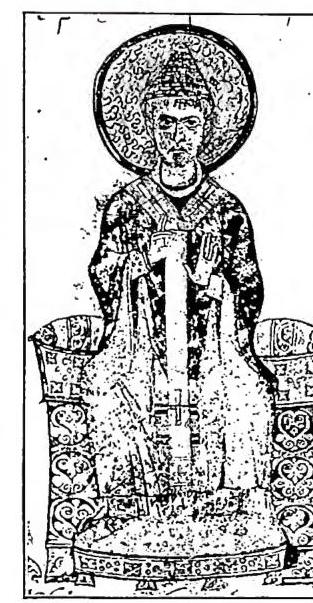
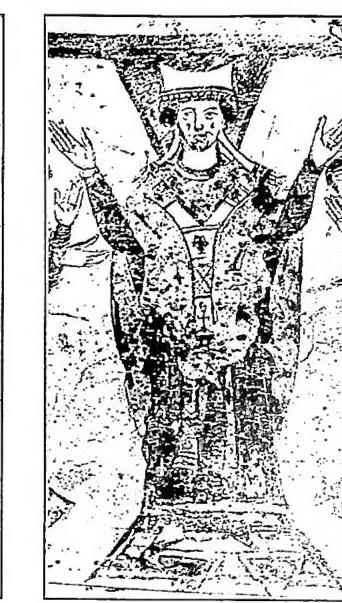
m. underwent transformations over the centuries. Of the earliest examples, shaped like conical caps terminating in a point, perhaps the oldest is found in the Exultet roll of the Archive of the cathedral of Bari, from the beginning of the 11th century. From the conical form one passes to the rounded form, subsequently flattened in the middle at the top, thus producing two lateral bulges (v. COLONNA). From the lateral bulges derive, through further transformation, the rigid cornua, which thereafter always retain this form, even when the m. is placed on the head no longer with the points at the temples, but at the forehead and nape, and the pendants are attached at the bottom of the rear horn rather than in the depression. Thus one returns to the primitive cone-shaped form, but one that has become bellows-shaped. The proportions, however, have changed; from the 14th century onward the m. becomes considerably elongated, and from the 16th century onward the sides of the horns become increasingly curved, until they form, as can also be seen in the present-day m., a true pointed arch. Examples of m. dating from the 12th–14th centuries are preserved: in Italy, those of white linen from the church of the Most Holy Trinity in Florence, the cathedral of Anagni, the parish church of Castel S. Elia, and Ferentino—the latter believed to have belonged to Celestino V—and, in damask, that of Giovanni XXII, in the Museo sacro of the Vatican Library and in the Abbey collection in Turin; there are also m. decorated either along the border around the edge (in circulo) or from the tip of the horn to the edge (in titulo). At first the ornamentation was made with galloons; from the 13th century onward, both the circulus and the titulus, as well as the pendants, were often decorated with embroidered figures. Beautiful examples of embroidered m. (v. STOFFE) from the 12th and 13th centuries are preserved in the Treasury of the cathedral of Anagni, in S. Zeno at Verona, and in the cathedral of Cividale; and, from the 14th century, in the cathedral of Fiesole, the National Museum of Ravenna, the cathedral of Urbino, and S. Pietro in Vincoli in Rome. The embroidery sometimes extends so far as to cover the entire front of the m., so that the “titulus” is wholly embroidered with figures or ornamentation. An example from the 14th century of a wholly embroidered m. is that in the Cluny Museum in Paris, made of white silk worked in black with extremely delicate representations of the burial of Christ, and with a border featuring half-length figures of Apostles within architectural frames. At the end of the 16th century and during the Baroque period, the m. was no longer decorated with
(phot. Enc. Catt.)
MITRA — Pontiff with a conical m., detail of one of the miniatures in Exultet no. 1 (ca. 1000) — Bari, Cathedral Archive.
(phot. Enc. Catt.) MITRA - Bishop with rounded m., Detail of one of the miniatures of the Exultet no. 2 (12th century) - Troia, Cathedral.embroideries with figures or precious stones, but with rich, applied embroidery of an ornamental character: e.g., the sumptuous m. of Freiburg Cathedral. - Vedi tav. LXXVII.
BIBL.: H. Bergner, Handbuch der bischl. Kunstaltertümer, in Deutschland, Leipzig 1905, pp. 377–78; J. Braun, Die liturgische Gewandung in Ocrident u. Orient, Freiburg im Br. 1907, p. 468; P. Toesca, Storia dell'arte ital., Turin 1927, pp. 1139, n. 31 ff.; V. F. Volbach, I tessuti del Museo sacro Vaticano, Rome 1942.
Luisa Mortari
Cite this article
“MITRA.” Enciclopedia Cattolica, vol. VIII (1952), p. 697. Azione Romana digital edition, https://azioneromana.com/article/mitra.