
TABLE, BLESSING OF. — This is a prayer added to the Breviary, used in religious houses before and after lunch and dinner. It begins with the superior’s greeting: «Benedicite!» to which the community responds: «Benedicite!»; it continues with the Gloria, the verse «Oculi omnium» (Ps. 144, 15) at lunch, «Edent pauperes» (ibid. 21, 27) at dinner, sometimes changed on certain principal feasts; then the Kyrie, Pater noster, and a brief prayer that concludes with the blessing of the food. To give thanks, the verse «Confiteantur» (Ps. 144, 10) is recited with the Gloria after lunch, and «Memoriam» (ibid. 110, 4. 5a) after dinner; a brief prayer of thanksgiving is followed by the psalm «Miserere» (50) or «Laudate» (116), then the Kyrie, Pater noster, and the litany verses «Dispersit» (Ps. 11, 9).
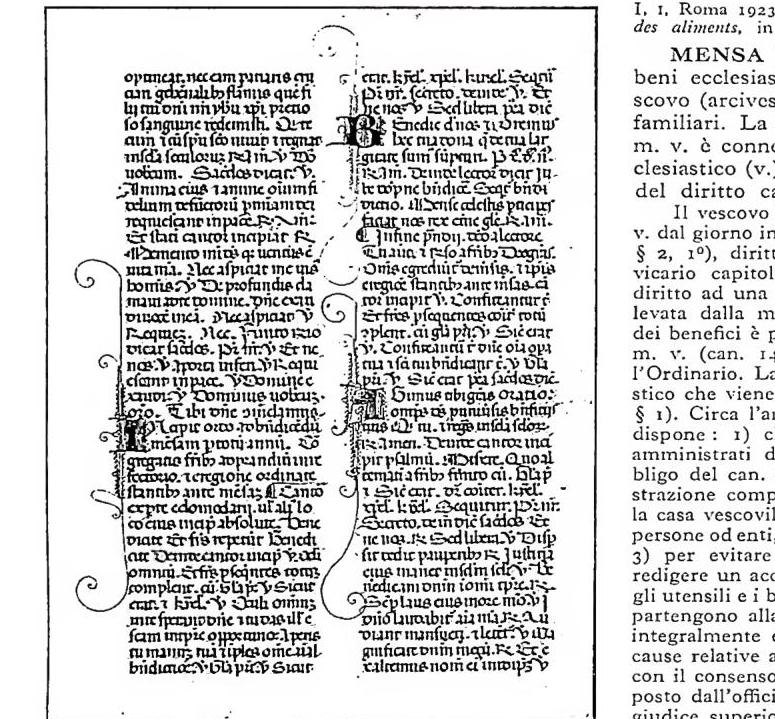
Following the example of the Lord (Mt. 14, 19) and of the Apostles (Act. 27, 35; I Tim. 4, 3-5), Clement of Alexandria (Paedag., II, 4) and Tertullian (De cor. militis, 3; Apol., 39, 16, 19; De orat., 25) refer to the « benedictine »—as the prayer before the meal was called, after its opening word—as a very ancient and widespread Christian practice. The most ancient texts are the prayers of thanksgiving in the Didaché (chs. 9, 10), related to the Jewish prayers of Saturday evening, although their content is Christian. Prayers used by virgins in convents are found in Pseudo-Athanasius, De virginitate, 12-14 (PG 28, 265, 268), Constit. Ap., VII, 49; St. John Chrysostom also refers to them in Hom. 55 in Mt. (PG 58, 545). For the Latin rite, the oldest form of the « Benedictine » is contained in cod. S. Gall. 349, f. 104 ff. (ed. Silva-Tarouca, pp. 213-14); the formulas still used today, « Oculi » at lunch and « Edent pauperes » at dinner, already occur there. For each dish or item of food, the superior pronounces a blessing; beforehand, at the superior’s signal, the reader interrupts the reading and everyone says « Deo gratias ». To his blessing everyone responds « Amen », and the reader continues. Formulas of this prayer and of the blessings are found in the Sacramentaries (Gelasian, Gregorian, in the Sacramentary of Fulda, 10th century, 2812, 2828, and in Gallican ones, e.g., Bobbio, ed. Lowe 1920, nos. 561-62). The Consuetudines monasticae of Cluny (PL 149, 711-12) and of Hirau (PL 150, 995-96) contain the formulas in use today.