
BENEDIZIONE. — In its liturgical meaning, it is a rite performed by a sacred minister, whereby, through the invocation of God’s name, some good is conferred or requested. According to a definition by St. Ambrose (De Patriarchis, II, 6), b. is: sanctificationis et gratiarum votiva collatio.
I. NATURE OF THE B
Essential elements of the b. are: the minister, who blesses; the matter, which is the object of the b.; and the form, that is, the words used in blessing. The rite may consist in a simple sign of the cross, with or without the recitation of certain supplicatory formulas, the sprinkling of blessed water, or the anointing with holy oils. The b. belongs to that class of rites called Sacramentals (v.).In Sacred Scripture we find the b. of God (Gen. 1:22, 28), of kings (ibid. 14:19), of patriarchs, and of parents (ibid. 9:26). In the Gospel we read of the b. given by Jesus to food, to his own, and to children (Mt. 14:19; Lk. 24:50; Mk. 10:16). The Apostles followed the example of Jesus. A formula of b. used by St. Paul at the end of the II Cor. passed into the Eastern liturgy and is found in the Constitutiones of the Apostles (VIII, 12, 4). In the Church, rites and formulas of b. developed, both within and outside worship, from the first century onward. The prayers of the b., from the most ancient times, were accompanied by the sign of the cross. Thus, in the writings of the Fathers of the early centuries, mention is made of the b. given by bishops and priests to persons and things; similarly, in the canons of a Council of Carthage held in 255, the b. of water for Baptism is prescribed, and it is repeated that blessing is one of the offices of the priest. In the Middle Ages, the formularies of the b. increased, especially in the Franco-Roman liturgy, reflecting to a greater or lesser degree the theological, liturgical, and linguistic learning of their authors. They are preserved for the most part in the sacramentaries, particularly the Gelasian and the Gregorian. Of special importance for liturgical history are the Benedictiones episcopales veteraglicanae, which from the fifth and sixth centuries onward were given during Mass between the Pater mater and Communion. The great number of these formulas constitutes one of the most abundant and valuable sources of the Middle Ages for knowledge of the worship and culture of the various countries. Their use also entered the Romano-Carolingian liturgy, just as from ancient times it had existed in the Eastern liturgies of St. Gregory, St. Cyril, St. Basil, and others, and it was retained until shortly before the reform of the Roman Pontifical under Leo X. Pius V abolished it, but some dioceses, for example Autun, still preserve II. For these b. in the Middle Ages, a special book, the Benedizionale (v.), was often used. In general, even the more ancient liturgical books contain formulas of b. for the most varied circumstances.
The most ancient formularies are found in the Constitutions of the Apostles and, already collected, in the Sacramentary of St. Serapion. An ancient b. for the door of a house is contained in a papyrus published in PO 18,440.
At the end of the Middle Ages, disadvantages arose in the compilation of the various formularies, such as an excess or lack of theological orthodoxy and literary good taste, legendary or magical ideas, and so forth. Reform became possible only after the invention of printing, when the various texts became more readily accessible, thereby facilitating their selection. A first attempt was the reform imposed on 9 July 1548 by the emperor Charles V. More effective, however, and more universal was that achieved through the official edition of the Ritale issued by Paul V in 1614.
II. MINISTER OF THE BLESSING
The legitimate minister of the blessing is the cleric who has received the power to impart it and who has not been forbidden to exercise it by the competent ecclesiastical authority (CIC, can. 1146).Excluded, therefore, are men who are not clerics, such as catechists, and all women, including abbesses. However, not every priest may impart every blessing, because some are reserved to the Pope, others to the bishop, the parish priest, religious, or others (CIC, can. 1147, § 2). A blessing given contrary to this norm is illicit but valid, unless the Holy See has provided otherwise (can. 1147, § 3). Blessings are invalid if the formula prescribed by the Church is not used (can. 1148, § 2).
In addition to the formula, the minister of the blessing must be vested at least in surplice and stole of the prescribed color, and the rubrics accompanying the formularies must be faithfully observed.
III. SUBJECT OF THE B
These are persons and things. It should be noted that, although b. are intended above all for Catholics, they may nevertheless also be given to catechumens and even to non-Catholics (provided that the Church does not expressly forbid it), in order to obtain for them the light of faith or, together with it, bodily health (can. 1149).IV. EFFECTS OF B
From this point of view, blessings may be divided into consecratory or constitutive blessings and invocatory blessings. 1) Constitutive blessings impress upon a person or thing a kind of sacred character, withdrawing it from purely profane uses and dedicating it in one way or another to divine worship (e.g., the blessing of a church, an oratory, or sacred vessels). 2) An invocatory blessing asks God for a particular spiritual or temporal good (e.g., the blessing of the table, of fields, of marriages, or of machines). Blessings derive their efficacy from the prayers of the Church; constitutive blessings unfailingly achieve their effect; in the case of invocatory blessings, especially when temporal goods are concerned, the effect depends upon the dispositions of the subject and the order of divine Providence.V. PAPA. — They are called apostolic blessings because the liturgy and the Christian people reserved the name of apostle for St. Peter and his successors. The Popes impart their blessing with the first three fingers of the right hand extended (symbolizing the three Persons of the Most Holy Trinity) and the other two folded. Apostolic blessings are of various kinds:
1. Ordinary or common blessings
Those imparted privately, at the conclusion of papal chapels, liturgical services, or an audience; or in the opening or closing formula of pontifical documents addressed to members of the clergy or laity, with the words: salutem et apostolicam benedictionem.2. Urbi et Orbi blessing
That which the Pope imparts solemnly, extending it to the entire world, on particular occasions, e.g. on the day of his election, his coronation, or after the most solemn pontifical functions, from the external loggia of the Vatican basilica or of other Roman basilicas. Until 1870, the Popes customarily imparted it four times a year: on Holy Thursday and Easter from the loggia of St. Peter’s; on the Ascension from the loggia of St. John Lateran; and on the Assumption from the loggia of St. Mary Major. Leo XIII, Pius X, and Benedict XV, as a sign of protest against the situation created for the Holy See by the capture of Rome, gave it only inside St. Peter’s Basilica; Pius XI restored the custom, interrupted for over sixty years, on the occasion of the Jubilee Year 1933–34 (Cf. La Civ. Cattolica, 1933, II, pp. 293–95). A plenary indulgence is generally attached to it, servatis servandis. By decree of 15 June 1939, this indulgence may also be gained, under the usual conditions, by those who receive the blessing by radio transmission (AAS, 31 [1939], p. 277).3. Papal blessing
That which bishops and priests may impart in the name of the Pope and by his delegation. It entails a plenary indulgence both for the person who gives it (S. Congreg. delle Indulg., 20 May 1896) and for those present, who have confessed and received Communion. According to can. 914, expanded by the decree of the S. Penitenzieria (20 July 1942), bishops may impart it three times a year: on Easter and on two other days of their choice; abbots, prelates nullius, apostolic vicars, and apostolic prefects twice, on solemn days; religious (can. 915) twice, but only on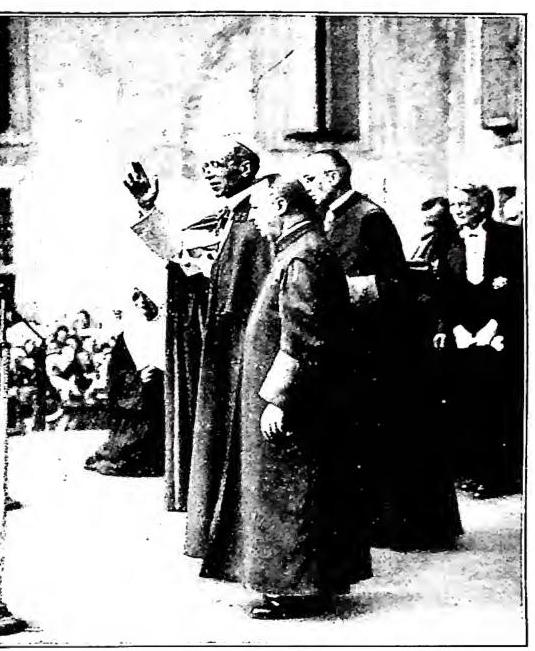
4. Occasional Apostolic B
This is the blessing obtained on the occasion of congresses, marriages, etc., by submitting a request to the Secretariat of State of the Vatican.5. Apostolic B. in articulo mortis. — This is the blessing, with a plenary indulgence attached, given to the sick person in danger of death, even when death is not imminent. According to can. 468, parish priests or any priest assisting the dying person have the power to impart II. By the will of the Church, the indulgence is valid at the moment of death; it therefore cannot be repeated during the same illness. The Popes customarily apply this b. to crucifixes and other objects of piety.
VI. BLESSING IMPARTED BY THE BISHOP
1) As pastor, the bishop is entitled to bless his own flock, which he usually does solemnly either during or at the end of the pontifical Mass, also announcing a partial indulgence and preceding it with a formula of absolution. He likewise usually does so at the end of a pontifical assistance at Mass or of other services celebrated by him or at which he has assisted. 2) The Pontifical also contains an entire series of blessings reserved to the Ordinary; the principal ones are: the blessing of an abbot or abbess, of a king or queen, of virgins, of the foundation stone of a church, of sacred vessels and vestments, of the tabernacle, and of bells. The blessing of the holy oils is included in the ceremonies of Holy Thursday. 3) The appendix to the Ritual contains other blessings reserved to the Ordinary, which he may, however, delegate to others.VII. B. GIVEN BY THE PRIEST. — 1. B. of persons. — Besides the b. imparted at the end of Mass, the Rituale contains, for the use of priests: a) the b. for children, so that they may grow in age, wisdom, and grace, and always be pleasing to God; for children either alone or in groups; b) for the sick, with different formulas for children and adults; c) for pilgrims, for their outward and return journeys and in case they should fall ill; d) for mothers,
both when they are in danger at the moment of childbirth and after childbirth. Under the Mosaic law, the woman who had given birth remained affected by a legal impurity that prevented her from entering the temple (Lev. 12, 2-4) for a period of 40 days in the case of a male child and 80 in the case of a female; after this period, she had to present herself to the priest and perform the rite of “purification.” In Christianity there is no longer anything more than a hint of legal impurity; everything is joy, thanksgiving, and good wishes for the new creature. The Rituale strongly commends this pious and praiseworthy practice. The b. may be imparted to every woman who has become a mother in a lawful marriage (S. Congreg. del Concilio, 18 June 1859), even if the child had died without Baptism.
2. B. of things. — Of the numerous b. of things, the principal ones may be mentioned, those concerning: a) the table, before and after meals; b) things: b. of a new house, of all houses on Holy Saturday and during and outside the Easter season; of the nuptial chamber; of schools, libraries, and archives; c) the countryside: b. of fields, vineyards, seeds, granaries, fruits, and, in general, of all edible things; d) animals: b. of the stable, draft and barnyard animals, bees, silkworms, etc.; with deprecatory formulas against harmful animals (mice, moles, caterpillars, locusts, etc.); e) means of transport: railways, railway cars, ships, airplanes; f) modern inventions: electric and telephone power stations, printing presses, seismographs, mountaineering equipment; g) there must also be added the b. of ashes (the first Wednesday of Lent); of palms (the Sunday preceding Easter); of candles (the feast of the Purification).
All this shows how the Church does not restrict her concern to persons or things belonging or in some way relating to divine worship; rather, she embraces everyone and everything; she desires to envelop human life as in an atmosphere of blessings, of the supernatural, of thought, and of recourse to God. Thus she recalls the words of s. Paul to the Corinthians: “everything is yours, whether Paul or Apollo or the world or life or death or things present or things to come; all are yours, and you are Christ’s, and Christ is God’s” (I Cor. 3, 22).
VIII. B. GIVEN BY A NON-PRIEST CLERIC. — The deacon and the lector receive the power to bless in their ordination; but its exercise is limited by canon law (can. 1147, § 4). The deacon may bless the Paschal candle during the Holy Saturday liturgy and, with the bishop’s permission, perform the rite of funerals, including the blessing of the tomb. The lector may bless bread and all newly harvested fruits (cf. A. Vermeersch–J. Creusen, Epitome Iuris Canon., II, 6th ed., Malines 1940, no. 465).
IX. BLESSINGS RESERVED TO RELIGIOUS
Some blessings are reserved to particular religious Orders: the blessing of the Way of the Cross to the Friars Minor; that of rosaries and crowns to the Dominicans; to the Carmelites, Theatines, Trinitarians, Passionists, Servites, etc., the blessing of their respective scapulars; and to the Benedictines, the blessing of medals of s. Benedetto.X. BLESSINGS GIVEN BY THE LAITY
No layperson, as has been seen, can give any blessing in the name of the Church. Therefore, the blessing given by parents or by an abbess, however much it may represent a beautiful and even moving custom, is nothing more than a private act or prayer, and not one of the Church.XI. PRAYER OF B
A brief formula of praise and thanksgiving to God (Hebr. bērākhāh) among the ancient and modern Jews, which begins with the verb “to bless”:“Blessed be the Lord” (Bārākh Jahweh; cf. Gen. 24:27; Ex. 18:10); “Blessed are You, Lord” (Bārākh 'attāh Jahweh; cf. I Chron. 29:10; Ps. 118:12). The use of b. is very frequent among the Jews in the liturgical service, called by the Miśnāh the “order (= rite) of b.” (sedher bērākhāh), as well as in private life.
The first treatise of the Miśnāh, which bears the name Bērākhāh (v.), prescribes, among other things, that everyone should bless the Lord not only before and after food, but also at the sight of the wonders and phenomena of nature, when using something new, upon receiving good or bad news, and in general both in good and in evil (Bērākhāh, 6, 9). Therefore Rabbi Me'ir declared (Mēnābāh, 43 b) that every Israelite is obliged to recite one hundred b. each day. In the form established by rabbinical tradition, the b. begin: “Blessed are You, Lord, our God, King of the universe.” Examples: for bread: “Blessed are You... who brings forth bread from the earth”; for wine: “Blessed are You... who creates the fruit of the vine”; for comets, earthquakes, lightning, thunder, and winds: “Blessed are You... whose strength and power fill the world”; for mountains, seas, rivers, and the desert: “Blessed are You... who has made the works of creation”; for good news: “Blessed are You... good and beneficent”; for bad news: “Blessed are You... true judge.”
In the New Testament, the b. before food is mentioned in several places with the verbs εὐλογεῖν (“to bless”) and εὐχαριστεῖν (“to give thanks”). Thus in the two multiplications of the loaves (Mt. 14:19; 15:36), at the Eucharistic Supper (Mt. 26:26 ff.), at the supper in Emmaus (Lk. 24:30), and elsewhere (Acts 27:35; Rom. 14:6).
The Apostle Paul wishes the faithful to perform every action for the glory of God (I Cor. 10:31) and to give him thanks in all things (Col. 1:3, 17; 5:18). The Apostle’s words find their fullest application in public and private Christian prayer, which devotes so much attention to praise and thanksgiving to God. Seeing God in everything, drawing from all things a reason to raise oneself to him, to praise him, thank him, and love him (v. GIACULATORIE), greatly helps to sanctify souls and is strongly recommended by Christian asceticism.