
ORDER OF THE MOST HOLY TRINITY – Martino, archbishop of Toledo, with the consent of the Chapter, grants s. Giovanni di Matha perpetual administration of the hospital of the B. Virgin Mary in the parish of the French (February 1206). Madrid, National Historical Archive.
fratrum ord. Can. Reg. S. Crucis, Roma 1926; R. Haas, Die Kreuzherren in den Rheinlanden, Colonia 1932; H. Van Rooyen, Theodorus van Celles, Rotterdam 1935; H. F. Chettle, The Priors of the Holy Cross in England, in History, 47 (1949), p. 122.
Pietro Rutten
ORDER OF THE MOST HOLY TRINITY (Ordo Sanctissimae Trinitatis redemptionis captivorum). - Founded MALTA (v.) Felice di Valois (v.), it was approved by Innocent III with a bull dated 17 December 1198, and is the first regular Order established in the Church with its own Rule distinct from that of St. Augustine.
Since the new Order responded to a grave social need of the time, it received approval and support from popes, bishops, kings, princes, and the faithful. Proof of this general favour were the many privileges and graces that the Holy See granted not only to the Order but also to the Confraternities of the Most Holy Trinity established everywhere by it to facilitate the collection of alms for the redemption of slaves. The Order spread rapidly in Europe and Asia Minor, so that by 1240 it already counted more than 600 houses with approximately 5,000 religious, a number that increased in subsequent centuries. However, due to the schisms that afflicted the Church in the 16th century and the various suppressions of religious Orders in the 18th and 19th centuries, it was reduced to very modest proportions. It began to recover at the end of the last century and now counts an apostolic prefecture in Madagascar and just over 50 houses scattered across Europe and the Americas. Belonging to the Order, in addition to the two saintly founders, are St. Michele dei Santi, Bl. Giovanni Battista della Concezione, Bl. Marco Criado, Bl. Simone de Roxas, and others. The secular Third Order of the Most Holy Trinity boasts, among other illustrious members, Bl. Anna Maria Taigi (d. 1837) and Ven. Elisabetta Canori (d. 1825). To the Order of the Most Holy Trinity are connected by their origin and spirit, though juridically independent, several female institutes of Trinitarian sisters, one of enclosure and others of a hospital or teaching character.
The first Order had various branches: that of the Reformed (1578) in France, which later in 1769 merged with the primitive branch under the name of Canons Regular of the Most Holy Trinity, and with it became completely extinct in 1894; that of the Discalced Reformed, which originated in Spain in 1599 through the work of Bl. Giovanni Battista della Concezione, and which survives today.
With the evolution of the times, the Order’s initial purpose ceased, which for five centuries had written pages of glory in the field of Christian charity. Today, its members dedicate themselves to various forms of priestly apostolate, both at home and in missions; and in particular to the propagation of the cult and devotion to the Mystery of the Most Holy Trinity, through the Third Order, the homonymous Confraternity, the "Perpetual Adoration," and publications of various kinds. - See plate XII.
ORDER OF THE MOST HOLY SAVIOUR AND OF SAINT BRIDGET. - Founded between 1344 and 1346, under the title of "Order of the Most Holy Saviour," by St. Brigida of Sweden, who dictated its Rule. It comprised nuns and religious with double monasteries, dependent on the abbesses. The mother house at Vadstena was established by the foundress herself.
For more than two centuries, the Order was a centre of spiritual life for all of Sweden. Bl. Urban V, in the spring of 1367, approved its Rule vivae vocis oraculo at Montefiascone; Urban VI, with the bull His quae pro divini cultus augmento (3 December 1378), confirmed it; other confirmations followed
(from Antonin de l'Assomption, op. cit.)
ORDER OF THE MOST HOLY SAVIOUR AND OF ST. BRIDGET
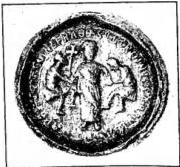
The most ancient seal of the Order (1221).
Further confirmations were granted by John XXIII (1415) and Martin V (1419). The Order spread especially in the Scandinavian and Germanic countries; the first two foundations in Italy were established in Florence (1394) and Rome (1396), in the house where St. Bridget had died. The 15th century marked the period of its expansion; by 1515, the Order counted 27 monasteries, though its development was not without crises.
The Lutheran Reformation of the 16th century nearly destroyed it everywhere; only a few foundations were transferred to France and Portugal. In Belgium, the Fratres novissimi Brigittini were approved by Gregory XVI, and in Spain, Marina de Escobar founded the Brigittines of the Recollection around 1600. Currently, only the female monasteries of Altomünster; Sion, in Stouth-Brent; Uden and Weert in the Netherlands remain. In Spain: Valladolid, Vitoria, Ascoitia, Paredes de Nava, Palencia. Two are in Mexico.
Through the efforts of Mother Elisabeth Hesselblad, a new Congregation of sisters of the ancient Order of the Most Holy Saviour began in Rome in 1911, soon spreading to England, Sweden, Switzerland (Lugano), and India. On 7 July 1940, it received the decree of praise and temporary approval of its Constitutions. By rescript of 12 September 1942, it was granted the title of Order of the Most Holy Saviour (commonly called of St. Bridget), which later became the Order of the Most Holy Saviour and of St. Bridget. On 2 December of the same year, it passed under the jurisdiction of the Sacred Congregation for the Propagation of the Faith, which on 17 July 1947 approved the statutes of the secular Oblates and on 2 December 1949 reviewed and approved the Constitutions ad septemnium.
The purpose of the Order is the work of converting the brethren of Scandinavia and also those who have separated from the unity of the Church.