
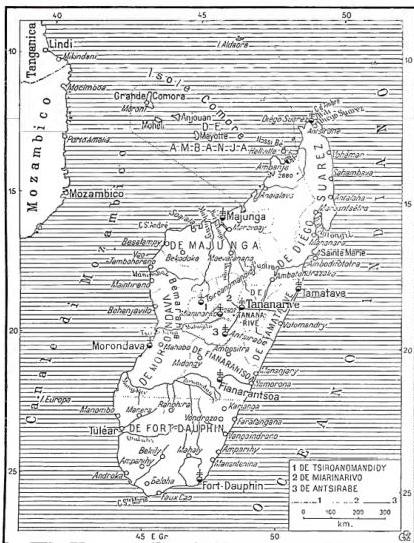
MADAGASCAR. - It is the only large island of the African continent (with its 585,000 sq. km. of surface area, it is the fourth largest on Earth), from which it is separated by the Mozambique Channel (400 km.). It consists of a high central plateau (from 800 to 2,000 m.) of ancient lands, surmounted by volcanic peaks (Ankaratra: 2,607 m.); while descending steeply toward the eastern coast, it slopes down in terraces on the opposite side, where it is bordered by extensive alluvial plains. The climate is hot, very humid on the Indian Ocean-facing slope, swept by the SE trade winds, and arid on the African side; in the interior regions, however, the extremes are tempered by altitude. The luxuriant tropical forests covering the former are replaced on the latter by steppes and savannas. The territories best suited to whites correspond to the plateau, which in any case occupies three-quarters of the island.
The inhabitants (4.3 million), overwhelmingly of Malay origin (25,000 French and 15,000 foreigners), are engaged in agriculture and stock-raising. Rice and manioc are the predominant crops; vanilla, coffee, cocoa, tobacco, bananas, cotton, etc., are also produced. Cattle (6 million head) supply the preserved-meat industry. The forest resources are considerable; and there are undoubtedly far from negligible mineral resources (in addition to coal, iron, copper, lead, nickel, asbestos, phosphates, as well as mica and gold, which are exploited); but only graphite gives rise to appreciable mining activity. The island could produce much more, if it were better developed (only 885 km. of railways and, essentially, a single port, Tamatave). The capital, Tananarive (163,000 inhabitants, of whom 20,000 are Europeans), stands on the plateau at an altitude of 1,300 m. M. has been an Overseas Territory of the French Republic since 1946, with an elected assembly.
From 1820 the Protestants worked fruitfully in M., while the Island remained closed to the Catholics. In 1829 the secular priest Enrico Solages was appointed apostolic prefect of the Islands of the South Seas, or Great Ocean, including the Islands of Réunion and M.; he died in 1832 while travelling toward Tananarive. His successor Delmond, of the Congregation of the Holy Spirit, succeeded in establishing the mission in the Islets of S. Maria east of M. and in the Islands of Nossibé and Mayotta to the west, which were erected as an apostolic prefecture in 1848. In that same year M. was erected as an apostolic vicariate and in 1850 assigned to the Jesuits, who, after a brief attempt in 1856, finally succeeded in 1861 in founding a permanent mission at Tananarive among the Hovas. The mission soon made great progress, despite the positions already gained by the Protestants, to whom Queen Ranavolana II herself had adhered. In 1871 the Jesuits succeeded in extending their missionary work among the Betsileos at Fianarantsoa. During the wars between the Hovas and the French in 1885 and 1895, the missionaries had to leave the Island for brief periods. The occupation by the French (a protectorate in 1885, a formally constituted colony in 1896) initially produced favourable results for the missions. In 1896 and 1898 M. was divided into 3 apostolic vicariates: central M., with the principal missions of the provinces of Imerina and Betsileo, which remained with the Jesuits; northern M., with the Comoro Islands, which was assigned to the Missionaries of the Holy Spirit; and southern M., which was entrusted to the Lazarists. In their vicariate, the Jesuits organized schools and education on a particularly broad basis, but the sectarianism of the colonial government, through the legislation of 1905, largely destroyed their work. Nevertheless, the mission, especially in the central provinces, made great progress among the Hovas and the Betsileos; the other tribes, on the other hand, offered greater resistance to evangelization. Later, new missionary institutes arrived: in 1899 the Fathers of La Salette, in 1920 the Premonstratensians, in 1926 the Trinitarians, in 1932 the Capuchins, and in 1933 the Montfortians. In 1939 M. had its first indigenous bishop in the person of H. E. Monsignor Ignazio Ramarosandratana, apostolic vicar of Mianarivo.
At present the Island is divided into 9 apostolic vicariates and 3 apostolic prefectures: Tananarive (1643 apostolic prefecture of M., 1848 apostolic vicariate of M., 1896 apostolic vicariate of northern M., 1898 apostolic vicariate of central M., 1913 apostolic vicariate of Tananarive), entrusted to the Jesuits; Fianarantsoa (1913 apostolic vicariate), entrusted to the Jesuits; Diego Suárez (1898
del Buon Rimedio e le Missioni trinitarie, XIV, Rome 1939, pp. 55-60; A. Boudou, Les Jésuites à M. au XIXe siècle, 2 vols., Paris 1942; A. Messmer, La préfecture apostolique d'Ambanja, in Missionnaires capucins, 27 (1947), no. 125, pp. 9-10; 28 (1948), no. 126, pp. 2-3; no. 127, pp. 8-9. Giovanni Rommerskirchen