
MALAYAN FEDERATION. — Replaced, as of 1 February 1948, the Malayan Union, proclaimed on 1 April 1946 and formed from the same British possessions and protectorates that, before the Second World War, constituted British Malaya, except for Singapore, which was made a Colony. The F. M. is now governed by a high commissioner, assisted by two councils, executive and legislative, while each State enjoys broad administrative autonomy.
The population (4.9 million inhabitants in 1947) consists of more than half Malays, approximately two-fifths Chinese, and the remainder Indians and Europeans.
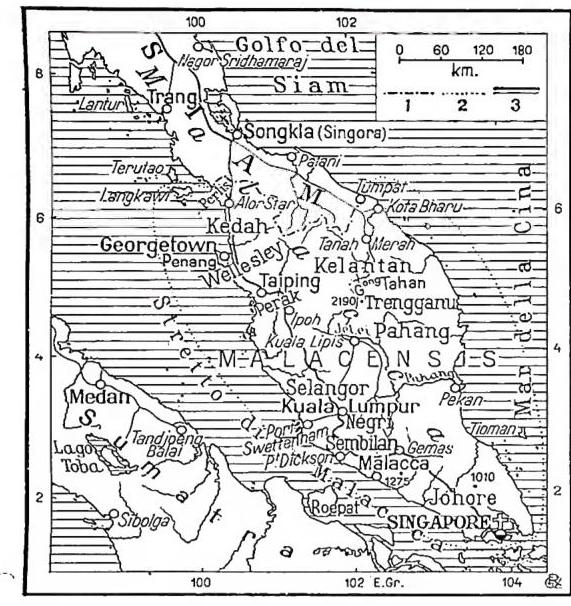
MALESE FEDERAZIONE — 1) State boundaries; 2) provincial boundaries; 3) ecclesiastical-circumscription boundaries.
| States | Area in sq. km | Absolute population (1941/1000 inhabitants) | Density per sq. km | Capital and its population in thousands |
|---|---|---|---|---|
| Penang | 285 | 247 | 868 | Georgetown (165) |
| Wellesley | 751 | 172 | 228 | Butterworth |
| Malacca | 1657 | 236 | 142 | Malacca (45) |
| Perak | 20.670 | 993 | 48 | Kuala Kangas |
| Selangor | 8180 | 702 | 86 | Kuala Lumpur (138) |
| Negri Sembilan | 6680 | 296 | 44 | Kuala Pilah |
| Pahang | 35.790 | 222 | 6 | Kuala Lipis (4) |
| Johore | 18.980 | 738 | 39 | Johore Bharu (32) |
| Trengganu | 13.080 | 211 | 16 | Kuala Trengganu (16) |
| Kelantan | 14.890 | 390 | 26 | Kota Bharu (15) |
| Kedah | 9430 | 516 | 55 | Alor Star (19) |
| Perlis | 800 | 58 | 72 | Kangar (2) |
| F. M. | 131.193 | 4781 | 37 |
…considerable reserve. The processing industries (rubber, metallurgical, mechanical, etc.) are developing promisingly.
The capital of the F. M. is established at Kuala Lumpur, at the centre of one of the most active industrial districts.
Malacca was the point of departure for missions in the Moluccas, Cochinchina, and Siam. In Malaya itself, the missionaries’ work was limited to the Portuguese and their slaves, since the Muslim Malays showed themselves resistant to the Gospel. The Dutch conquered Malacca in 1641, expelled the Portuguese and their missionaries, and allowed the churches and convents to fall into ruin. The bishop of the diocese of Malacca, which in any case was for the most part vacant, took up residence in Portuguese Timor. In 1787, Msgr. Garnault, apostolic vicar of Siam, fled with his small flock from Quedah (Siam) to the island of Penang, where he founded a seminary; in 1807 the missionaries of Paris reopened their General College there. In 1830 the same missionaries began a mission in Singapore. The city was taken in 1795 by the English, who subsequently, in 1824, seized the entire Malacca Peninsula, making it a central point of trade. Msgr. Courvèzy, apostolic vicar of Siam, took up residence there in 1838. The diocese of Malacca was suppressed in 1838 by the brief Multa praeclare, and the Malacca Peninsula was annexed to the apostolic vicariate of Ava and Pegu, in 1840 to the apostolic vicariate of Siam, and in 1841 was erected as an independent apostolic vicariate of Western Siam. The missionary work of the missionaries of Paris in their stations at Singapore, Malacca, and Penang was restricted to the Chinese and Indians, because the indigenous Malays offered almost insurmountable resistance to evangelization. In 1888 the diocese of Malacca was restored as a suffragan of Pondichéry, though no longer under Portuguese patronage; only one church in Malacca and one in Singapore were annexed to the diocese of Macao. It is true that later the mission was also able to establish itself in the Malay States, but it remains largely limited to immigrant Chinese and Indians. The educational organization under the Brothers of the Christian Schools and the Ladies of S. Mauro is particularly well developed, and is gaining new momentum now that the Japanese occupation during the Second World War has ended.