
INDOCHINA, FEDERATION. – This is the name given to the group of territories controlled by France in the peninsula of the same name; before the last great war, these territories comprised the colony of Cochinchina and the four protectorates of Tonkin, Annam, Cambodia, and Laos. Before surrendering, the Japanese, who had occupied the country, proclaimed (July 1945) the independence of the unitary State of Viet-Nam (comprising Tonkin, Annam, and Cochinchina), which, after the Japanese surrender, was claimed by the local Communists against France. After lengthy negotiations, which followed military operations conducted by the French with alternating success, France recognized first the independence of Viet-Nam and then that of the other two protectorates within the framework of the F. I. and the French Union. The five members of the F. I. thus enjoy full administrative autonomy and are answerable to a French high commissioner, whose functions are to coordinate the common services.
SUMMARY:
I. Geography
II. Evangelization
III. Ecclesiastical circumscriptions
IV. The legal status of the Church
V. Art
VI. Educational system.I. GEOGRAPHY
The territory of the I. F. corresponds to the eastern part of the Indochinese peninsula: the landscape is highly varied; it is predominantly mountainous or hilly in the N., while in the central regions it expands into plateaus deeply cut by rivers, and in the S.-W. it descends into the broad alluvial zone of the Me-Kong. The climate is, on the whole, tropical, with high temperatures even inland and abundant but irregular rainfall, although related to the monsoon regime. The acclimatization of Europeans is generally rather difficult, and increasingly so the farther one proceeds toward the south.The population (27 million inhabitants; 37 per sq. km), quadrupled from 1800 to the present day, is very unevenly distributed, being concentrated along the coasts and also around the deltas of the Song-coi (Red River) and the Me-kong. There are few urban centers, although the capital Saigon (Cochinchina) today numbers approximately 700,000 inhabitants. In demographic importance there follow Cholon (480,000 inhabitants), Long Xuyen (148,000), likewise
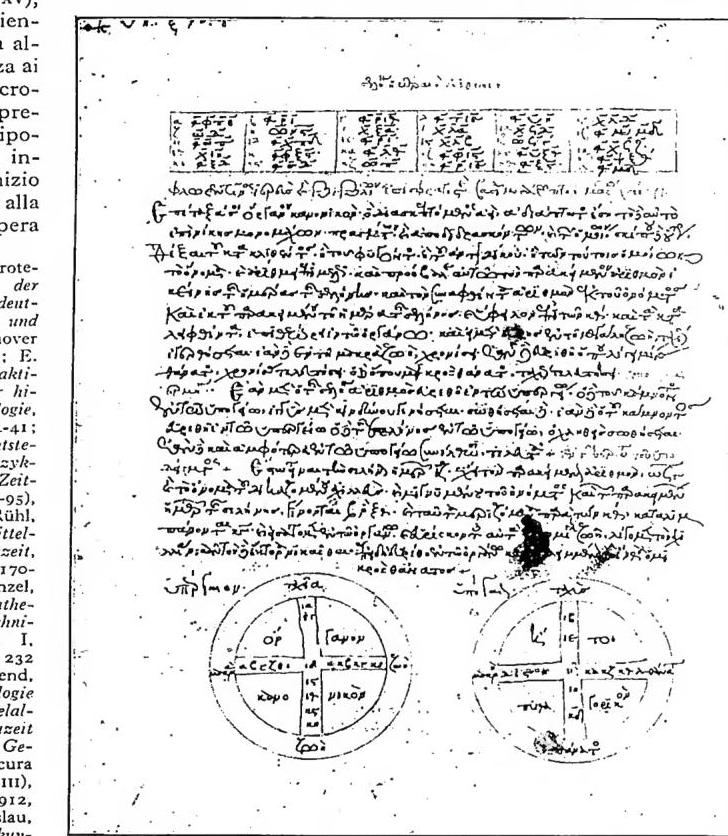
INDIZIONE – Method of locating the i. according to the work: Astronomica nonnulla di un Florentinus sacerdos – Vatican Library, cod. Vat. grec. 432, f. 138v (16th century).
| Divisions | Area in sq. km. | Population 1947 (thousands of inhabitants) | Density per sq. km. | Capital and its population (thousands of inhabitants) |
|---|---|---|---|---|
| Tonkin | 115,700 | 9,851 | 85.1 | Hanoi 160 |
| Annam | 149,800 | 7,184 | 47.9 | Hué 40 |
| Cochinchina* | 64,100 | 5,579 | 87 | Saigon 111 |
| Vietnam | 320,600 | 22,614 | 68.6 | Hanoi |
| Cambodia | 139,000 | 3,227 | 23.2 | Pnom Penh 260 |
| Laos | 236,800 | 1,189 | 5 | Vientiane 10 |
| F. i. | 705,400 | 27,040 | 38.3 |
* Including the Condor Islands, 175 sq. km. and 3,000 inhabitants.
The F. I. is a typically agricultural country, with tropical and equatorial crops. Under normal conditions, rice and maize predominated, making a substantial contribution to exports. Among the notable industrial crops are rubber, cotton, tobacco, sugar cane, pepper, coffee, etc. The forests (over half of the total area) provide valuable timber. Livestock farming is of little importance; fishing, on the other hand, is a major resource. The subsoil yields chiefly anthracite, iron, and zinc in Tonkin, phosphates in Annam, and also tin, antimony, tungsten, gold, etc. Modern large-scale industry is only in its beginnings, but its possibilities are extremely broad in every sector.
The consequences of the war and the present unstable political situation have compromised the development under way in the local economy; communications and trade, too, have been significantly affected.
II. EVANGELIZATION
The first missionaries arrived in Indochina in the sixteenth century. Portuguese and Spanish Dominicans and Franciscans attempted to establish missions in Cambogia and Cocincina. The continual wars, especially between Siam and Cambogia, however, prevented the mission from becoming stable. It was only in 1615 that the Jesuits began a lasting mission. Favored by the Portuguese trade between Macao and the two Annamite kingdoms, Cocincina and Tonchino, the Jesuits were able to establish themselves in Cocincina in 1615 and in Tonchino in 1626. They succeeded in winning the favor of the regents and mandarins and in establishing Christianity despite sporadic expulsions and persecutions. It was the great merit of Fr. Alessandro de Rhodes (1591–1660), founder and apostle of the Annamite Church, to have organized the mission through the institution of the catechists: it was they who, during the ensuing persecutions, after the expulsion of the missionaries from Cocincina in 1645 and from Tonchino in 1663, preserved Christianity. It was also Fr. de Rhodes who urged the Sacred Congregation of Propaganda Fide to appoint apostolic vicars for Indochina.The first, Francesco Pallu (1626-84) and Pietro Lambert de la Motte (1624-79), appointed for Tonchino and Cocincina in 1658, initially remained in Siam due to persecution. From there, the first missionaries of the Paris Foreign Missions Society secretly entered Annam in 1666. The first indigenous priests, chosen from among the catechists, were ordained without knowledge of the Latin language, and the female institute of the "Lovers of the Cross" was established. In 1669, the Jesuits returned, and in 1676, the Dominicans also arrived from the Philippines. In 1678, Tonchino was divided into two apostolic vicariates, the eastern and the western.
In the 18th century, the Indochinese mission suffered many persecutions. In Cocincina, under the rule of the Chua Nguyen, great persecutions occurred from 1698 to 1702 and from 1714 to 1727. However, under the Chua Ninh-Vuong (1726-1739) and Vo-vuong (1739-1765), until 1750, the mission was able to develop freely. In that year, the Paris Missionaries, the Franciscans, and the Jesuits, who had gained great influence at court, were expelled. Subsequently, they were allowed to return in very limited numbers and to work in secret. In Tonchino, under the rule of the Chua Trinh, persecutions continued almost without interruption. The Paris Missionaries, Jesuits, Dominicans, and Augustinians worked in the two vicariates of the east and west, increasing the number of indigenous clergy, who, with the help of catechists, managed to continue missionary work even during the bloody persecutions. The situation worsened further in the second half of the 18th century due to civil wars and unceasing persecutions, after the new Tai-song dynasty succeeded in subduing Tonchino in 1765 and Cocincina in 1774. With the ascension to the throne of Nguyen Anh, who later took the name Gia-long, the last of the Nguyen family, who, with the help of the French, especially the apostolic vicar Pierre-Joseph-Georges Pigneau de Béhaine (1741 [1771]-99), triumphed in the struggle against the Tai-song dynasty and in 1802 united Cocincina and Tonchino into a single empire, Viet-Nam, the mission enjoyed relative freedom. Gia-long did not forget that the apostolic vicar Pigneau de Béhaine had been the powerful promoter of his cause. The Paris Missionaries and the Dominicans continued their work in the missions. However, under his successor Minh-Mang, a terrible persecution broke out in 1833, which continued, with few interruptions, for over 50 years. Numerous bishops and missionaries from the Paris Seminary and the Dominican Order, hundreds of indigenous priests, catechists, and "Lovers of the Cross" sisters, and tens of thousands of Christians suffered martyrdom. From this host of heroes, 4 bishops, 9 missionaries, 32 indigenous priests, 20 seminarians and catechists, and 19 Christians were beatified in 1900 and 1909. Yet, despite all these persecutions and martyrdoms, the destruction of churches, and the exile of Christians, the mission endured and even made progress. In 1886, France occupied all of Indochina and in 1887 united the Kingdoms of Tonchino, Cocincina, and Cambodia, to which Laos was added in 1893, into the Indochinese Union under French rule. The bloody persecutions ceased; however, the mission suffered considerably under the anticlericalism of French officials, the secularization of schools, and government interference in the internal affairs of the Church. Nevertheless, the mission made notable progress, especially in Tonchino and Cocincina; in Cambodia and Laos, progress was slower.
During the persecution, the mission was subdivided. In 1844, Cocincina was divided into Western and Eastern Cocincina; in 1850, Cambodia was separated from the former, and Northern Cocincina from the latter in the same year. Tonchino, already divided into two vicariates in 1678, was also reorganized. In 1846, Southern Tonchino was established; in 1848, Central Tonchino; in 1883, Western Tonchino; and in 1901, Maritime Tonchino. Further subdivisions in the 20th century increased the number of apostolic vicariates to 17, of which 3 were entrusted to the indigenous clergy; additionally, an apostolic prefecture was established.
After World War I, in 1922, an apostolic visitor was sent, and in 1925, the apostolic delegation was established; in 1934, the first Plenary Council of Indochina was held. Other religious congregations arrived: in 1928, the Redemptorists; in 1928, the Franciscans; and in 1929, the Sulpicians for special works. The Oblates of Mary Immaculate took over part of Laos in 1933. Since 1919, there has also been a convent of indigenous Cistercians. The Christian Brothers maintain flourishing schools, assisted by two congregations of indigenous brothers. Charitable and educational works are directed by several congregations of European sisters, primarily the Sisters of St. Paul of Chartres; the indigenous "Lovers of the Cross" are mainly involved in primary schools. Since 1861, there has been a Carmelite monastery in Saigon; six others were later founded in Indochina.
The Japanese occupation during World War II, nationalism, the proclamation of independence in 1945, and the wars between France and Vietnam caused serious difficulties for the Church. A true persecution broke out: many European missionaries, indigenous priests and sisters, and countless Christians were slaughtered; a large part of the Christians were forced to flee, and entire missionary territories with their churches and ecclesiastical institutions were more or less completely devastated. Although in 1948 a precarious agreement was reached between France and the provisional government of Vietnam, the struggles with the communist Viet-Minh party, occupying a large part of Tonchino, continue.
III. ECCLESIASTICAL CIRCUMSCRIPTIONS
According to the Annuario ecclesiastico 1951, the Indochinese Federation includes the following apostolic vicariates and apostolic prefectures, listed here in alphabetical order: BACNINH, established as the apostolic vicariate of Northern Tonkin in 1883, renamed in 1924 with its current name, entrusted to the Dominicans; BUICHU, established as the apostolic vicariate of Central Tonkin in 1848, renamed in 1942 with its current name, entrusted to the secular clergy since 1950; HAIPHONG, established as the apostolic vicariate of Eastern Tonkin in 1678, renamed in 1924 with its current name, entrusted to the Dominicans; HANOI, established as the apostolic vicariate of Tonkin in 1658, after the division of 1678 it took the name of Western Tonkin, renamed in 1924 with its current name, entrusted to the Société des Missions Étrangères de Paris; HUE, established as the apostolic vicariate of Northern Cochinchina in 1850, renamed in 1924 with its current name, entrusted to the Société des Missions Étrangères de Paris; HUNG-HOA, established as the apostolic vicariate of Upper Tonkin in 1895, renamed in 1924 with its current name, entrusted to the Société des Missions Étrangères de Paris; KONTUM, established as an apostolic vicariate in 1932, entrusted to the Société des Missions Étrangères de Paris; LANGSON and CAOBANG, established as an apostolic prefecture in 1913, elevated to apostolic vicariate in 1939, entrusted to the Dominicans; PHAT DIEM, established as the apostolic vicariate of Maritime Tonkin in 1901, renamed in 1924 with its current name, entrusted to the secular clergy since 1935;(prop. Ene. Catt.)
INDOCHINESE FEDERATION - 1) State borders; 2) ecclesiastical circumscription borders; 3) railways.
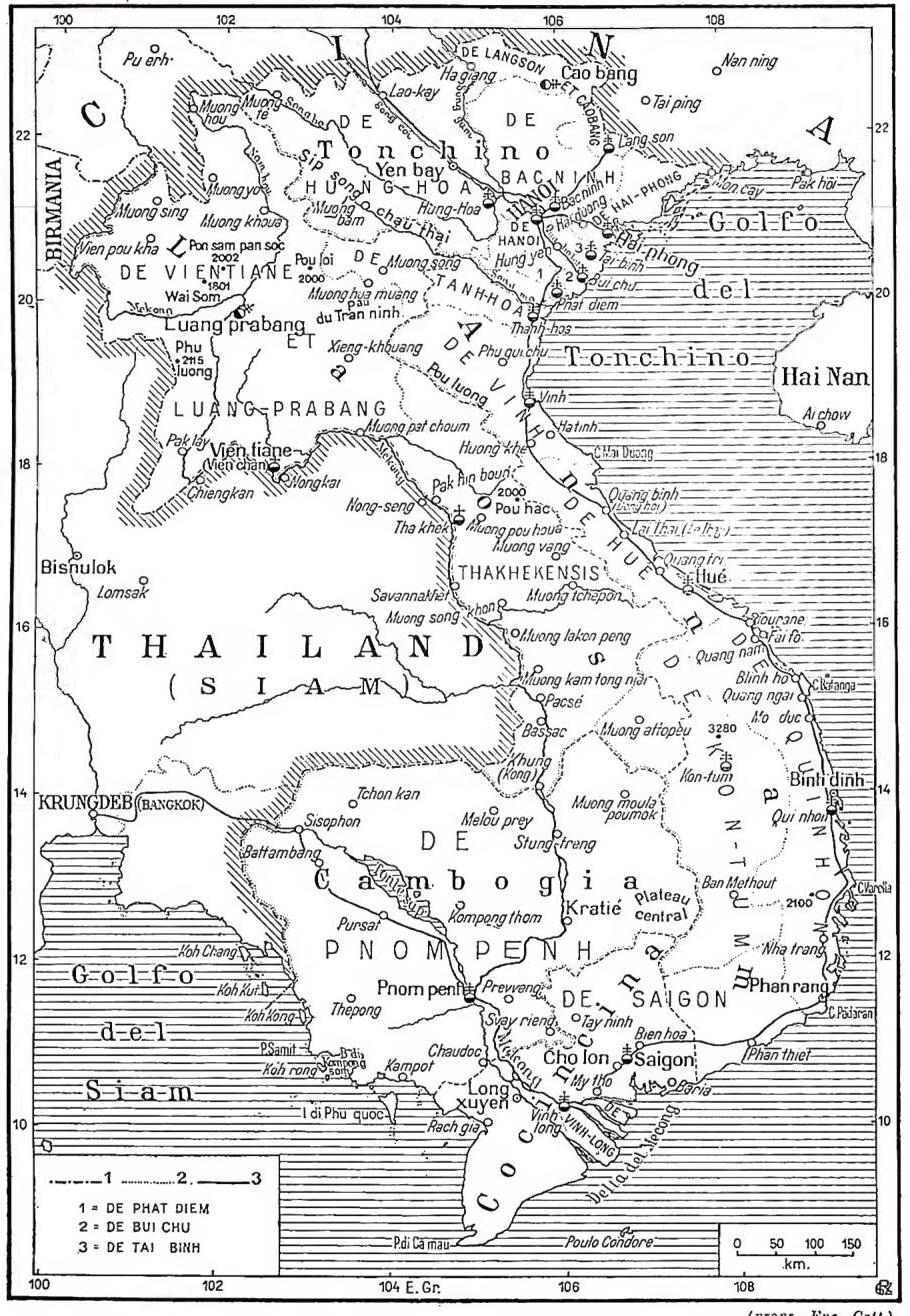
KHEH, apostolic prefecture erected on 21 Dec. 1950 by division of the former apostolic vicariate of Laos erected in 1899, and entrusted to the Société des Missions Étrangères de Paris; THAN HOA, erected apostolic vicariate in 1932, entrusted to the Société des Missions Étrangères de Paris; VIENTIANE and LUANG PRABANG, erected apostolic prefecture in 1938 and entrusted to the Oblates of Mary Immaculate; VINH, erected apostolic vicariate of Southern Tonkin in 1846, from 1924 current name, entrusted to the Société des Missions Étrangères de Paris; VINH-LONG, erected apostolic vicariate in 1938, entrusted to the secular clergy. Giovanni Rommerskirchen
IV. LEGAL STATUS OF THE CHURCH IN INDOCHINA — It is currently regulated by the decrees of January 16 and December 6, 1939, which recognize for the Church the freedoms of worship, education, and assistance.
1. Freedom of Worship
Article 2 of the Treaty of June 5 between France and Annam expressly states: «The citizens of the two nations of France and Spain may exercise the Christian cult in the Kingdom of Annam, and the subjects of this Kingdom, without distinction, who wish to embrace and follow the Christian religion, may do so freely; but those who do not desire it shall not be forced to become Christians».2. Freedom of Education
In Tonkin and Annam, the freedom of education clearly resulted from the Treaty of 1874 (between France and Annam): «Bishops, missionaries, and Annamite priests shall have the right to acquire and rent lands, build churches and schools». The right to build schools would seem rather theoretical if not accompanied by the right to teach in those same schools. In Cambodia, the Treaty of the Protectorate of August 11, 1863 (Art. 15) was even clearer: «Catholic missionaries shall have the right to preach and teach. They may, with the authorization of the Cambodian government, build schools, etc.».3. Freedom of Assistance
That is, to create medical and social welfare establishments. Such assistance, provided by Catholic religious sisters, is entirely free in Indochina. In Tonkin and Annam, the Treaty of March 15, 1874 alludes to welfare establishments and authorizes their creation indirectly: «Bishops, missionaries, and Annamite priests shall have the right to found hospitals and orphanages». Finally, the decree of November 9, 1923, and the ordinances of December 10, 1924, and February 7, 1925 (all issued by the French authorities) organized the administrative supervision of private welfare institutions in Indochina, with the aim of ensuring good hygiene conditions and controlling the morality and loyalty of the directors. However, Catholic religious sisters did not devote themselves solely to purely private welfare works. They also cared for the sick in civil hospitals in Hanoi, Saigon, etc. This situation changed when France entered a period of general secularization. The sisters were replaced by lay personnel (decree-ordinance of November 20, 1904).4. Recognition of Legal Personality for Missions and the Regime of Ecclesiastical Property
The decree of January 16, 1939 enshrined the concept of «mission» for the purpose of granting legal recognition to ecclesiastical circumscriptions: apostolic vicariates, apostolic prefectures, considered as legal entities independent of the religious Orders that direct them. Thus, the registration of property is made in the name of the mission, duly endowed with civil personality. Article 1 of the same decree of January 16, 1939, establishes the creation of administrative councils, designed to represent missions in civil life acts: «Religious missions may constitute administrative councils, which can acquire, possess, and conserve or alienate, in the name and on behalf of the represented mission, all movable and immovable property, all movable and immovable rights, and any other interest. They have full powers to administer and dispose of the property belonging to the mission. They may stand in court and defend themselves».(from M. Biasutti, Le razze e i popoli della terra, II, Torino 1915, p. 655)
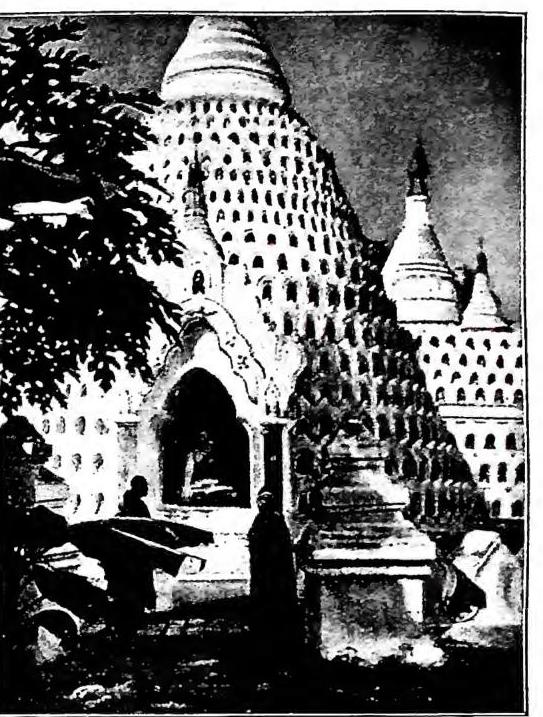
INDOCHINESE FEDERATION - Pagodas near a convent in Ava.
ART
In the evolution of Indochinese art, two main currents can be distinguished: the Indian and the Chinese. The former prevails in the south, particularly in Cambodia, where the flourishing of an original and justly revalued art emerged, that of the Khmer civilization, to which the splendid monuments of Angkor (12th century) belong. Earlier art, however, had left its most beautiful expressions in the temples of Sambon Prei Kuck.
The Chinese current, prevalent in the north, is especially evident in the art of Tonkin, Annam, and Siam. Of particular importance is that of Siam, where a distinct art form asserts itself only in the 13th century; the art of Annam appears more colorful and inclined toward decorative elements. The French occupation undoubtedly marks the beginning of a period of decline in Indochinese art, which has recently been countered by the establishment of the School of Fine Arts in Hanoi by Vittorio Tardieu.
### Christian Art
One of the most important figures in the Christianization of indigenous art was, in the last century, Don Luca Tran (b. in the province of Thanh-Hoa, between Tonkin and Annam, in 1825; d. in Phat-Diem in 1899). A hydraulic engineer and architect, he was particularly esteemed for his development of the source region around Phat-Diem, at the mouth of the Red River, where he built dikes, undertook drainage and irrigation works, and constructed churches and chapels. In these, utilizing the richest expressions of local art and the work of indigenous artists, he created works that simultaneously express tradition and the new Christian faith. The cathedral of Phat-Diem, which he erected (1878-95), is a felicitous transformation of the pagoda, preceded by a large atrium like the ancient Christian basilicas: the five richly carved portals, the 13 columns of 16 meters in height and 1 meter in diameter in a single shaft of lim wood, the rich high altar of red lacquer, the five graceful chapels, constitute the best solutions to the problem of missionary art. Also inspired by local art is the parish church of Thakhek in Laos, though its plan was designed by the French architect Tournon.
In painting, the artist Celso Le-Van-De, born on 28 August 1906 in Mocay in Cochinchina, belongs to the artistic current influenced by China. A graduate of the Academy of Fine Arts at the University of Hanoi, he also spent three years in Paris, indulging for a time in Western tastes. However, his purest expressions reveal a keen sense of line, entirely Asian and spontaneous.
Decorative art has also produced embroideries, lacquers, and inlays, often of exquisite taste. With a spirit of understanding, it has not hesitated "to incorporate into the heritage of indigenous Christian art those elements that no longer hold superstitious meaning and are merely traditional formulas of ornamental flavor or are susceptible to a Christian interpretation" (Costantini).
VI. SCHOOL SYSTEM
School education takes place in: 1) schools for the French, 2) schools for the indigenous population, 3) Catholic missionary schools.Schools for the French include 33 elementary schools, 6 higher elementary schools, and 3 lycées in Hanoi, Saigon, and Dalat. Indigenous students are admitted only to the Lycée in Saigon and Dalat. Schools for the indigenous population include 7,141 elementary schools, 19 higher elementary schools, 4 middle schools, and 5 vocational schools. Catholic missionary schools include 5,454 catechism and prayer schools, 1,877 elementary schools, 29 lower middle schools, 7 upper middle schools, 23 normal schools, and 65 vocational schools. Professionals are trained at the University of Indochina in Hanoi, founded in 1917. Particular esteem is enjoyed by the École française d'Extrême-Orient in Hanoi, which is under the patronage of the Institut de France. The education of the Catholic clergy is provided in 6 novitiates, 16 minor seminaries, and 9 major seminaries. There are 18 schools for catechumens.