
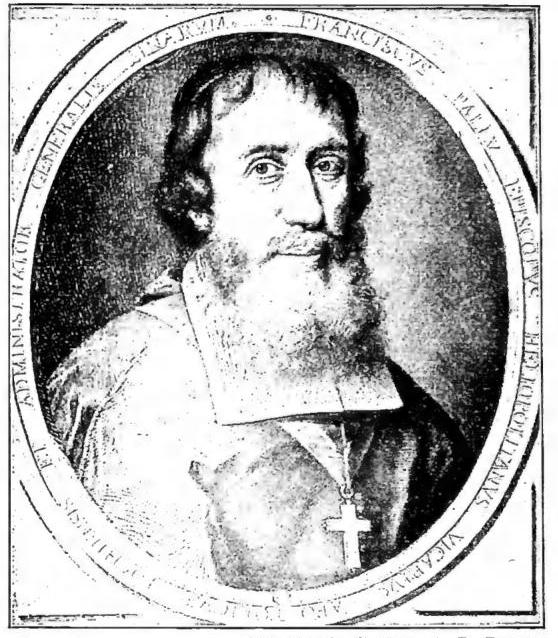
PALLU, FRANÇOIS. - Born at Tours (Indre-et-Loire, France) on 29 Aug. 1626, died at Moyang (Fokien) on 29 Oct. 1684. While still very young, he was appointed canon of St. Martin of Tours and ordained a priest in Paris on 24 Sept. 1650. Following his meeting in 1653 with Fr. A. de Rhodes, in 1657 he went to Rome, together with Pierre Lambert de la Motte, to ask the Pope to appoint bishops for East Asia. On 29 June 1658 he was created bishop of Heliopolis and on 9 Sept. 1659 vicar apostolic of Tonkin and administrator of Yunnan, Kang-tcheu, Hukuang, Szechwan, Kuangsi in China and of Laos.
Consecrated in Rome on 17 Nov. 1658, he founded the Society of Foreign Missions to secure auxiliaries and successors for himself, and on 2 Jan. 1662 he set out for Siam, where he arrived on 27 Jan. 1664. His first concern was to create a seminary for the natives, which was later transferred to Penang (Malaysia). In 1667 Pallu, who had had to struggle to have his powers recognized by the local civil and religious authorities, returned to Rome to explain the situation and obtain greater faculties. He set out again in 1670, and on 18 Oct. 1673 he was received in solemn audience by the King of Siam, who granted him freedom to preach Catholicism in the Kingdom. In 1674 he embarked for China, but, thrown by a storm onto the coasts of Manila, he was arrested by the Spaniards, who took him back to Europe by way of Mexico. Following the intervention of Louis XIV he was freed in 1677 and went to Rome, where he obtained the appointment of new vicars apostolic and the creation of Annamite and Chinese bishops. In 1679 Tonkin was taken from him, and on 1 Apr. 1680 he was appointed general administrator of the missions in China. In 1681 he set out again for Siam and for China, where he arrived on 27 Jan. 1684; but he was soon overtaken by death. In 1912 his remains were transported to the "Nazareth" retreat house of the Foreign Missions in Hong Kong.
As co-founder of the Foreign Missions of Paris, Pallu had the great merit of having given a strong impetus to France's missionary interest; with the Paris Seminary the missionary collaboration of the secular clergy was for the first time organized, and moreover the founders of the Seminary, following the ideas of Fr. Alexandre de Rhodes, emphasized the necessity of a native clergy and a native hierarchy. A son of his time, he shared the political and religious-ecclesiastical ideas of the majority of the French clergy.
Bibliography
Antonio Anoge