PALLOTTI, VINCENZO, BEATO

VINCENNZO PALLOTTI, Blessed. — Born in Rome on 21 April 1795, died there on 22 January 1850. Ordained a priest on 16 May 1818, he began his apostolic work in associations for young men. In 1827 he was appointed spiritual director of the Roman Seminary; later he served as confessor in the Urban, Greek, English and other colleges. He also devoted himself to workers and the spiritual direction of souls.

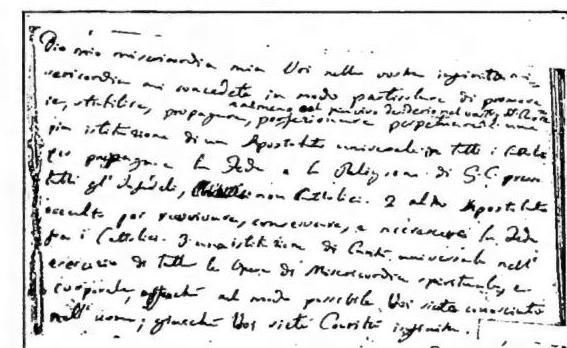
On 9 January 1835 he was inspired to consolidate, spread and defend a threefold apostolate: 1) of all Catholics to propagate the faith, 2) to preserve, strengthen and increase the faith among Catholics, 3) of universal charity. Pallotti proposed a mobilization of all, both clergy and laity, and likewise a greater coordination of Catholic forces. Although Gregory XVI blessed Pallotti’s plan on 11 June 1835, no few difficulties prevented its homogeneous and universal realization. Nonetheless, within a few years the priest succeeded in forming an institute of secular priests (v. SOCIETY OF THE CATHOLIC APOSTOLATE), a congregation of sisters, works of charity and education—particularly the Pia Casa di Carità for abandoned and at-risk girls, which he entrusted to the generosity of benefactors and collaborators. He also instituted the solemn octave of Epiphany and formed and spread the idea of the Apostleship of Prayer. He worked especially for the propagation of the faith and for the return of Eastern schismatics and Protestants. Pallotti’s most profound and lived idea was Catholic apostolate. For this reason Pius XI called him “the forerunner of Catholic Action,” saying that Pallotti “divined the thing and the very name itself, founding the Society of the Catholic Apostolate, that is, what is the raison d’être of Catholic Action, the lay apostolate under hierarchical direction.” Pallotti proclaimed Mary the protector and exemplar of Catholic apostolate under the title of Queen of the Apostles.

BIBL.: Works: Among the many works for which the Institute is preparing a critical edition, the following may be noted: Mese di maggio per i fedeli, Rome 1833; Mese di maggio per religiosi, 3rd ed., ibid. 1852; Epistulae latinae.
Article illustration
Pallotti, Vincenzo, Blessed. Thoughts. Autograph page of 9 January 1835 — Rome, General Curia of the Pallottines, archives.

PALLOTTI VINCENZO — PALMA BIAGIO

to China. In 1681 he set out again for Siam and China, where he arrived on 27 January 1684; but he soon died. In 1912 his remains were transferred to the “Nazareth” retirement house of the Foreign Missions in Hong Kong.

As co-founder of the Foreign Missions of Paris, he rendered great service by greatly stimulating France’s missionary interest; with the Paris Seminary, the missionary collaboration of the secular clergy was organized for the first time, and moreover the founders of the Seminary, following the ideas of Fr. Alexandre de Rhodes, emphasized the necessity of indigenous clergy and hierarchy. A man of his time, he shared the political and religious-ecclesiastical ideas of the majority of the French clergy.

BIBL.: M. Pallu, Essais biographiques sur Fr. P., Le Mans 1863.

ANTONIO ANONYMOUS PALMA. — The martyrs, with their blood, merit from Christ the reward of eternal life, and so in the apocalyptic vision they bear the palm (Apoc. 7:9).

Tertullian sees them with the triumphal garment, *palmata vestis* (Apol., I); the palms and crowns have passed into Christian iconography and epigraphy, so that Damasus will say of the martyrs Protus and Hyacinthus: *hic victor meruit palmam, prior illa coronam* (A. Ferrara, *Epigrammata Damasiana*, Vatican City 1942, p. 192); Gordian is called a martyr of Christ *quem palma coronat* (G. B. De Rossi, *Inscr. Chr.*, I, Rome 1887, p. 64,15). Prudentius sings of Vincent: *palmam tulisti* (Peristephanon, V, 539). Just as in games the victor was offered the palm, so too it will be given to the Christian who in life has been victorious over the devil and the passions (St. Gregory, Dial., III, 26). With this meaning it is found inscribed on sepulchral inscriptions from the end of the 2nd century or the beginning of the 3rd. In many medallions, in gaming boards, in fragments of sealed earthenware, in clay lamps and in Christian inscriptions of the 4th–5th centuries, and even in a consular diptych, the monogram E or also S often recurs, explained by Fr. L. Bruzza and G. B. De Rossi as *palma feliciter*, by P. Arcangeli as *palma elea* (Dell’interpretazione del monogramma E, Rome 1879). H. L. Marrou has found the exact explanation *palma et laurus*, studying an inscription of the year 363, now in the Lateran Museum (G. B. De Rossi, *Inscr. Christ.*, I, Rome 1857–61, no. 159), in which the said monogram is represented together with the crown and the sign of Christ; it signifies the supreme reward: *palma et laurus*.

BIBL.: H. L. Marrou, *Palma et laurus*, in *Mélanges d’archéol. et d’hist.*, 58 (1946), pp. 109–31.

ENRICO JOSI PALMA, DIOCESE OF

V. MAIORCA, DIOCESE OF PALMA, BIAGIO

A Barnabite spiritual writer, born at Fara Sabina in 1577 and died on 13 January 1635 in the Roman college of S. Carlo ai Catinari.

Among the various spiritual booklets he published, the following enjoyed wide diffusion: *Atti virtuosi interni dell’anima cristiana* (Rome 1616), which, on account of the unction that pervades them and the very great number of editions that were made of them (now anonymous and now under another title, such as *Palma spirituale*, *Thesaurus*), were compared to the *Imitation of Christ* or to St. Francis de Sales’ *Philothea*; *Core sacrato a Giesù* (ibid. 1626), composed of 20 engravings in the shape of a heart with at the foot a

Article illustration
Palma — Sepulchral inscription of 363, in which are carved: the palm (twice), the crown, the Constantinian monogram and, in monogram, “palma et laurus” — Rome, Lateran Museum.

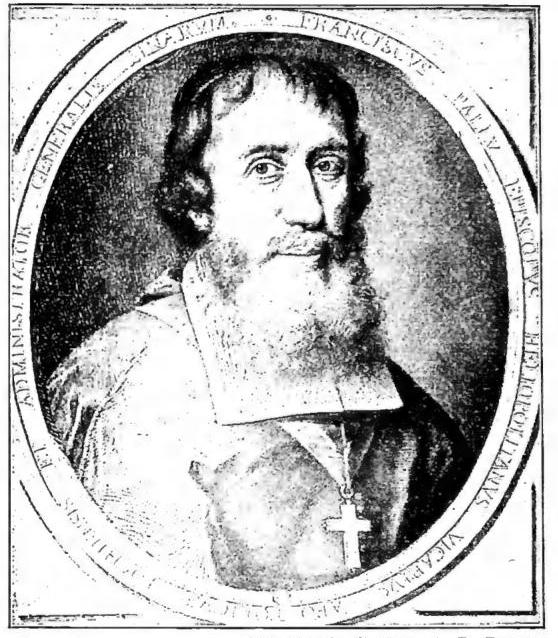
PALLU, FRANÇOIS — Portrait. Paris, Seminary of the Foreign Missions.