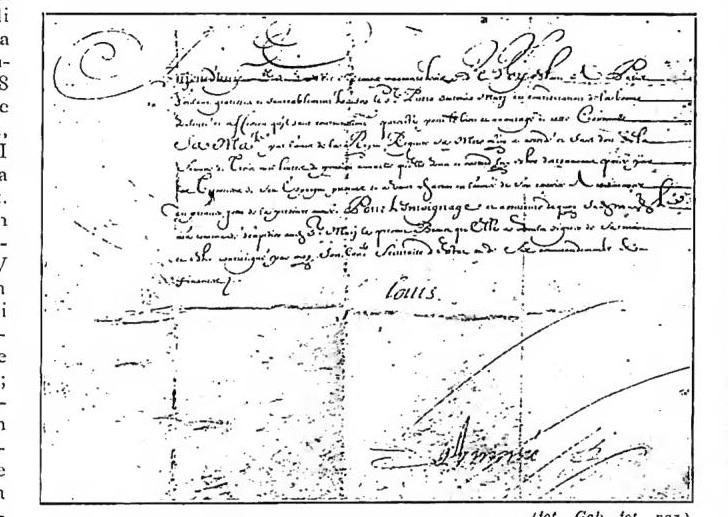
LOUIS XIV of Bourbon, King of France. — Born at Saint-Germain-en-Laye on 5 Sept. 1638 to King Louis XIII and Anne of Austria, daughter of Philip III, King of Spain; died at Versailles on 1 Sept. 1715; married first to Maria Theresa, daughter of Philip IV, King of Spain, and in a second, secret marriage to Madame de Maintenon (1683); his only legitimate son was the Grand Dauphin, who predeceased him in 1711. His childhood was unhappy, spent with parents who were little in accord; he was nominally king from 14 May 1643, declared of age at fourteen amid the flight and tumults of the Fronde, but he did not exercise real authority until the death of Mazarin (9 March 1661), whose passing allowed him to begin in peace the organization of that absolute monarchy which, modified by circumstances and by the character of his successors, endured in its main lines until 1789. In judging Louis XIV’s work, it is unjust to forget the responsibility of the nation, which, flattered in its pride, applauded its king in designs that later proved deplorable; for example, in ecclesiastical matters. Louis XIV, however, sometimes moderated excessive proposals of the Parlements.
As soon as he took the reins of government, to the incredulous astonishment of the Court, Louis XIV made known that from then on nothing was to be done in the kingdom without his order; the era of prime ministers was closed. In fact, he exercised power personally; three ministers formed the Council of State or *Conseil d’en haut*, namely, at first the Chancellor Michel Le Tellier, H. de Lionne, Secretary for Foreign Affairs, and N. Fouquet, Superintendent of Finances. The latter was soon replaced by Colbert, and in 1666 the Chancellorship passed to the latter’s son, the Marquis de Louvois, Minister of War. With these three men of bourgeois origin, the king took the major decisions of foreign and domestic policy in the first decades.
The best-known and most criticized aspect of Louis XIV’s policy was certainly that directed toward creating a primacy for France in Europe (as had already been the case with Henry IV, Richelieu, and Mazarin), but with broader means, more prepared men in arms and diplomacy, and facing a Europe that was at first very weak but that gradually organized resistance against this growing ambition, which would finally be contained and humbled. Moreover, Louis XIV’s Spanish marriage was already, in its purpose and even in the wording of the contract, in function of a probable succession; the first opportunity was offered by the Spanish Netherlands (which extended so deeply into the kingdom) under the pretext of the local right of devolution. At the death of Philip IV in 1667, Louis XIV occupied twelve cities (among them Lille), which in the Peace of Aix-la-Chapelle (April 1668), imposed by the Anglo-Dutch-Swedish alliance, he was able to retain, returning Franche-Comté (Besançon), which had been easily conquered. The indignation of Louis XIV and of France then turned against Holland, the author of the league; diplomatically isolated by England and Sweden, it was invaded in 1672 with the famous crossing of the Rhine (12 June) at Tolhuis, celebrated by poets and painters. The European reaction was vast, and more than against Holland, Louis XIV had to struggle against the Empire and a strong European coalition; Messina, which had rebelled against Spain in 1674, was occupied and then abandoned to Spanish vengeance in the Peace of Nijmegen (August–September 1678 with Holland and Spain), in which Louis XIV retained Franche-Comté and Flemish cities (Cambrai, Valenciennes, etc.); he gained some territories but aroused deep resentment in Holland.
The best-known and most criticized aspect of Louis XIV’s policy was certainly
1663 LOUIS XIV OF FRANCE – LOUIS XV OF FRANCE 1664
driving the Dutch from the Flemish fortresses they held, sending French troops to Milan, and recognizing James III Stuart as King of England. A European coalition was formed, and from 1701 the war was fought on three fronts: Germany, Italy, and the Netherlands; already in 1704 Germany was lost, and in 1706 also Italy and the Netherlands; in Spain the Archduke Charles had landed. The condition of France, threatened with invasion, induced the king to seek peace; but when it was demanded that he expel his grandson from Spain, he refused, preferring to humble himself rather than appeal to his people. Salvation came from the danger that Spain and Austria might unite when, at the death of Emperor Leopold, his brother Charles succeeded him as the Spanish claimant. Holland and England concluded with Louis XIV the Peace of Utrecht (1713) on the basis of a partition, and the following year Emperor Charles VI had to adapt himself to II. The only advantage for France was that Spain was no longer an enemy, but the threat remained on the flank of an Austria established in the Netherlands.
If Louis XIV’s personal power took precise form in 1661 with the *Conseil d’en haut*, in which every important matter was decided, centralization was gradually organized in the following decade both at the center and in the country, especially with the development of the provincial intendants. Finances constituted the most troubled and delicate sector, and Louis XIV, freed from the imprudent Fouquet, who had ostentatiously displayed his ill-gotten wealth, found in J. B. Colbert (though he was only Controller-General) an honest and capable man who gave the administration its new character. The Council of Finances met twice a week around the king, who examined the ledgers of income and expenditure and signed the final accounts. In the provinces, the intendants controlled municipal administrations, at first to liquidate their debts and remedy mismanagement, then for complete oversight that, though beneficial in essence, suppressed ancient autonomies. Thus absolutism penetrated deeply into the country to establish an order that in fact did not exist, eliminating local resistance and abuses.
In ecclesiastical policy, Louis XIV pursued the same absolutist mentality both in internal affairs and in his relations with the papacy. He engaged in two conflicts with the popes over local issues: the first, in 1662, concerned the Corsican papal guard, in which Pope Alexander VII was forced to endure a humiliating treaty (Pisa, 12 Feb. 1664); the other was with Pope Innocent XI, who sought to abolish the freedom of the quarter that French ambassadors claimed to preserve, while others renounced II. However, the true ecclesiastical clash arose over the right of regalia (administration of vacant dioceses), which Louis XIV extended to the whole of France between 1673 and 1675. Only in 1678–80 did Pope Innocent XI publicly protest and make use of the Assembly of the Clergy, which complained that the Pope was intervening in a civil matter. At further protests from the Pontiff, another assembly in March 1682 adopted the famous Four Articles of the so-called "Gallican Liberties," which infringed upon the full papal authority. Louis XIV ordered these to be professed by all and taught in universities and seminaries.
Proceeding with the same absolutist spirit, he imposed the retention of the Huguenots, more through harassment than persuasion, and when Calvinism seemed to be eradicated through emigration or forced conversion, he revoked the Edict of Nantes as superfluous. Not all in Catholic France agreed with this violent course, and in Rome the Pope, while celebrating the conversion of heretics, doubted whether these claimed "liberties" might not lead France into schism. Innocent XI refused investiture to new bishops who had participated in the 1682 assembly, and when the see of Cologne fell vacant, he opposed the French candidate.
The outbreak of war and its severity forced Louis to seek an accommodation after Pope Alexander VIII had condemned the Four Propositions in a bull in 1691. Only with Innocent XII, in 1693, was an agreement reached whereby the Pope tolerated the regalia but obtained that the new bishops disavow the Gallican propositions and that the king withdraw the order to teach them. In his disagreements with the Jansenists, the king instead supported papal action; for Quietism, he sought a condemnation from the Pope. During the final War of the Spanish Succession, when the Pope was threatened, even attacked, by the Emperor, he found better relations with the King.
Louis XIV’s death was greeted as a relief in the kingdom after its last years of dire suffering; indeed, disturbances were feared. Thus ended the king, once the idol of France, who had nonetheless secured for it—if not a political primacy, which was impossible—cultural supremacy in European civilization, a supremacy that even disasters could not erase. Unfortunately, by creating absolute monarchy, Louis XIV planted a deadly seed through the exaggeration of sovereign arbitrariness, which in him had some restraint in his constant personal intervention in affairs—something that did not recur in his successors, who lacked willpower. The lust for absolutism was aggravated by his isolation, as he established his court at Versailles, where he certainly worked seriously but where it seemed that only the pomp of his royalty was celebrated, against a backdrop of a mass of courtiers, in a stifling etiquette that separated him from the country and made him, along with his successors, a prisoner of those privileged classes with which the monarchy would ultimately precipitate its downfall. – See pl. CXV.
After the death of the Duke of Orléans, the young King was guided by H. de Fleury, Bishop of Fréjus, a gentle and modest man who gained such influence over the young monarch that he secured the appointment of the Duke Louis Henri of Bourbon as prime minister in 1723. With the Marquise de Prie, the Duke dominated domestic and foreign policy. The alignment with England and the clash with the Orléans faction led France to drift progressively away from Spain. Louis XV married on 4 Sept. 1725 Maria Leszczyńska, daughter of Stanislas, who had been created King of Poland by Charles XII but deposed by the Elector of Saxony, Augustus II.
Since the Bourbon sought to deflect onto Fleury the hostility aroused by new taxes and measures of rigor against Jansenists and Protestants, the King reacted by dismissing the Duke, exiling the Marquise de Prie, and cooling toward the Queen, who openly opposed Fleury. Fleury obtained the red hat just two months after the dismissal of the Duke of Bourbon and advised the abolition of the office of prime minister; he himself effectively became the arbiter of government until his death in 1743.
The cardinal, moderate and inclined toward peace, pursued a policy of retrenchment abroad and at home in the interests of the monarchy and France, continuing this approach during the War of the Polish Succession, which broke out in Europe following the sudden death of Augustus II of Saxony (February 1733). It was largely due to his policy that the Treaty of Vienna in 1738 secured advantages that allowed Louis XV to remain an arbiter of Europe.
In domestic policy, Louis XV found himself contending with opponents of the famous bull Unigenitus, which had Jansenist tendencies. It was largely thanks to Fleury’s skill that, despite resistance and appeals even to the throne, lay Jansenism was silenced and the bull Unigenitus was accepted (24 May 1730), while subtle interpretations by opponents of the bull—interpretations that undermined hierarchical rules and respect for law—were banned, and writings of Jansenist inspiration were prohibited, with penalties ranging from fines to exile. Only in December 1737 was peace achieved in accordance with Fleury’s wishes.
The role played by mistresses in both private and public affairs after the disgrace of the Queen is only too well known. From 1745 to 1750, Antoinette Poisson d’Étioles, created Marquise de Pompadour, completely dominated the king’s mind. She provided him with shrewd and sagacious counsel even in political matters and steered him toward rapprochement with Austria, which, when transformed into alliance, led to a disastrous war against Prussia and England allied together. This was partly due to the king’s irresolution, which he also displayed in the issue of mortmain property raised by Machault, in which, after remaining aloof for a time, he abruptly abandoned his intention to tax clerical property; and also in the struggle between the Parlement and the Church in France and Rome, where he frequently shifted between condemnation and pardon, supporting the Archbishop of Paris and exiling the Parlement to Pontoise, only to recall it without having obtained a single concession when he failed to prevent the exile of the archbishop. Finally, to secure silence on the bull Unigenitus, he was obliged to turn to Benedict XIV and hold the lit de justice of 1756, after which 180 councillors resigned.
Even with the “philosophers” of his century, Louis XV pursued a vacillating and uncertain policy. While the Pompadour stood by to protect them, Louis XV agreed to support only the physiocrats because their theories offered fiscal advantages to the monarchy, yet he did not reject the idea of winning Voltaire to his side. In the final years of his reign, ferment grew among the French people. The reckless expenditures of the royal treasury on royal mistresses (it is reckoned that for the Pompadour alone the King had spent no less than thirty-six million francs), and the scandalous dissipation by financiers, only worsened and became causes of popular unrest. Satires and lampoons circulated through the streets and squares of Paris and France. In this context, the attack by Damiens (7 Jan 1757) found justification in the popular irritation.
After the death of the Pompadour (1764), hopes were raised that, with the King’s reformation, a financial reorganization would begin. Instead, the moment brought a new favorite, the Du Barry, who, though without political ambitions, took part in all the intrigues of the Court as an opponent of Choiseul. He, Secretary of State for Foreign Affairs from 1758, had in fact directed policy since the Peace of Paris (1763), seeking to reorganize civil and military administration and restore France’s prestige abroad. His work was hindered by the King’s contradictory conduct and by internal complications arising from preparations for war against England, which Choiseul desired. To secure the necessary funds for the conflict, Choiseul placed great reliance on revenues that could be drawn from the Jesuits’ property. He therefore abandoned them to the fury of the Parliament and vigorously fanned the violent campaign waged against them, accused of sedition and plots, and against the Society itself. The campaign ended, as is well known, with the sequestration of the Society’s houses (1762) and the expulsion of the Jesuits from the Bourbon states (1764–67). Louis XV, to bend the reluctant Pope, ordered the occupation of Avignon, even as Neapolitan troops proceeded to occupy Benevento and Pontecorvo, until the Society of Jesus was suppressed (21 July 1773) by papal decree. The fall of Choiseul, chiefly due to the war he was preparing against England, paved the way for a triumvirate (the Duke of Aiguillon, R. C. Maupeou, and J. M. Terray), which succeeded in avoiding war at all costs and, by suppressing the Parliament, attempted to strengthen absolute power. Yet the corrupt sovereign, at the mercy of his favorites, lacked the moral strength required; the financial system was too ruinous; and France, now in decline on the international stage, lacked unity of purpose, as was partly demonstrated by the fact that without it the partition of Poland could be carried out.
Toward the end of April 1774, the King fell ill with smallpox. His regularity had necessarily kept him distant from the Sacraments (cf. on this point: J. Guiraud, *Histoire partiale, Histoire vraie*, Paris 1917, IV, pp. 248 ff.): now he ordered the Du Barry to leave the court, received the last sacraments, giving clear signs of repentance, and died on 10 May 1774. — See pl. CXV.