
INNOCENZO XI, POPE. — Born in Como on 19 May 1611, died in Rome on 12 August 1689. Benedetto Odelscalchi, from a wealthy merchant family, carried out his early studies in Como and studied law in Rome and Naples, where he obtained his degree; he had been protonotary, market commissioner, governor of Macerata, cardinal (6 March 1645), legate of Ferrara (1645–50), and bishop of Novara (1650–54). He lived in great seclusion, attending to his duties as a cardinal and to works of piety and charity, when, as many had expected, but against his will and only after all the cardinals had signed a capitulation of which he himself was the author, he was elected pope on 21 September 1676.
He was tall, with a broad forehead, aquiline nose, and prominent chin; dignified in bearing, reserved, and averse to applause. Free from nepotism, to the point of declaring that he had neither household nor family, he would have liked to strike at it with a bull, which he was unable to promulgate because of the opposition of cardinals and governments. He abolished the position of cardinal-nephew and gave the Secretariat of State the organization it still retains.
He took great care of religion and morality. He ordered that the preaching of the Gospel be simple and practical, that children and adults receive catechetical instruction, and that monastic Rules be observed; he provided for the education of the young and for the spiritual assistance of the sick; he promoted devotion to the Eucharist; he wanted fewer priests, but good ones, and paid close attention to the choice of bishops and ecclesiastical dignitaries. He imposed modesty in women’s dress and, though with difficulty, managed to obtain some improvement; he combated usury and gambling; he tolerated theatrical performances only reluctantly and with restrictions; in years of particular hardship he even prohibited Carnival amusements.
Setting the first example of the strictest economy, reducing offices and salaries, eliminating waste, and even renting out the papal gardens, he restored the finances and had funds for the defense of Europe against the Turks, for supplying Rome and the Papal States in years of famine, and for very extensive charitable works. He wanted justice to be administered properly and reformed the tribunals of the Curia, without, however, succeeding in eliminating abuses entirely.
He defended the integrity of religious doctrine, keeping aloof from every form of interconfessionalism. He worked for the conversion of Protestants, but insisted that guarantees of seriousness and disinterestedness be provided. He fought against the Portuguese Inquisition, seeking to reserve to himself the judgment—too often tainted by political interests—of converted Jews suspected of Judaism. He joyfully greeted the accession to the English throne of the Catholic King James II and sent Gerolamo d’Adda on a mission to him; he nevertheless advised prudence and tolerance, resisted the King’s demands, and, although deploring his expulsion, did not assist the dethroned monarch.
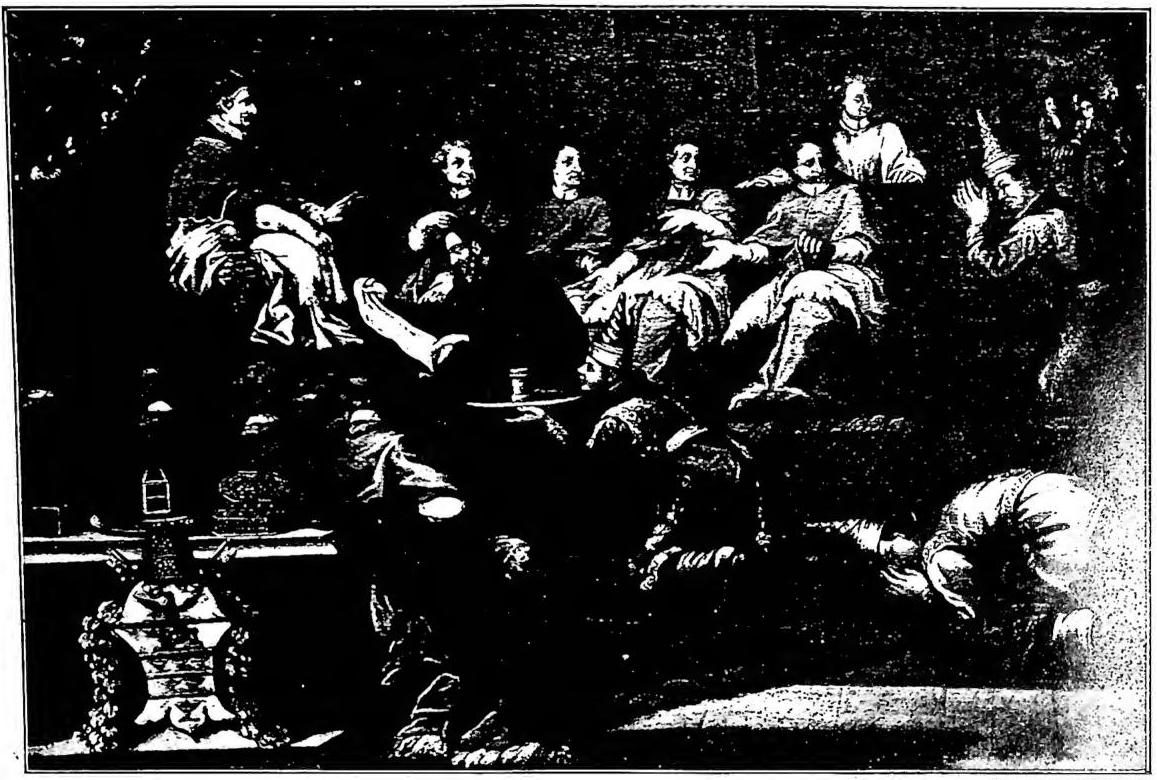
INNOCENZO XI, pope — The Pontiff receives the homage of the ambassadors of Siam presented by Fr. G. Tschard. Unknown artist of the seventeenth century — Rome, Odescalchi collection.
An energetic defender of papal authority, he engaged in a lengthy dispute with Louis XIV. He praised the King’s zeal in suppressing Calvinism and celebrated the revocation of the Edict of Nantes (1685); but he neither approved Louis’s brutal methods nor admitted his interference in religious matters. He condemned the extension throughout France of the right of regalia, that is, royal administration of vacant dioceses, and resisted the King’s interference in ecclesiastical appointments. And when the Assembly of the French clergy voted the four articles of Gallican liberties (March 1682), he accused the consenting bishops of weakness, condemned the decisions of the Assembly (brief of 11 April 1682), and refused to preconize bishops who were members of it unless they retracted the articles.
A new object of conflict with the Sun King was the Pope’s decision (circular to the nuncios of 4 January 1677, bull of 12 May 1687) to abolish the “quarter” of ambassadors, that is, their right of exemption and asylum in their buildings. The French envoy de Lavardin entered Rome with armed men (16 November 1687) and fortified himself in the Palazzo Farnese: the Pope considered not only the ambassador but the King himself and the ministers excommunicated. The conflict grew more bitter over the King’s attempt to place Cardinal von Fürstenberg, a French creature, in the German archiepiscopal see of Cologne. Parliament and King appealed to the Council (8 February and 27 September 1688); Avignon and the Comtat Venaissin were occupied; the Pope was threatened with armed intervention. I. did not yield; but the questions were resolved after his death.
I.’s principal claim to praise was that he had been the soul of Christendom’s defense against the Turks. The attempt to unite for this struggle not only the Christian nations of the West but also the non-Christian states of the East failed because of weak religious fervor, divisions among Christians, and the policy of Louis XIV, directed toward overthrowing the Habsburgs and enlarging France’s frontiers, even with the indirect support of the Turks. The Pope nevertheless played a part in the negotiations at Nijmegen (1677–79); and, although he considered the rights of the Church injured by the treaties, he limited himself to a moderate protest so as not to compromise the cause of peace. Later, too, he worked for the truce concluded at Regensburg between France and the Habsburgs (1684). He greatly contributed to the conclusion of the alliance between the Emperor and John Sobieski, King of Poland (1 April 1683), which led to the victory of Vienna, and to the accession of Venice (March 1684) and Russia (1686) to the “Holy League”: he contributed extensively to the liberation of Buda (1686) and to the successful campaigns that checked the new Turkish onslaught and saved European civilization. The war between France and the Emperor obstructed the completion of the undertaking.
The remains of I. rest in St. Peter’s in a grand monument, the work of Monnot. The people, who during his lifetime had not shown that they loved him because of his austerity, later venerated him as a saint. Indeed, the process for his canonization was begun in 1714 and continued under Benedict XIV. It is to be hoped that it may be resumed, because, despite a certain angularity, the indecisiveness resulting from excessive scrupulousness, and his tenacity in preserving his own opinions,
I. was, for the nobility of his ideals and the holiness of his life, among the best pontiffs
Vedi tav. VI.Giovanni Battista Picotti