
JUDAISM. — The religion and institutions of the people of Israel, which assumed their definitive form from the time of the Babylonian exile onward (6th century B.C.), when Israel found itself reduced to the single tribe of Judah (v.).
Before the exile, the Jewish religion had Moses (v.) as its supreme “mediator” (Gal. 3:20), Law (v.) contains the norms governing the religious and social life of the people, founded upon the doctrinal cornerstones of monotheism and Retribution. The principal representatives and interpreters Patriarchs (v.) and the Prophets (v.), while the leaders of the people and the ministers of worship (priests and Levites) were entrusted with safeguarding its tradition.
Judaism consists of beliefs and practices, derived from the Bible and from tradition, which constitute the common heritage of the Pharisees, Sadducees, Essenes, and also the popular milieus.
The written sources for knowledge of Judaism are, besides the Bible: 1) the works of Philo; 2) the works of Flavius Josephus; 3) various rabbinic writings: a) the legal books of the 2nd and 3rd centuries (Meghilath Ta'anith, Miñah, Tšesphtā) and the commentaries on the last four books of Moses, predominantly legal in character (Mekhilthā, Siphrah, Siphrē, to which may be added the Sedher (Glāh, a kind of chronicle); b) Targum (v.); c) Talmud (v.); d) the Midhrāf (v.). The apocrypha of the Old Testament are also of some use for learning about the ideological milieu in which Judaism developed.
SUMMARY:
I. Religion
II. Philosophy during the Middle Ages.I. RELIGION
The Jewish people is an essentially religious people. God is for them Father and King, but He is also the Holy One, whose holiness the people are obliged to reproduce. Relations with God are expressed through worship (the means of paying homage to the transcendent God) and observance of the rules, which seek to consecrate man to God. Religion is fundamentally national.1. God
The existence of God is a fact and needs no demonstration: God can be known only through revelation; He is the only one, and apart from Him there are no other gods.Despite numerous anthropomorphisms, there is a tendency (increasingly so from the 3rd century B.C. onward) to accentuate the transcendence of God. The tetragrammaton of God, Jahveh, God’s proper and personal name, is replaced by Adhānaj (“Lord”), and, in the Targum, God is even designated by Mēmrā (“Word”). This is probably due, among other things, to the fear of idolatrous profanation. God’s transcendence is emphasized above all in the apocryphal writings, whereas the rabbis are more reserved; indeed, they seem to have considered it extremely dangerous for a man who was not “wise and intelligent” to pursue such study. An exceedingly important attribute of God is His “holiness”: for Isaiah God is “the Holy One of Israel”; the prayers qaddī and qādhūrah celebrate God’s holiness. From the 2nd century onward, the invocation “the Holy One, blessed be He” is also extremely frequent among the rabbis. God is the source of all holiness, this epithet signifying absolute purity and infinite power; and this holiness, existing absolutely in God, is communicated in relative measure to men through the covenant (bērīth), imposing on them certain obligations so that they may make themselves worthy of God, the greater party to the covenant. God’s power is an integral part of His “holiness”: God works wonders in order to be sanctified among the peoples; therefore manifestations of impotence and the defeats of the holy people are profanations of the “name of God.” God’s power coincides with what we call Providence: God constantly watches over His people. As regards whether or not God acts in the human soul, the Palestinian doctors limit themselves to believing that God assists man along the path he himself has chosen; many apocryphal writings, however, affirm that God gives man a pure heart. Opinions concerning predestination vary: the Pharisees, according to Flavius Josephus, manage to reconcile fate and human freedom, whereas the Essenes place no limits on destiny, and the Sadducees deny belief in II.
God, however, is present everywhere, and Gamaliel states that God revealed Himself in a bush to demonstrate that “there is no place empty of tehhīnah” (a term derived from a verb meaning “to dwell”; it indicates God’s presence, experienced as “glory” and as assistance).
Miracles are universally acknowledged; nevertheless, there is a tendency to consider ordinary providential activity more important than they are, and it is asserted that wonders cannot prevail against the rabbinical decisions that have binding force.
Between God’s justice and mercy, there is a tendency to give precedence to the latter; and the problem of God’s justice, in view of the prosperity of the wicked and the misfortune of the just, seems to have been resolved by R. 'Aqibā' (d. 135): the prosperity of the wicked is the reward they receive, before being cast into the fire of gehenna, for whatever merits they too possess; the sufferings of the just serve to purify them of their shortcomings, so that, completely purified, they may enjoy the happiness of the next life.
2. Angelology
Angels (v.) frequently appear in the Bible, but angelology develops above all among the rabbis and in apocryphal literature. Angels share in God’s attributes, especially His holiness. Their mission is to surround God in heaven and in His theophanies on earth. Gradually, the concept of the guardian angel develops. The angelic categories are elaborated, and Metraron assumes tremendous importance; at times he seems to be the personification of God Himself. Toward the end of the 3rd century he appears as an assistant of Jahveh, sharing His throne; as heavenly scribe, he records the merits of Israel.Opposed to the good angels are the destroying angels, evil and impure spirits. They are discussed extensively in the two books of Henoch (v.), the Jubilees (v.), the Testaments (v.) of the patriarchs, and the Apoc. of Baruch
(v.). According to the various traditions, the chief of the demons is Satan, Belial, Sammael, Mastema, Azazel, or Beelzebub.
3. The Chosen People. — The concept of the chosen people is one of the most important pillars of g. Election took place, as is repeatedly stated in the Bible, by the choice of God and God alone, and its first realization is found in the history of the patriarchs; nevertheless, in the covenant concluded between God and the people, with Moses as mediator, He submitted to Israel’s free will whether or not to accept His choice.
The later elaboration of this doctrine tends to diminish the promises made to Abraham while instead exalting national particularism; at the same time, it tends to attribute God’s choice to the merits of the people of Israel itself. Thus the biblical notion and that of Jewish theology, with regard to the covenant, display significant divergences, and it comes to be said that a single Israelite is worth, before God, all the peoples of the earth (Siphrē on Deut. 14, 2), and that Israel is the only people of God (Mē-khilthā on Ex. 15, 13-16).
The greatest gift God bestowed upon the chosen people is the Tōrāh (the Law), and God gave it to Israel because He foresaw that Israel alone would be able to receive II. In the Tōrāh, the Jewish people find the foundation of their religion, because it reveals their fundamental beliefs and promulgates the rules governing their entire life. The principal object of the Sinaitic Revelation is the “ten words” (v. DECALOCO) engraved on the Tablet and received by Moses. The Law is divided into written and oral law. The former is that which is read in the “Book” (the Scriptures were initially divided into the Law and the Prophets, a division already found in the 2nd century B.C.; later, perhaps from the 1st century B.C. onward, into the Law, the Prophets, and the Hagiographa); it is the word of God and as such is sacred; the various authors, inspired by God, faithfully reproduce thoughts and words that are not their own.
The oral law had the task of adapting the Law to particular cases and, in theory, of making the Law easier to apply. In reality, the situation was quite different; it is enough to note that the rabbis came to enumerate 613 commandments: 248 positive commandments, corresponding to the number of bones in the human body, and 365 negative commandments, corresponding to the number of days in the solar year. To lend greater authority to this law, an attempt was made to trace it back to Moses himself, who, on Sinai, was said to have received from God the revelation of all rabbinical decisions as well; Moses was said to have transmitted it to Joshua, Joshua to the prophets, and so on (Ābhāth, I, 1-12).
The Law must be observed because every Israelite has the duty to advance the Kingdom of God and to “sanctify the Name”; the idea of sanction, however, is of great importance. The fundamental principle is that every action is followed by a reward or a punishment. At the end of the year, each man’s merits and demerits are reckoned, and, according to the predominance of one or the other, he is classified among the just or the wicked; but the sentence will be carried out only on the Day of Atonement, and until then it can be changed through good conduct. The principle followed is a mathematical one; nevertheless, the measure of rewards is more generous than that of punishments (Siphrāh on Lev. 5, 18). Rewards are generally bestowed already in this world and are chiefly temporal and material in nature.
4. Sin. — Originally, it was every violation of the law, even involuntary. Little by little, however, an acute casuistry developed, analyzing the human act in depth and admitting that even purely interior acts could be sins: that is, sins of sight, desire, etc. (Niddāh, 13 b; Zābhīm, II, 2). Sin is regarded as impurity, profanation, and failure to recognize divine holiness. It entered the world with Adam’s rebellion.
According to Mosaic law, sin is expiated through sacrifice; Leviticus mentions first and foremost the sacrifice pro peccato; but the great expiation takes place on the day of kippār, or “expiation” (v.). Before Jesus Christ, the value of expiation through suffering, death, and especially martyrdom appears also to have been universally recognized (II Mach. 7, 37; Siphrē on Num. 25, 13, etc.). Penance requires confession and reparation for the wrongs committed as a preliminary act; it is open to all and obtains complete forgiveness.
5. The Temple. — It is the house of God, the purest and holiest place; sacrifices are offered in II. Nevertheless, as time passed, the liturgy gave ever greater importance to prayer. Thus synagogues arose, already very numerous in the time of Jesus, as places of prayer and study of the Law. When the Temple was destroyed in A.D. 70, the priesthood and sacrificial worship disappeared, and all religious practice was confined to biblical synagogue (v.).
6. The feasts. — The principal feasts were and are: the Feast of Tabernacles (v.), originally an agricultural feast recalling the period spent in the desert; Passover (v.), commemorating liberation from Egypt; Pentecost (v.), an agricultural feast that later became the commemoration of the giving of the Law at Sinai. The following had an eminently national character: the Feast of the Dedication, recalling the victory of Judas Maccabaeus (v.); and the feast of Pārīm (v.), celebrating Esther’s triumph over Haman. Other feasts, moreover, are intended to rekindle the spirit of piety and penance, among them the beginning of the year, rō's haš-šānāh, kippār. Every day is consecrated to God through the various prayers said upon waking and going to sleep, putting on and taking off one’s clothing, eating, etc. (v. BENEDICTIONS).
7. Morality. — It is an integral part of religion, because it is God himself who lays down its rules. It is distinguished by a refined humanity, whereby children, women, the poor, and in general those who are weak and in need, are made objects of care and protection: the dignity of women must be respected; slaves, who formed part of the family, must be treated well; numerous and sensitive prescriptions protect the poor; almsgiving obtains every temporal good and is called “the salt of wealth” (Kē-thubhāth, 66 b), its value lying in the charity that inspires it (Sukkāh, 49 b). Superior to almsgiving are works of charity, which engage the whole person. These rules, however, bind the Israelite in relation to another Israelite; toward the gentiles, the line of conduct to be followed is different, just as God’s love toward the Israelites differs from his love toward other peoples.
8. Eschatology. — On this point the ideas are diverse and somewhat vague; Sacred Scripture itself offers no certain data. Some, in the time of Jesus, still believed in šē'ōl (v.), the common abode of the dead; others, however, were beginning to regard it as the place of punishment of the wicked (Ps. Sal. 14, 6; 16, 2; 17), while placing the righteous in Abraham’s bosom (IV Mach. 12, 17; 18, 23) or in the garden of Eden. Few admitted that the righteous would go to the “holiest place in heaven” and then put on pure bodies (Fl. Josephus, Bell. Ind., III, 8, 5).
9. Messianism. — Jewish messianism has the restoration of the nation as its central concern. From certain passages of the Gospel, from the histories of Fl. Josephus, and from the few rabbinical sayings of the time of Jesus, it can be established that during that period the expectation of the Messiah—particularly among the people—was still alive. National restoration was conceived as taking place in this world, or
in a new and wonderfully fertile land; others held that it would occur together with the resurrection of the dead.
In the Apocalypse of Ezra, belief is found in the advent of a messianic era, followed, at the end of the ages, by the resurrection and judgment; messianism and eschatology, in fact, are very often confused. Some sought to determine the date of the Messiah’s coming through calculations or anticipated signs, whereas the deeper spirits preached that the event would be determined only by the spirit of penance (Sanhedhrin, 97 b, 98 a). The concept of the Messiah as a being belonging to the divine sphere—a concept quite clear in the Old Testament—is found only among the apocrypha, while the rabbis strove to deprive the Messiah of every divine halo (Sanhedhrin, 38 b).
The Hebrew Bible also represented the Messiah as one who had to endure great suffering. Judaism initially accepted this representation of the Messiah, then rejected it, in reaction to nascent Christianity; consequently, the passages that speak of the Messiah’s sufferings were either interpreted differently or applied to another Messiah, called the Messiah of Ephraim or of Joseph, who is not a son of David and whose figure arose toward the end of the second century. This Messiah will conquer Rome and all the enemy nations; to obtain victory, he accepts death, a death that nevertheless has no expiatory value.
The central point of messianic restoration is the return from exile; this event will be accompanied by prodigies and miracles (Mēhhlthā' on Ex. 14, 24), and some attribute it to God himself rather than to the Messiah. God plays a most important part in the establishment of the messianic kingdom. He directs everything, making use of figures who are merely his instruments.
II. PHILOSOPHY DURING THE MIDDLE AGES
The book of Jeremiah and certain psalms touch upon the problem of theodicy; Ecclesiastes contains philosophical reflections; the deuterocanonical sapiential books here and there show the influence of Greek philosophy; in the Talmud one encounters only vague references to Greek philosophical thought, and never any philosophy in the proper sense. Judeo-Hellenistic philosophical thought, Philo (v.) of Alexandria, exerted little influence in the Jewish milieu. A philosophical movement arose within Judaism only during the Middle Ages. At that time philosophy was regarded as the highest form of religious knowledge; attempts were made to understand the Bible philosophically as well; philosophical thought became evident in liturgical compositions and preaching.In its origins, Jewish religious philosophy followed Islamic kalām and later Arab Neoplatonism and Aristotelianism. In the late Middle Ages, Jewish philosophy also spread among Jewish groups in the Christian parts of Spain and Provence and in Italy, undergoing, alongside Islamic influence, the influence—although later—of scholasticism. Interest in Arab philosophy remained predominant in Judaism, also because, under the influence of islām and in connection with islām, various sects arose, the most important being that of the Karaites (v.), who required a work of defense which, although concerned with the biblical-exegetical and juridical-religious spheres, had to resort to philosophical arguments. It was also necessary to undertake an apologetic defense against islām, which urged the conversion of the Jews to the word of Muhammad. The polemic led into philosophy. If Muhammad’s revelation, it was argued, were true after other divine revelations likewise recognized as true, how could the metaphysical problem of the constancy of God’s will be explained?
Sa'adhjāh Gā'ōn (A.D. 882–942) was the representative of this standpoint in Jewish circles. He polemicized against the Jewish heretic Hīwī of Balb (in present-day Afganistān), who, in his destructive criticism of the Bible, denied divine omniscience and justice and placed Parsi dualism above biblical monotheism. The Karaite Binjāmīn of Nihāwand (c. the middle of the ninth century) maintained that God had created an angel who later became the creator of the world and the author of prophetic inspiration. These appear to have been influences of Philo’s thought. Man was created not in the likeness of God but of the supreme angel. As a result of these currents, both Islamic and Jewish kalām had to engage in a struggle against Parsi dualism. The authoritative criterion in discussions concerning the truth of individual religions was replaced by that of ratio as a basis common to all. The doctrine according to which nature itself gives man faith in God goes back to the Stoa. As a result of these circumstances, the theology of the Muʿtazilites (v. ISLĀM), which originally contented itself with rationalizing religious ideas by adapting them to the needs of theoretical and moral reason, proceeded to demonstrate the existence of God, to prove through logic the necessity of revelation and the authenticity of Islamic revelation, thus creating a rationalism consistent with faith in revelation.
Unlike the Islamic Neoplatonists and Aristotelians, who dealt with philosophy as a whole, Jewish thinkers limited themselves to subjects of a philosophical-religious nature. There were, however, exceptions: among the Jewish Neoplatonists, Jāhāq Jisrā'ōlī (c. A.D. 850–930) and Šēlōmōh b. Gēbhīrōl (born in 1020, died in 1070?) engaged in natural philosophy and metaphysics in complete independence from religious philosophy; among the Aristotelians of the late Middle Ages, Lāwī ben Gērāōn (v. GERSONIDE, 1288–44) and Mōšeh of Narbonne (died in 1362) commented on Ibn Rušd’s writings concerning logic and the natural sciences. Most Jewish thinkers, however, dealt with philosophical-religious problems, and the Bible was the center of gravity of their work. In this field Dāwīdh b. Marwān al-Muqammis and, after him, Sa'adhjāh followed the kalām. Sa'adhjāh should be regarded as the founder of medieval Jewish religious philosophy; in his philosophical activity he followed the rationalist-Muʿtazilite direction, close to Judaism insofar as he developed the concepts of God’s existence and unity and of free will. At the foundation of his philosophy lies the doctrine of the relationship between reason and Revelation, the latter conceived as a mark of truth. Neither in Sa'adhjāh nor in his followers is the issue the relationship between reason and religion, with religion conceived as a general function of human consciousness, but rather between reason and a particular religion, without denying, however, that reason is the basis of various religions. The metaphysical truths and moral postulates of a religion are independent of human reason. Revelation offers ultimate truths even to those unable to attain them through their own reason, without thereby exempting the individual from reaching the truth by means of reason. This mode of thought is also found in Maimonides (v. , 1135–1204) and in Christian scholasticism. By means of reason, one must demonstrate whatever is true in Revelation, which is wholly truth. Interpretation tends to harmonize the sacred text with reason. The world (and here Sa'adhjāh follows Aristotle) is a finite entity; bodies are composite; therefore the world is not eternal, and whatever is composite requires the existence of a Creator, one sole Creator (against dualism). The fundamental predicates of the creator God are life, power, and wisdom. The fundamental attributes of God are unity and incomparability. God’s attributes are identical with God (and here the influence of Greek philosophy and of Muʿtazilite philosophy is apparent), a concept that foreshadows the denial of the attributes.
Divine foreknowledge does not prejudice free will in man, since the soul is independent notwithstanding divine foreknowledge. The attributes of the soul are substantiality, incorporeality, and unity. At the resurrection of the dead, the soul will be reunited with the body in order to receive the reward of eternal life.
The rationalist tendency continued to exercise its influence on the thought of the Rabbanites (that is, the followers of rabbinic law, in contrast to the Karaites), such as Šēmū'ēl ben Hofnī (died in 1013) and Nissim ben Ja'āqōbh of Qajrawān, in North Africa, but also on the thought of distinguished Karaites, such as Jōšēph ben 'Abhrāhām (early eleventh century) and his disciple Jēhōšūa' of Judah (mid-eleventh century). In rationalism they far surpassed Sa'adhjāh.
Neoplatonism manifested itself in the already mentioned Jishāq Jisrā'ēlī, more a physician than a philosopher. The essence of philosophy lies in the ideal of imitatio Dei, in man’s approach to God within the limits of human possibility; and this is also what religion postulates. Right knowledge produces right action. Isaac associates the concept of creation with that of emanation. All creatures came into the light through the intellect, the immediate work of God. The triad arises: intellect, soul, nature. The soul is rational, animal, and vegetative, according to a graduated process of emanation.
Šēlēmōh b. Gēbhīrōl, a pillar of Jewish philosophy in Spain (he is the supposed Muslim or Christian philosopher Avicèbrol or Avicèbrol), follows Neoplatonism in his Fons vitae, not as a general religious conception, but as a metaphysical system. His power as a thinker is demonstrated not so much in his dialectic, which often struggles with concepts without managing to master them, as in the energy with which he draws all the consequences from the fundamental concepts. At the centre of his intellectual labour is the relationship between matter and form, conceived as two realities, two powers existing in their own right. For Aristotle, the two factors signify potentiality and actuality; becoming is thus the passage from one to the other. He brings together the two correlative concepts: genus and species. Through the concept of prime matter and form, he arrives at the monistic construction of reality. Prime matter is the genus generalissimum. Gēbhīrōl’s psychology too remains under the influence of Aristotelian psychology. Gēbhīrōl surpasses all the other Jewish Neoplatonists in speculative interest.
Less consistent in his Neoplatonism is the moralist Bahjā b. Pāqūdā (d. ca. 1080). Adhering to Neoplatonism is the anonymous author (between the eleventh and twelfth centuries) of the book On the Essence of the Soul (erroneously attributed to Gēbhīrōl), akin in thought to the mathematician and astronomer 'Abhrāhām ben Hijjā of Barcelona (early twelfth century). Neoplatonism intermingled with Aristotelianism and Mu'tazilite doctrines forms the basis of the thought of Jōšēph b. Ṣaddīq (d. 1149). He is close to Gēbhīrōl in his treatment of the subject of matter and form. The last in the series of Jewish Neoplatonists is 'Abhrāhām ben Mē'īr b. 'Ezrā' (ca. 1092–1167). His philosophical Excursus in his biblical commentaries do not constitute a closed system.
Outside every philosophical school stands the poet and thinker Giuda Levita (ca. 1085–ca. 1141), hostile to the nascent Aristotelianism that insinuates itself into Islamic and Jewish Neoplatonism. Giuda Levita regards Aristotelianism as the enemy of revealed religion.
The first Jewish Aristotelian was Abramo ibn Dāwūd (d. ca. 1180). Jewish religious teaching is equivalent to truth, and therefore to... Aristotelianism! More precisely, to the Aristotelianism of Ibn Sīnā. God is the unmoved mover; the uncaused cause of the existence of everything. The soul is the entelechy of a natural organic body. Prophetic revelation does not proceed from God, but from the active intellect,
and is free—and therein lies its merit—of fantastic elements (Maimonides considers prophetic revelation the work of the intellect and the imagination).
The originality of Maimonides (1135–1204) is manifested not in the novelty of his thought, but in his tendency to create a synthesis between the identical elements contained in Greek philosophy, Aristotelian philosophy, and revealed doctrine, thus linking himself with his predecessors from Sa'adhjāh onward. Religious faith is a form of knowledge graspable through philosophical knowledge. Philosophy is the central element of religion. Philosophy leads to God and gives a constant light, unlike the light of metaphysics, which gives flashes, sparkles that appear and disappear. This is a matter of momentary intuition, and prophetic intuition represents a form superior to the philosophical, but philosophy receives it and associates it with its own.
God is necessary; he is the unmoved mover; he is the sole source of metaphysical knowledge and of the love of God in man. From this knowledge, through communion with God, man derives the immortality of the soul. Religion is thus intellectualized. The thirteenth century becomes the period of the uprising against philosophy and the rationalistic elaboration of religious values within Judaism. It began to be observed that the salvation of the soul occupied in the mind of Maimonides, the philosopher par excellence, a position superior to that of messianic redemption.
The philosophers Jōšēph ben Jēhūdhāh b. 'Aqnīn (end of the twelfth century), Šēmṭōbh b. Palquera (d. ca. 1290), the Italian Hillēl ben Šēmū'ēl (d. ca. 1291), his contemporary Jishāq al-Balag, Mōsheh of Jēhōšūa' of Narbonne (d. 1362), and Lēwī ben Gēršōn (Gersonides, 1288–1344) all move within the sphere of Aristotelian rationalism and Jewish religious thought.
In the first half of the thirteenth century, the Talmudist and biblical exegete Mōšēh ben Naḥmān (Naḥmānides) sought to mitigate the struggle against philosophy, but demanded a clear separation from Aristotelianism.
The critic of Christian dogmas Ḥasdhaj Crescas (ca. 1340–1410) opposed Aristotelianism and the intellectualization of religion; he subjected Aristotelian physics and the concept of the unmoved mover to acute criticism. The absolute Being of God is opposed to the multitude of beings whose existence is possible, and thereby the existence of God is demonstrated. Not thought existing in itself, but goodness, is God’s principal attribute.
Šim'ōn ben Šemāh Duran (1361–44) likewise admits positive attributes in God that do not affect God’s unity. As regards the human soul (nēlāmāh): it is not material and derives its origin from God. The influence of the Qabbālāh is by now perceptible.
The Dogmas ('Iqqārīm) of Jōšēph Albo (d. 1444) are based on the thought of Maimonides, Ḥasdhaj Crescas, and Duran. A tendency towards eclecticism is evident in them. The vis philosophica falters. The cabbalist Šēmṭōbh ben Jōšēph b. Šēmṭōbh (ca. 1440) attacks philosophy and Maimonides in depth: Maimonides tends to set limits to God’s supernatural action, to place philosophy above the Tōrāh, and the unbelieving philosopher above the believer who confesses the Tōrāh. His son, Jōšēph ben Šēmōṭōbh, seeks to defend Aristotelianism, insofar as it is not without religious tendencies.
Jishāq Abravanel (1437–1509) also seeks to mitigate the anti-religious or irreligious character of philosophy, bringing the latter closer to religion. In place of the “living, warm, and historical intuition” of Giuda Levita, he presents a scholastic-type supernaturalism.
The names of the following Jewish philosophers, either Italian or residing in Italy, are connected with the humanist movement: Jēhūdhāh Messer Leon, Aleinann Jōhānān of Isacco (ca. 1435–ca. 1504), Elia Del Medigo (ca. 1460–93), Leone Ebreo or Giuda of Jishāq Abravanel, Jōšēph Šēlēmōh Del Medigo (1591–1655).
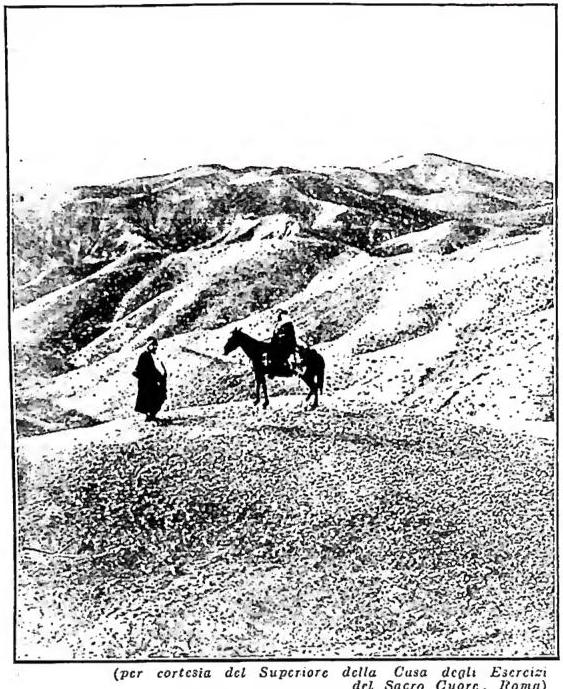
(courtesy of the Superior of the House of Exercises of the Sacred Heart, Rome)
GIUDEA - Desert of G.
losophy, Filadelfia 1916, reprint with updated bibliography 1941; E. Bertola, La filosofia ebraica, Milano 1947; G. Vajda, Introduction à la pensée juive du moyen âge, Parigi 1947. Eugenio Zolli