
GIUDA LEVITA (Jéhâdhâh ben Šemû'el hal-Lêvi, in Arabic Abû'l-Hasan b. al-Lêvi). — Jewish poet and apologist, born in 1070 (or 1075) at Tudela. He later lived in Toledo and elsewhere in Spain. He had many poets and literary men among his friends, including Môšeh ibn 'Ezra', as well as many influential protectors.
His youthful poems are bacchic, amorous, floral, and composed of riddles; in his mature years he wrote poems of religious and moral content, some imbued with sorrow over the fate of his people. As regards form, he was influenced by contemporary Arabic poetry, but distinguished himself from it through greater restraint. His song for Zion, the Sionide, is famous. The rise of the pseudo-messiah Môšeh Dera' provoked many satirical jibes from Muslims. To demonstrate the superiority of biblical Revelation over Neoplatonism and Aristotelianism, G. composed the dialogue hak-Kûzâri (“The Khazar”), whose Arabic title was: Kitâb al-hugâh wa 'd-dalîl fî naṣr ad-dîn ad-dalîl (“Book of proof and foundation in defense of the despised religion”), a work of theological Zionism. The king of the Khazars recognizes the superiority of the Jewish religion. Overcome by longing for Zion, G. undertakes the journey to the Holy Land. The poems concerning the visions of Egypt and the seafaring songs were the fruit of this journey. Did he reach Palestine? Where and when did he die? Nothing certain is known.
(Ist. Orlandini)
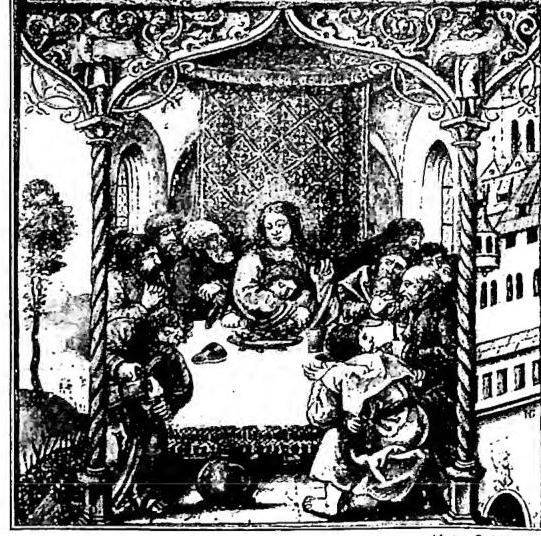
GIUDA ISCARIOTA — G. present at the Last Supper. Miniature by N. Glockendon of Nuremberg (1534) in the Meditations in vitam Jesu-Christi — Modena, Biblioteca Estense, Ms. a, U. 6, 7, fol. 32.