
GIUDA ISCARIOTA. – Apostle, sadly famous for having betrayed Jesus. Son of a Simon, from the city of Qérijôth (Io. 6:72; 13:2–26), perhaps the present-day Hirbet el-Qarjatejn, a small town in southern Judea, he was called to the apostolate (Lc. 6:16) and appointed administrator of the group of the “twelve” (Io. 12:6; 13:29). He betrayed the Master for thirty pieces of silver (Mt. 26:14 ff. and parallel texts). A participant at the Last Supper, he does not seem to have taken part in the Eucharistic Communion (Io. 13:2–32). He led co-
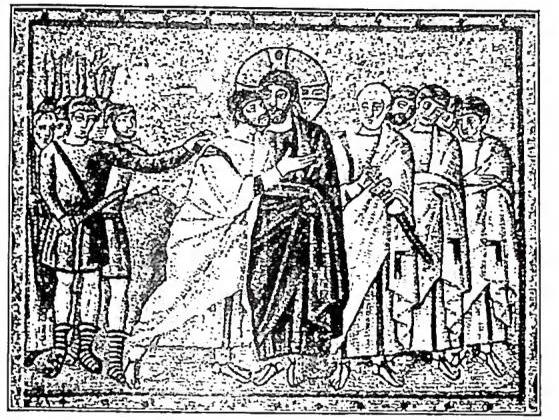
In the lists of the Apostles, G. is always named last, with the infamous designation « the traitor » (Mt. 10, 4; Mc. 3, 19; Lc. 6, 16). Jesus knew from the beginning « who the traitor was » (Io. 6, 6), and designated him with the titles: « a devil » and « son of perdition » (Io. 17, 12). But one must not suppose that G. had perverse desires from the outset or that he was an intruder in the apostolic college; he was chosen by Jesus together with the others: he must have possessed practical abilities and good qualities that made him worthy of being chosen as an apostle and treasurer.
The crisis perhaps began in the synagogue of Capharnaum, where Jesus’ response to Peter suggests that G. did not share the faith of the head of the Apostles (Io. 6, 70 f.). More than Peter, G. must have been scandalized by Jesus’ repeated predictions of the Passion (Mt. 16, 21-23; 17, 22 f.; 20, 18 f.). His avarice, which made him a « thief » (Io. 12, 6), then continued to increase, and Jesus’ rebuke at the supper in Bethany must have stung him (Io. 12, 7 f.), where he learned from the Master’s words that his end was now near. He received confirmation of this after Jesus’ triumphant entry into Jerusalem, when Jesus alluded to his own Crucifixion (Io. 12, 32). Then the crisis erupted. And G. went to the priests to ask how much they would give him to hand the Master over to them (Mt. 26, 14). It is difficult to establish the psychological motive for the betrayal. The Evangelists, in addition to God’s design (Io. 13, 18; 17, 12; Act. 1, 16), point to avarice. But this does not fully explain G.’s conduct after Jesus’ condemnation. Love of money, wounded pride, and shattered illusions must have contributed to G.’s betrayal, and a certain love for Jesus cannot be ruled out—human love that revived as an impulse of despair when the consequences of the horrendous deed became clear. Then G., having returned the money, went and hanged himself (Mt. 27, 5); the rope broke or the branch bent, and he, falling to the ground, « burst open in the middle » (Act. 1, 17).
Legend also built upon G. While the Arabic Gospel of Infancy represents him as possessed by the devil from childhood, Papias mentions some who believed that he had survived the hanging (in F. X. Funk, Patres ap., Paderborn 1901, pp. 360-63).
G. also found his apologists in the course of the centuries. From the Cainites of the 2nd century to a Roué of the present century, through E. Renan, Petruccelli della Gattina, G. Bovio, and others, a succession of admirers has sought to defend his person and his deed, or at least to excuse him. But against every attempt at rehabilitation stands Jesus’ word: « The Son of man goes, as it is written of him; but woe to that man by whom he is betrayed: it would have been better for him if he had never been born » (Mt. 26, 24).
1947. Archaeology
On certain Christian sarcophagi, two successive scenes of G. with the Redeemer can be observed; the first represents the encounter, when the traitor approached, greeting him: « ave Rabbi »; the second moment is the kiss (Mt. 26, 47-48). Thus on the sarcophagus of Servanne (Wilpert, Sarcofagi, pl. 15, 2). Several examples are known of the scene of G.’s kiss on sarcophagi, among them one known since the time of A. Bosio (Roma sotterranea, Rome 1632, p. 431); others were published by Garrucci and Le Blant. Among these, mention may be made of the sarcophagi of Verona (Wilpert, Sarcofagi, pl. 150, 2) and of Arles (ibid., pls. 32, 3; 148, 2; 217, 3). There is a single example on sarcophagi of G.’s hanging, at Arles; of it Wilpert identified in the Museum of Nimes the fragment with G.’s two-faced head; the artist thus wished to express falsehood (ibid., pl. 15, 1).In non-cemetery art, G. is represented on one of the columns of S. Marco in Venice when he goes to receive the thirty pieces of silver (Venturi, I, fig. 252). On the ivory casket of Brescia, G. points Jesus out to the soldiers (J. Kollwitz, Die Lipsonothek von Brescia, Berlin 1933, p. 15, pl. 1).
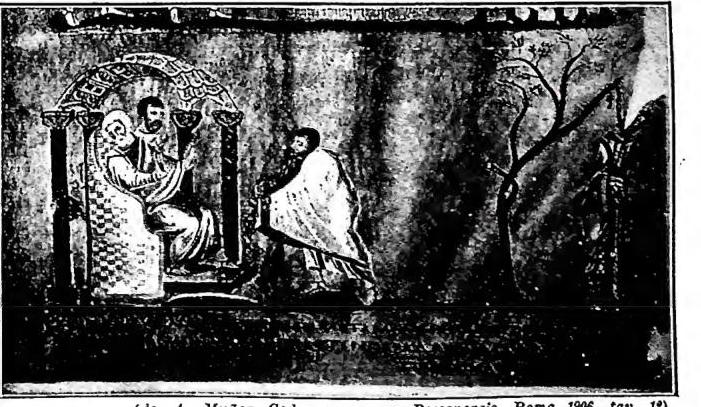
In the Evangelary of Rabbùlà, G. embraces the Redeemer at Gethsemane (R. Garrucci, Storia dell’arte cristiana, III, Prato 1876, pl. 138); in the mosaic cycle of S. Apollinare nuovo (6th century), G.’s kiss is represented first, as on one of the columns of S. Marco in Venice, and then he is shown handing back to Caiaphas the price of his betrayal, a scene also found on a diptych in the cathedral of Milan and on one of the columns of the ciborium of S. Marco. In the mosaic cycle of a basilica in Spain, perhaps at Saragossa, G. was depicted hanging from the tree, as attested by the illustrative distich composed by Prudenzio (Dittochalon, no. 41); this scene is found several times, for example, in the Lipsanoteca of Brescia (J. Kollwitz, op. cit., p. 32, pl. 5); on an ivory in the Museum of London (O. M. Dalton, Catalogue of the ivory carvings of the christian era of the British Museum, London 1909, no. 291); on a diptych of the cathe-
(Ist. Orlandini) GIUDA ISCARIOTA - G. receives the thirty denarii. Relief placed at the entrance to the crypt of the Cathedral—Modena (12th century).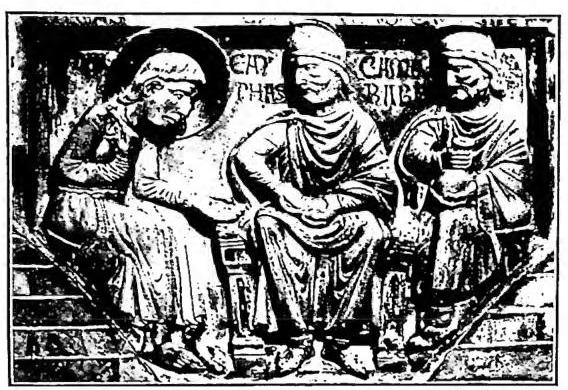
In some Christian inscriptions of Rome, Capua, Nola, and Ravenna, imprecatory expressions are found against the violator of tombs, who is threatened either that he «anathema habeat de Iuda» or that he «cum Iuda partem habeat».
2. Art.—Apart from his appearance in the countless images of the Last Supper, the representations of the kiss and the arrest form an essential element of the Passion cycles in medieval Byzantine and Italian monuments (mosaics in S. Marco in Venice and in Monreale; frescoes in S. Angelo in Formis; bronze doors at Benevento and Monreale), reaching their highest artistic level in Giotto’s fresco in the Arena Chapel at Padua. The further iconographic development of these themes concerns the introduction of realistic details into the bearing of the constables (cf., for example, the prints of the late German Gothic period and, again, Dürer’s three woodcuts); Renaissance artists tried their hand at reproducing a nocturnal scene.
Of the other scenes in which G. is the protagonist, the bribery with the thirty shekels is encountered for the first time in the 9th century (the Chludov Psalter in Moscow); in the West, the relevant examples are divided among Germany (the Gospel Book of St. Bernward at Hildesheim, ca. 1000; a relief in the choir of Naumburg Cathedral, ca. 1270), southern France (Romanesque reliefs in the friezes of St-Gilles and Beaucaire), and Italy (the relief on the aforementioned column of the ciborium in S. Marco, the relief of Modena Cathedral, Duccio’s painting in Siena, and Giotto’s frescoes in Padua and Barna’s at S. Gimignano). In contrast to G.’s repentance, of which the ciborium column in Venice provides one of the very rare representations, the punishment of the traitor—that is, his hanging—which had already been found in an ivory in London dating from around 400, is encountered in the Rabbülâ Gospel Book, in Byzantine miniatures, in the Catalan Bibles (ca. 1000), and also on the ciborium column in Venice. As time passed, there emerged a tendency to render the scene of the suicide, originally limited to the strictly essential elements, as gruesome as possible: with reference to the text Act. 1, 18, the thirteenth-century reliefs on the Calenda portal at Rouen and on the central façade of Reims show the entrails emerging from the disembowelled body, while in a relief at Strasbourg (ca. 1300) the devil himself extracts them.