
HOLY WEEK (Major hebdomada, Hebdomada sancta, Hebdomada authentica). — It is the week preceding Easter, also called the “greater” or “authentic” week, because it commemorates the Passion, Death, burial, and Resurrection of Christ. Today the last three days (Thursday, Friday, and Saturday) are called the Sacred Triduum and have their own proper Offices.
Originally, on the weekdays of Holy Week no Holy Eucharist was celebrated. Even St. Leo I the Great (440–61) clearly distinguished between the first days, including Thursday, which were called Lent, and the other three, considered as a single unit. The days of Good Friday and Holy Saturday were days of strict fasting (Hippolytus, Innocent I); together with the following Sunday of Easter they were called the “paschal sacrament,” the “paschal feast” (St. Leo, Serm. 47 and 48). At first, only on Good Friday was there an assembly with readings and prayers alone; later the preceding Wednesday was added, on which St. Leo continued his sermons on the Passion, begun on the Sunday of the Passion, as Palm Sunday was then called. On this Sunday the Passion according to St. Matthew was read, on Wednesday that of St. Luke, and on Friday that of St. John; hence the entire week came to be called Passion Week (cf. in cod. Vat. lat. 316: Sunday “in palmis,” “de Passione Domini”), at first without fasting. To these two aliturgical days was added Holy Thursday as a liturgical day. At the time of St. Augustine (d. 430) in Hippo, on Holy Thursday there were two liturgical assemblies in honor of the institution of the Holy Eucharist: one in the morning for those who did not fast, the other for the fasters (“mane offertur propter prandentes, quia ieiunis simul et lavarum tolerare non possunt, ad vesperam vero propter ieiunantes,” Ep. 54, 9). Even in Rome in the 5th century there was at least one Eucharistic assembly on this day, because on it were fixed the reconciliation of penitents and the blessing of the holy chrism. Holy Monday acquired its liturgy when the Monday, Wednesday, and Friday of every Lenten week did, namely in the time of St. Leo or shortly before (A. Chavasse, Le carême, pp. 331–34). In the years 546 and 550 (Codex Epistolaris of Fulda by Victor of Capua and Capitulare evangeliorum Neapolit.) Holy Tuesday too was provided with a liturgy or readings. Good Friday and Holy Saturday (the primitive Christian Easter) never had Eucharistic celebration either in Rome or elsewhere.
On Holy Monday: the reading was John 12:1–36, “Ante sex dies…,” now reduced to 1–9.
On Holy Tuesday: the Gospel reading was originally John 13:1–32 (the washing of the feet and the denunciation of the traitor); it was still read in the 8th century (Comes of Würzburg), then replaced (9th century) by the Passio of St. Mark. The Gospel, now reduced to John 13:1–13 (instead of 1–32), is read today on Holy Thursday (the Capitulare of Würzburg records no Gospel for this day). In the time of Egeria, the Passio of St. Mark was read on Good Friday (12th century, also at Monte Cassino) together with that of St. John; at Rome it was read on Easter Sunday itself (Baumstark, Liturgie comp., cit. in bibliography, pp. 183–84).
On Holy Wednesday: at Jerusalem (in Egeria’s time) the Gospel passage of Judas’s betrayal was read. At Rome, originally an aliturgical day, it later had two services: one in the morning at the Basilica of St. John Lateran, where besides the usual readings the Orationes sollemnes were recited (now used exclusively on Good Friday). In aliturgical synaxes there were normally three readings: the Passio of Luke, attested in the Capitularia at the end of the 7th century, perhaps already in use in St. Leo’s time; or was the reading of St. Matthew continued, as St. Leo’s words suggest: lectio dominicae passionis iterabitur? Even today on Holy Wednesday there are three readings (a sign of antiquity in contrast to Monday or Tuesday, which have two). The morning aliturgical assembly is the more ancient. Another took place in the evening at the Liberian Basilica with the Eucharistic celebration; it began with the Offertory, then the morning readings followed. Only the Orationes sollemnes were left to the morning assembly; cf. Ord. Rom. XXVI, 1–7 (Andrieu).
On Holy Thursday the institution of the Eucharist is commemorated. It is called Feria quinta in Coena Domini in Africa and Italy from the beginning of the 5th century; also Natalis calicis (with the date of March 24) in southern Gaul in the 6th and 7th centuries; natalis sacramenti is found in a Preface of the Leonianum (XXVIII, 4). In the Roman Sacramentaries, but of Gallican origin, there are three Masses for Holy Thursday.
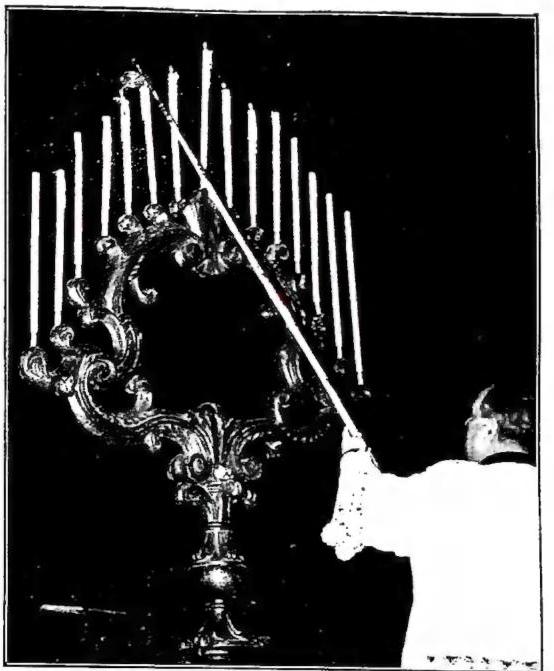
HOLY WEEK - Triangular candelabrum with 15 candles which are successively extinguished at the end of each psalm of Matins and Lauds of the Office of Tenebrae. The candelabrum reproduced here is that of St Peter’s Basilica.
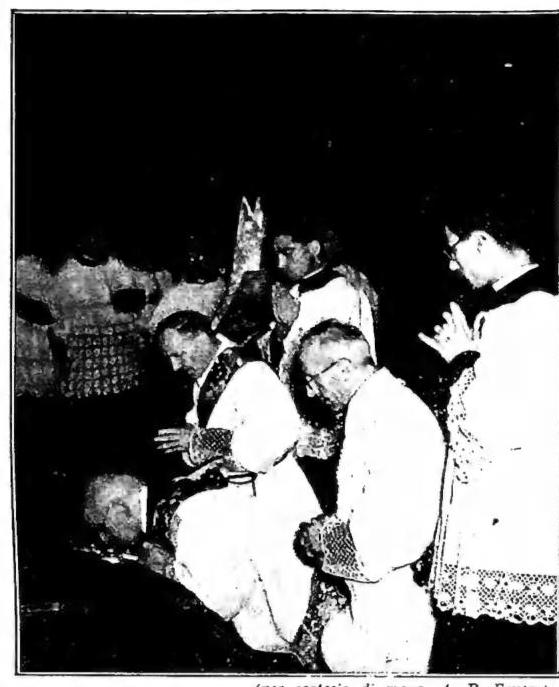
SETTIMANA SANTA - Adoration of the Cross during the liturgical action of Good Friday. The celebrant and the ministers depicted here are canons of the basilica of St. Peter.
The Preface is recited, and the oil of the catechumens is consecrated with a simple prayer, preceded by an exorcism. On this Mass of Holy Thursday another Host is consecrated (in some regions of Germany even a third for the “holy sepulchre”) for the “Mass of the Presanctified” on Good Friday. This consecrated Host is carried after Mass with a more elaborate ceremonial beginning in the 11th century to a specially prepared chapel; this chapel becomes the representation of Christ’s sepulchre, especially from Good Friday until Easter dawn.
After Vespers (composed in the 11th century), the recitation of Psalm 21 is followed by the stripping of the altars, a very ancient ceremony, since it is a remnant of the primitive custom of removing the altar cloth every day. In the Middle Ages the washing of the altar was added, which is still performed today in the Vatican Basilica and in monasteries. The last function of Holy Thursday is the Washing of the Feet, called Mandatum from the first antiphon (Jn 13:34): an act of charity on the example of Christ (Jn 13:1–15), common in the Church (St. Augustine, Ep., 55, 18–33); made obligatory for all bishops and priests toward their dependents by the Council of Toledo in 694. The washing is mentioned in the Ord. Rom. X, 12, and XII, 25, 27. Today, after the reading of the Gospel (Jn 13:1–15), the feet of twelve poor men are washed; while some antiphons relating to the Gospel event are sung, especially the hymn Ubi caritas… (of Veronese origin from the 9th century, rich in a very simple but very ancient and precious melody).
A peculiarity of these three days is the silence of the bells after the singing of the Gloria on Holy Thursday until the Gloria of the Easter vigil, already noted by Amalarius. In place of bells and handbells, signals for sacred functions are given with a tabula, crepitaculum or crotalum, of wood derived from monastic usage since the time of Cassian (De instit. caenob., I, 2, 17; IV, 12), in the Middle Ages by the Cluniacs (v. CREPITACOLO; CROTALO).
Good Friday (according to St. Augustine and St. Leo) was still the first day of the sacred Paschal Triduum (St. Aug., Ep., 55, 14: “sacratissimum triduum crucifixi, sepulti, suscitati”); it is called “parasceve,” i.e., “preparation,” from the Greek (παρασκευή). It was an aliturgical day in the West and in the East; in Spain in the 7th century churches were kept closed. Another custom of this day was the recitation of the entire Psalter, as Honorius III (1216–27) did “primo diluculo una cum suis cappellanis totum psalterium ex integro”; in the same century the monks of Monte Cassino did so barefoot. At Rome the functions are held in the basilica of Santa Croce in Gerusalemme; formerly (as in the “Gelasian Sacramentary”) at the 9th hour of the day or toward evening.
Eulogical Service. — This first part of the present functions is a fine example of ancient aliturgical assembly. As in the time when the Introit was not yet sung, the ministers prostrate themselves on the floor praying in silence; in the meantime the altar is prepared. Then the readings begin at once; the first from Hosea (Hos 1–6 of Gallican origin), with a responsorial psalm from Habakkuk (Hab 3:1–3; the verse “in medio duorum animalium” is referred to Christ crucified between two thieves); the second from Exodus (Ex 12:1–11) alludes to the symbol and figure of Christ’s sacrifice in the Paschal lamb of the Hebrews. This is followed by a third reading: in the church of St. Augustine the Passion according to Matthew was read; that according to St. John is attested from the time of St. Gregory the Great. As a rule, the aliturgical assembly concludes with the Solemn Prayers for all the people and for each class of them; a common usage in the Holy Mass until the 6th century (in the 8th century still on Holy Wednesday, V. above). In the Prayer for the Jews the usual genuflection after the invitation “Oremus” is omitted after the 9th century for symbolic reasons (cf. Ord. Rom. XII, 29). This was followed by the sermon of the officiating bishop (four homilies delivered on Good Friday by St. Augustine are preserved).
The Adoration of the Holy Cross. — It comes from Jerusalem, where, according to Egeria, it was performed before the relic of the True Cross, and was a simple rite without precise liturgical character: the bishop held the relic, kissing it and applying it to the forehead and eyes; no chant, no prayer; everything took place in silence. This rite was introduced into Rome (Ord. XVI, 33–34 does not have it) perhaps in the first half of the 7th century. According to the description in the Ordo of Einsiedeln (Ord. Rom. XXIII, 9–22) the pope went from the Lateran to Santa Croce in Gerusalemme; behind him the Holy Cross was carried (A. Baumstark, Lit., cited in bibliography, p. 153) by a deacon in a casket and placed on the altar; the Pope uncovered the Holy Cross, prostrated himself to adore it; the faithful followed; but women, so as not to let them approach the altar, the sacred relic was brought to them. After the veneration the readings of the eulogical service continued and the functions of the Presanctified were added; the Pope himself and his deacons did not communicate.
In other churches there was a double rite, in the morning the eulogical service, in the evening the veneration of the Holy Cross together with the rite of the Presanctified (Ord. Rom. XXIII, 29–38 [Andrieu]); the Cross was placed before the altar carried by two acolytes; then it was venerated by the Pope and the people; meanwhile the antiphon Ecce lignum was sung, with Psalm 118; this was followed by the Mass of the Presanctified (cf. Ord. Rom. XXVII, 41–50). The present rite of the Adoration of the Cross was formed between the 9th and 11th centuries in Spain and Gaul: the uncovering and exhibition of the Cross, the triple prostration, the Improperia, the Byzantine trisagion (in Greek and Latin), the antiphon (of Greek origin) of triumph Crucem tuam, the two hymns of Venantius Fortunatus Pange lingua and Vexilla Regis; all this is found in the Roman Pontifical of the 12th century (M. Andrieu, Le Pontifical romain au moyen âge, I, Vatican City 1934, p. 236, nn. 8, 9).
The Mass of the Presanctified. — It is a simple rite of communion, made with the Sacred Species “presanctified,” i.e., previously consecrated, used on aliturgical days, as the Greeks did in Lent etc., on Saturday and Sunday; at Rome only on Good Friday. It seems that at first the Roman Church (like the Ambrosian rite still today) did not officially have the use of the Presanctified, which entered the papal liturgy between the 7th and 8th centuries (Duchesne). The primitive rite contained only the Our Father with the embolism, followed by the fraction and commixture recited aloud; then offertory prayers were added, the incensation of the offerings and of the altar, the washing of hands (Ord. Rom., XIV, 83; the elevation of the Host (Ord. Rom., XV, 77) at the words sicut in caelo et in terra (today after the embolism); a French usage of the 14th century, perhaps introduced at Avignon.
4. Deposition (burial) of the Cross and of the Host
A rite intended to commemorate in a more expressive manner the burial of the Lord, dating from the 10th century (cf. the biography of St. Ulrich of Augsburg [d. 973]), in use almost everywhere except in the Church of Rome; it continues in Germany and Austria.The Cross or a consecrated Host or both together are carried into a kind of sepulchre, there incensed and sprinkled with holy water, and finally the sepulchre is closed and sealed, to be venerated by the piety of the faithful. At the dawn of Easter Sunday they are solemnly taken out to represent the Resurrection.
Sabato Santo. — Nei primi sei secoli, sia in Oriente che in Occidente, era giorno completamente liturgico. Le funzioni che si svolsero, durante più di un millennio, il Sabato Santo, si celebravano in origine nella notte successiva. Al tempo di s. Ambrogio (397) a Milano e di s. Agostino (430) ad Ippona si celebrava lungo tutta la notte la veglia pasquale; s. Girolamo invece (419-20) accenna a una funzione che occupava soltanto la prima parte della Notte Santa (ante noctis dimidium dimittere non liceus). La veglia della prima parte della Notte Santa diviene la regola sotto Leone I (m. nel 461) a Roma, sotto Lupo di Troyes (m. nel 479) in Gallia, nello stesso tempo nel Testamentum Domini per la Siria. Da Giovanni diacono nel 523-26 la fine della solennità sembra già celebrata alla sera del Sabato Santo; lo stesso risulta da un racconto meno edificante di s. Gregorio (m. nel 604) nella Spagna (sacratissimo paschali Sabato post ieiunium), e inoltre una seconda Messa «in Notte Santa» si diceva alla prima luce del giorno di Pasqua. Il Gelasiano più antico (Bibl. Vat., Reg. 316) in una rubrica dopo le Orationes per singulas lectiones in Sabato Sancto determina l'ora della Messa in nocte: et ingrediantur ad missas in vigilia ut stella in caelo apparuerit e contiene una seconda Messa nel Dominicum Paschae. Anche i Sacramentari del tipo gregoriano hanno una Messa in Sabato Sancto in nocte e un'altra «in dominico sancto»; la domenica seguente si considera fuori dell'ottava die dominica post albas (scil. depositas; V. PASQUA, II, 3).
BIBLI: P. de Puniet, Du rite des processions à la consécration des saintes Huiles, in Rass. Greg., 2 (1900), p. 216 sgg.; A. Baumstark, Der Orient und die Gesänge der «Adoratio Crucis», in Jahrb. f. Liturgienrissensch., 2 (1922), p. 4 sgg.; L. Duchesne, Origines au Culte chrétien, Parigi 1925, pp. 260-71; A. Wilmart, L'Hymne de la Charité pour le Jeudi saint, in Auteurs spirituels et textes dévolts du moyen âge, ivi 1932, pp. 26-36; E. Eisenhofer, Handb. der hath. Liturgie, I, Friburgo 1932, pp. 311-50; A. Baumstark, Liturgie comparée, Chevetogne [1939], pp. 149-55; 183-84; M. Righetti, Man. di stor. liturg., II, Milano 1946, pp. 140-82; A. Chavasse, Le carême romain et les scrutins préhaptistiaux avant le IXe siècle, in R. de sc. rel., 35 (1948), pp. 325-87; A. Chavasse, La préparation de la Pâque à Rome, avant le Ve siècle, Jeune et organisation liturgique, in Bibliothèque de la Fac. cath. de théol. de Lyon, Mémoire I, Chaîne, 5 (1950), pp. 61-80; A. Stulber, Von der Pascha-Nachtsache zum Karsanstagsgottesdienst, in Katechet. Blätter, 75 (1950), pp. 48-107; M. Andrieu, Les «Ordines Romani» du haut moyen âge, III, Lovanio 1951; J. A. Jungmann, Die Vorverlegung der Ostervigil seit dem christl. Altertum, in Lit. Jahrbuch, 1 (1951), pp. 48-54; H. Vorgrinder, War die altchristl. Ostervigil eine ununterbrochene Feier?, in Zeitschr. für hath. Theol., 74 (1952), pp. 464-72. Pietro Siffrin
FOLKLORE. — The folkloric cycle of Palm Sunday (v.) to Easter Monday. Rather than describing the rites of Holy Week day by day, it is more useful to classify the various folkloric elements, especially since these are concentrated particularly on Holy Thursday, Good Friday, Holy Saturday, and Easter Sunday. The cycle thus presents liturgical ceremonies to which the people have given their own colors and forms without altering their character; ritual ceremonies aimed at securing good fortune that recur at the beginning of each year or season, and in particular for Easter indicate the beginning of spring, so much so that the period is also called “the time of the beginning of spring or of Easter”; and finally, various superstitious beliefs and practices, each of which may elude our understanding, but which taken together point back to the sacred and exceptional nature of those days.
The first group includes dramatic processions, sacred representations, and other living relics of medieval and Renaissance religious drama, as well as certain ecclesiastical prescriptions in which the folkloric element has been added to the liturgical one. Processions occupy a place of primary importance in all survivals of sacred drama, and it has been observed that “the rhythmic movement of masses of people, especially when the rhythm is heightened and marked by divisions into companies or groups dressed in special uniforms, as well as by songs and sounds, creates an atmosphere of connection, cohesion, and mutual understanding among the crowds and prepares their spirits to fully grasp what will constitute the climax of the event or rite” (Toschi). Easter processions are characterized by scenes from the Passion, known as “mysteries,” reconstructed using wooden or papier-mâché statues and sometimes living groups of people: preeminent for their splendor are the procession of Seville in Spain, with its groups (pasos) partly composed of statues and partly of living people, and with the colors of the garments always the same (blue and white for the Virgin, green for St. John, and yellow for Judas); in Italy, the procession of Trapani, where the 18 mysteries carved in wood at full size are carried on the shoulders by representatives of different guilds (cooks, waiters, carpenters, etc.) and visit all the churches, entering through the central door and exiting through the side door; that of Caltanissetta, where the mysteries are 15 groups modeled in papier-mâché that the people call vare and designate according to the social class to which they belong (“vara de li sulfatara,” sulfur miners; “di livucci,” butchers; “di li vinaroli,” wine merchants, etc.); and also those of Sezze in Lazio, Grassina in Tuscany, Romagnano in Piedmont, and Vértova in the Val Seriana. In Bari, the Easter procession takes on a penitential character: the confraternity members are called perdune and proceed two by two, barefoot, dressed in wide white tunics, their faces covered, a crown of thorns on their heads and a long staff in hand; the triscola (elsewhere called raganella, scarabattola, etc.), a wooden instrument with small metal plates that makes a clattering sound and substitutes for the sound of bells, is auctioned off the day before, and obtaining it (one may end up paying several thousand lire for it) is considered a penance performed by the sinner; the triscolare leads the procession, regulating its route, stops, and pace, which is slower or faster depending on the sin to be expiated. In some towns of the Mezzogiorno, especially in Sicily, the chanting of the lamentanza, a litany in dialect sometimes mixed with Latin, accompanies the rhythmic procession of the crowd. Among the sacred representations of the Passion of Christ, the most famous is the one that is reenacted every year Oberammergau (v.).
The setting up of the sepolcri (Easter sepulchres), practiced in parishes of the Roman rite, shows the folkloric element in the variety of decoration, which is related to local traditions: laden with statues, paintings, and scenes evoking the Passion are, for example, those in Spain; in some regions of France, such as Roussillon and Cerdagne, they are called monuments on account of the richness of their adornments; in Italy, notable examples are those set up in Sicily, e.g., in the church of S. Anna dei Lombardi at Monteoliveto; in Naples, in the church of the Girolamini with very ancient gold-embroidered fabrics, and in the church of S. Francesco di Paola with a 14th-century gilded bronze urn. A complete folklorization has been achieved in Nantes, where the sepulchres are installed along the streets.
Among the propitiatory rites classified in the second group, the custom of singing and begging for eggs deserves special mention. The egg has a symbolic value of fertility, also in relation to the spring season; but historically, the practice of giving eggs does not date back in Europe earlier than the 16th century (the oldest document is from Alsace); in the 18th century, it was customary in the Kingdom of France during Holy Week for the largest decorated egg to be given to the king. In Paris, students and altar boys used to go begging for eggs to the sound of bells and drums. In the Jura, shepherds go around at Easter from house to house leading a young girl adorned with flowers and ribbons, called the May Queen; the same ceremonial is used to celebrate May Day in Provence and elsewhere. On Holy Saturday, the mountain girls of the upper Val Brembana offer eggs, wrapped in embroidered handkerchiefs, to their sweethearts, who bring in return an olive branch tied to some object; the arboreal spirit present in these rites is a symbol of spring. And the very outings on Easter Monday, so traditional over a vast area, have always had the appearance and significance of spring rites. The coloring of eggs is folkloric in terms of technique (in Anjou, for example, cardinal red is obtained by boiling onion skins with vinegar) and in terms of interpretation (red is considered almost everywhere effective against any evil influence). Eggs are also used in various games, the most specifically Easter-related and widespread in Europe being two: one consists of having two eggs collide; the player whose egg does not break is the winner and takes possession of the opponent’s egg (coccotta in the Marches, sobaz in Romagna, toguette in France, Eierspecken or Eierpicken in Germany, croquer in French-speaking Switzerland, and Tupfen and Tütschen in German-speaking Switzerland); the other consists of rolling the egg down the slope of a meadow, with the winner being the one who manages to send it the farthest; this game, called cutulello in the Marches, which is widespread in France (roulée), Scotland, Germany (Eiervallen or Eierscheiben), and all over Eastern Europe, some scholars have sought to give a ritualistic explanation. What is certain about both games is their propitiatory character for the opening of a new cycle: the roulée, for example, was played at Christmas with nuts in Nans-sous-Thil, in Burgundy during Carnival days, and the winner was proclaimed queen of Jaudiau. Other transfers to Easter of Carnival rites are documented by Fehrle in Germany, where the winner of certain horse races was called king; similarly, a final trace of the “king of Carnival” can be recognized in the Romagnol custom described by Placucci: on Holy Saturday, “a man is found who is the clumsiest and least clever in the village; a box full of stones is placed on him, and he is ordered to carry it to the parish, being told that it contains the keys of the alleluia;” from the church it is carried around until the trick is discovered. Also propitiatory is the custom, documented in Romagna, of observing, on Holy Saturday, an hour before the Ave Maria, “to see the champions, who are the winds that will dominate the coming year; thus to predict good or bad fortune that may befall the products of the countryside in the said year”: this is a typical rite of every annual or seasonal beginning.
Innumerable, finally, are the beliefs and superstitious practices not properly connected with the Paschal cycle as such, but referring to it only insofar as it is an exceptional period. Common to the feast of St John is the custom of bathing at dawn in the dew, which is held to be blessed. In general, the water of Easter night preserves from evils and makes women beautiful: in Sicily, people and sick animals immerse themselves in the sea; in Romagna, at the moment when the bells are unbound, the peasants are wont to bathe their eyes to preserve their sight; in Saxony and Silesia, young men hidden near riverbanks and fountains sprinkle water on girls who come to draw II. Forms of compaternity are the so-called rites of fraternisation performed in Ukraine with an embrace and among the South Slavs with the mingling of blood, on the day after Easter or on another solemn or fair day, called druzzicola, the day of friendship. Many other customs are related to the silence of the bells: the people of Romagna, for instance, when the bells are bound on Holy Thursday, tie trees to make them fruitful; others tie them on Holy Saturday so that mist may not harm them; in many towns of Abruzzo and Romagna, from the binding of the bells to their unbinding, a fast (trapassato) is observed. Among the various taboos of Holy Week, the most universally widespread is the suspension of all work, as during any feast: in some regions of Italy and France, in particular, women must not do the laundry, especially on Good Friday, which is a day of mourning.