
TRAPANI, DIOCESI di. – Diocese and provincial capital city in western Sicily. It has an area of approximately 1,090 sq. km, with a population of 196,158 inhabitants, of whom 195,180 are Catholics, distributed among 47 parishes served by 109 diocesan priests and 53 religious priests; it has one seminary, 13 male and 49 female religious communities (Ann. Pont. 1953, p. 429). The diocese is a suffragan of Palermo. The Cathedral is dedicated to s. Lorenzo.
The city rises at the foot of Monte Erice, facing the Egadi Islands, and was called Drepana because of the sickle shape of its harbor. It was the maritime emporium of Erix (today Monte S. Giuliano). To this extreme corner of Sicily is linked the Trojan legend which, in its later reworking (especially Virgilian), has Anchises die there and attributes to Aeneas the foundation of the temple of Venus Erycina, upon whose ruins the present sanctuary of the Assumption was rebuilt (15th century). T. was fortified by the Carthaginian Hamilcar; its waters witnessed the defeat of the Roman consul P. Claudius Pulcher. After the battle of the Egadi Islands (241 B.C.), it fell into the power of the Romans, who made it a consular city. It subsequently came under the Vandals of Genseric, from whom it was taken by Belisarius. Occupied by the Arabs in 844, it later experienced Norman, Hohenstaufen, Angevin, and Spanish rule. Peter III of Aragon landed at T. in 1283, summoned by the Sicilians to the crown of the island after the revolt of the Vespers; in 1535 Charles V stopped there after his victorious campaign in Tunis. From the Aragonese onward, the city shared the historical vicissitudes of the rest of Sicily.
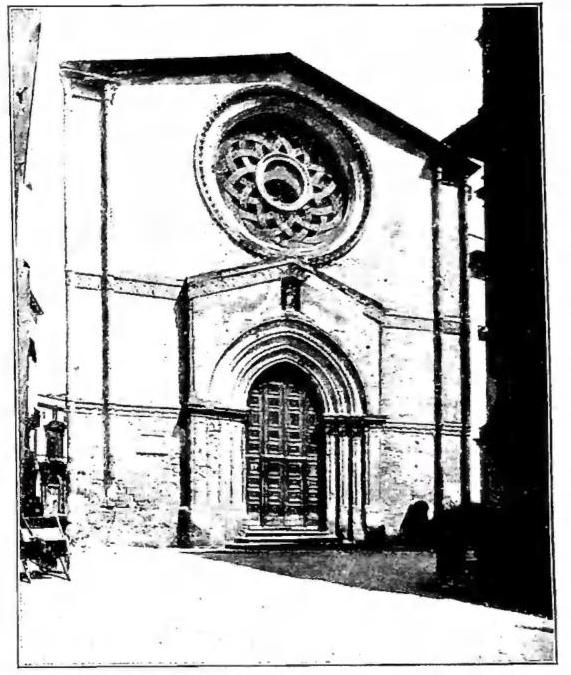
(Alinari photograph)
Enzo Navarra
ART. — Architecture. — Impressive ruins of Phoenician architecture are found at Motya, a small island just south of the city. The oldest construction, however, is the Colombara, a fortress guarding the port, already existing in the time of the Elymians and continually rebuilt; the principal framework of what remains of it dates from the Norman period. Clearer evidence is provided by Chiaramontan architecture: the basilica of the Annunziata, with the appearance of a fortress on its northern side, the church of S. Agostino, and the Fountain of Saturn (1342). The chapel of the Fishermen of the Annunziata, in the Catalan style, dates from the end of the fourteenth or the beginning of the fifteenth century. Here and there, moreover, in the streets, one notices distinctive round-headed “fan-shaped” arches on low pillars (the arch of the Palazzo del Banco di Sicilia). Belonging to the second half of the fifteenth century are the chapel of the Marini family in the Annunziata, the Palazzo Cismbra (Giudecca), and Casa Pilati. The seventeenth and eighteenth centuries are extensively represented by the churches of the Collegio dei Gesuiti (Francesco Pinna), the Badia Nuova, the Purgatorio, and S. Lorenzo (G. B. Amico), as well as by the Palazzi Cavaretta, forming the backdrop to the Corso, Xirinda, and the Carmelite convent, now the Pepoli Museum.
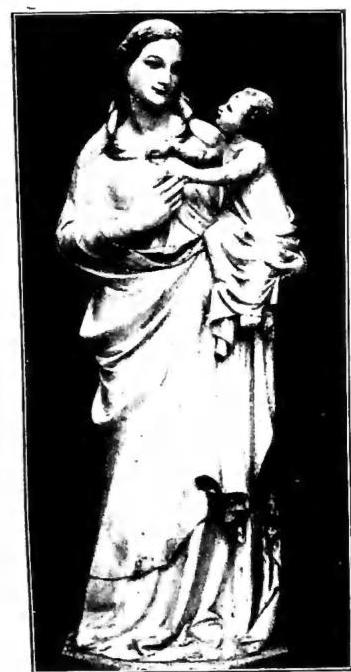
Sculpture. — The oldest and most notable surviving work in the city is the Madonna di T., from the school of Nino Pisano (fourteenth century). Works from the early years of the sixteenth century, on the other hand, are the portal of the chapel of the Madonna della Annunziata, the baldachin of the Carmine, that of S. Maria di Gesù, and a triptych now in the Museum, all works by Antonello Gagini.
Pietro Orlandini, a notable seventeenth-century wood sculptor, left a cabinet in the sacristy of the Collegio and another now in the Museum, as well as a Crucifix in the church
There are also paintings by Andrea Carreca, a local painter. A fine painting in the Flemish school is found in the Badia Nuova. The minor arts were particularly highly developed in T. in the seventeenth and eighteenth centuries: jewelry, carvings in ivory and coral, and ceramics. Worthy of mention are the Museum’s extremely rich nativity scene and coral Crucifix; numerous altar frontals, lamps, sacred furnishings, cameos, nativity figurines, works by Tipa, Laudicina, and Matera; and the maiolica pieces held in the Museum and in several private collections. — Vedi tav. XLIV.
Maria Pia Cosentino