
MAZARA del VALLO, DIOCESE of. – City and diocese in the province of Trapani, in Sicily. It has an area of 1,905.10 sq. km.; 252,800 inhabitants, all Catholics; 50 parishes served by 197 diocesan and 34 religious priests, one seminary, 8 male and 38 female religious communities. Patrons: the holy martyrs Vito, Modesto, and Crescenzia.
I. HISTORY
M. was an emporium of Selinunte and derived its name from the river Mazaros, near whose mouth it is situated. It was occupied by Caius Duilius during the Second Punic War; it appears in the Itinerarium of Antoninus; on 17 June 827 the Arabs landed there, from which point they moved to conquer Sicily, subsequently dividing it into three districts or valleys, one of which was that of M. In 1073 it was seized by the Normans, who surrounded it with a double wall and a castle, of which some ruins remain.The diocese was erected in 1093 by Urban II, when the episcopal see of Lilybaeum was transferred there: its territory stretched from the Belice to the mountains of Corleone and the Tyrrhenian Sea, near Sferracavallo. The first bishop was Stefano de Ferro of Rouen, a relative of Count Roger. The third bishop, Tristiano, ceded Jato and Calatrasi to the archdiocese of Monreale in 1176; nine other municipalities within the jurisdiction of M. were assigned to it on 20 May 1844 by Gregory XVI, who, with the bull Ut animarum pastores of 31 May of the same year, erected the diocese of Trapani with territory taken from the diocese of M. Of its 67 bishops, two were cardinals: the famous Bessarione (1449) and Gian Domenico Spinola (1637–46). Since 1933 it has been governed by Msgr. Gioachino Di Leo. By decree of 15 September 1950 of the Sacred Consistorial Congregation, the island of Pantelleria was transferred to the diocese of M.; the municipalities of Alcamo, Calatafimi, Castellammare del Golfo, and the rural district of Borgo Fazio to that of Trapani (AAS, 42 [1950], pp. 888–89).
II. MONUMENTS
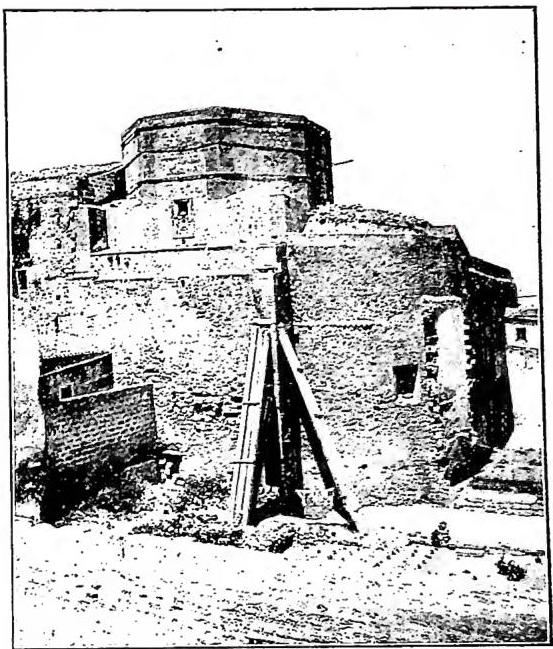
The Cathedral, begun by Count Ruggero, was restored by Bishop Giovanni da Monteaperto (1470–85); Bishop Luciano de' Rossi (1589) completed the dome and the organ, built the baptistery, and restored the choir and the pulpit; in the apse, richly decorated(phot. Gab. fot. naz.)
About 1 km from the town, on a hill, stands the sanctuary of the Madonna dell'Alto, founded by Ruggero, later becoming a commandery of the Order of St John of Jerusalem, and rebuilt at various periods. Another suburban church is the fifteenth-century S. Maria di Gesù, with a fine portico and valuable sculptures. Several Christian tombs are also found in M.