
MONREALE, ARCHDIOCESE of. – City and archdiocese in Sicily, in the province of Palermo. It has a population of 200,000 inhabitants, of whom 199,500 are Catholics; it has 50 parishes served by 180 diocesan priests
and 40 religious priests, one seminary, 6 male and 30 female religious communities (Ann. Pont., 1951, p. 275).
On 3 July 1483 Sisto IV approved the statutes of the new Benedictine Congregation of Sicily, to which M. also affiliated itself, but a few years later, in 1506, by order of Giulio II, it became part of the Cassinese Congregation. Meanwhile, another suffragan see had joined the archdiocese during the 15th century, Augusta. The union with Palermo, which took place on 7 July 1775, was not lasting. Reconstituted once again, it had as suffragans the dioceses of Catania, Siracusa, Piazza and Caltagirone. The monks were expelled from the abbey following the suppressive laws of the last century. At present the suffragan dioceses are Caltanissetta and Agrigento. The Cathedral is dedicated to the Blessed Virgin under the title of S. Maria Nuova.
Among the archbishops are remembered: card. Giovanni Proccamazza (1278); card. Aussio Despuig de Podio (1458); card. Pompeo Colonna (1531); Alessandro Farnese (1536);
Ludovico de Torres (1584), to whom the foundation of the Seminary is owed; Traiano d'Acquaviva d'Aragona (1739); among the monks: Paolo Catania, author of a history of the monastery; Mauro Marchese, who prepared a new edition of the works of s. Bruno.
Milan 1914; Montis Regalis ecclesiae synodus IV..., Palermo 1932; P. F. Kobe, Italia pontificia, VIII, Berlin 1935, p. 52; Cottineau, II, col. 1889; C. A. Garufi, Per la storia dei monasteri di Sicilia nel tempo normanno, in Archivio storico per la Sicilia, 6 (1940), pp. 1–66; S. Spinnato, M., Palermo 1942.
Ambrogio Mancone
ART. - The cathedral of M. constitutes the most splendid example of Norman-era architecture in Sicily.
Externally, the best-preserved part is the apse, characterized by three tiers of interlaced blind arcades that lighten the mass, standing out through a vivid chromatic contrast of limestone and lava. Internally, the clear basilican structure has not been altered by the addition of Baroque chapels, which are independent entities. Muslim architectural elements (the pointed arch) and Byzantine elements (pulvins on the capitals, and some iconographic details, such as the prothesis and diaconicon and the three terminal apses) are elaborated and fused with the same perfect equilibrium achieved in the decoration. This adorns the entire interior with Oriental splendor: the pavement displays Muslim artistry; the mosaics, likely executed with the contribution of local craftsmen, are Byzantine; they are the most extensive in Sicily, covering all the walls with episodes from Genesis and the New Testament, scenes from the lives of SS. Peter and Paul, images of saints and prophets, and, in the apse, the dominant image of the Redeemer, iconographically similar to that of the cathedral of Cefalù. However, these mosaics, nearly completed by 1182, belong to that late Byzantine current tending toward conventional pathos.
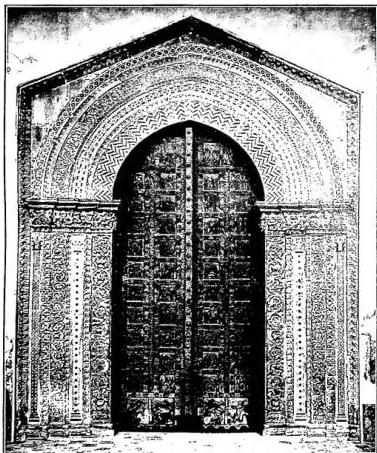
Contemporary with the decoration are the bronze doors of the two portals: those of the main door, sculpted in 1186 with a lively pictorial ease by Bonanno Pisano; and those of the side door, in which Barisano da Trani instead pursues the softness and elegance of ivories.
Among the later additions, the most notable is the Chapel of the Crucifix, begun in 1692 to a design by Fra Giovanni da Monreale, in which the sumptuous decoration of sculptures and marble inlays is typical of Sicilian Baroque. In the 18th century, after the demolition of the ancient narthex, the small portico of the façade was constructed between the two large Norman towers, now truncated.
To the right of the church is the cloister of the ancient monastery, perfectly preserved, the most vast and evocative among those of the 12th century. The Arab imprint dominates in the architecture, in the lively mosaic ornaments of the columns, and particularly in the stemmed fountain set in a corner, enclosed by arcades. The capitals, adorned with a great variety of figurative decorations (in one, Guglielmo II is depicted, as in a mosaic of the church, in the act of offering the temple to the Virgin), display the most diverse characteristics of Romanesque art, not only from the schools of southern Italy but also from northern Italy and beyond the Alps, testifying to the monastery's role as a rich cultural center. - Vedi tav. XC.