
AGRIGENTO, DIOCESI di. — In southern Sicily, it is a suffragan see of Monreale, called Girgenti until 1927; it now has approximately 28,000 inhabitants (35,000 in the municipality) and is the capital of a large province (3,043 sq. km and 475,600 inhabitants). Founded in 582 B.C., ancient Akragas was dominated in its early years by the fierce tyrant Phalaris (565–549). Later, the figure of Theron (488–472) emerged; allied with Syracuse, he defeated the Carthaginians at Himera (480) and extended the dominion of A., which he brought to a high degree of prosperity. After him, the city was governed by a republican form of government, enjoyed periods of great prosperity, and suffered foreign domination, first by the Carthaginians and later by the Romans, under whom it definitively fell during the Second Punic War (210 B.C.). After the fall of the Western Empire, it came under the Vandals, the Goths, and then the Byzantines, under whom the city had by then declined. In 827 it fell under Muslim rule; they rebuilt the destroyed city higher up, surrounding it with walls. Only in 1086 was it wrested from their rule by the
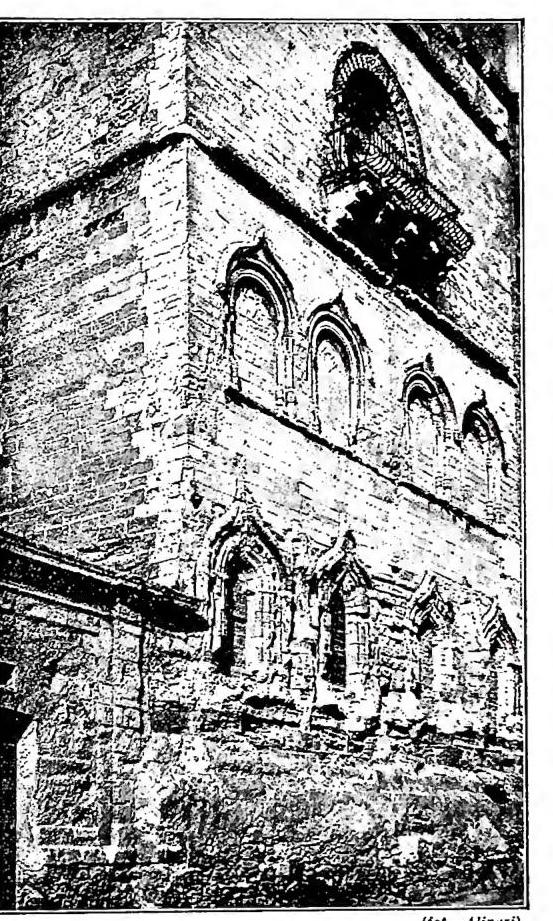
(Alinari photograph)
AGRIGENTO – Detail of the bell tower of the Cathedral (15th century).
The existence of a Christian community in A. before the peace of the Church cannot be documented; contrary assertions, being based on an interpolated clause in the authentic Acta of St. Felix of Thibiuca, have no evidentiary value, just as various hagiographical texts concerning saints in some way connected with A. have no documentary value, since they generally involve anticipations of later events or local reduplications of authentic saints from other places. Among the information supplied by these sources, we may retain only the name of Libertino, albeit with reservations, as that of the first bishop of Agrigento; but
nothing can be said about the period of his episcopate. The testimony of a Jewish colony (inferred from an inscription) might nevertheless lead us to consider it possible that a Christian community arose from it not long afterward; its earliest evidence is archaeological in character (some fourth- to fifth-century lamps).
Historical information is available only from the end of the sixth century, during the pontificate of Pope Gregory I (590–604), whose correspondence records the names of several bishops of Agrigento, specifically Eusanio, who was deposed by Pelagius II (578–90), and Gregorio, who, accused of an unspecified offense, was likewise deposed but subsequently rehabilitated and returned in 598 to his see, where he was still present in 603. It may be presumed that this Gregorio was the celebrated holy bishop of Agrigento, author of a commentary on Ecclesiastes in ten books and of other minor works (which have not survived), and greatly venerated in the Eastern Church; we have four biographies of him, all in Greek, the principal one written by Leonzio, a monk and abbot of the monastery of St. Saba in Rome and his contemporary (PG 98, 742–1181).
Subsequently, the signatures to the acts of the Lateran Council of 643 and the Council of Constantinople of 680 reveal two other bishops of Agrigento, Felice and Giorgio: the last known before the invasion of the Saracens.
As for the monuments of this period at A., some are mentioned in the hagiographical sources. Leaving aside certain minor ones, it should be noted that the aforementioned biography of St. Gregorio written by Leonzio speaks of an ancient basilica and episcopal residence which, because they had been profaned by the presence of a usurper during Gregorio’s trial, were, upon his return, destroyed and rebuilt elsewhere with the consent of the Pope and the Emperor, who on that occasion are said to have made generous donations.
The new Basilica, built by restoring “an idolatrous temple near the southern walls,” is certainly the one that remained, until the works of the 18th century, within the Doric temple known as that of Concordia. In the walls of its cella, arcades were opened, and the partition with the opisthodomos was also demolished in order to obtain a broad central nave; the peristasis was then enclosed, thereby creating the side aisles, just as had occurred, similarly and more or less contemporaneously, at Syracuse in the temple of Athena, the present Cathedral of that city. The Basilica, dedicated to SS. Peter and Paul, subsequently received the name of its founder (“S. Gregorio delle Rape”). The oldest monuments, however, are funerary in character and are located in the area of the southern walls. Immediately south of these walls extended the Roman necropolis, part of which, excavated in 1899, proved subsequently to have been used by Christians as well. Other tombs cut into the very thickness of the southern walls also belong, on account of their characteristic arcosolium form, to the Early Christian and Byzantine periods. Throughout the area, moreover, between the temple known as that of Juno and the Porta Aurea (thus also along the southern walls), numerous formae and approximately twenty underground burial chambers have been cut into the rocky ground; most were made by transforming ancient water cisterns and ancient grain stores. The largest of these chambers, the so-called grotta Fragapane, may, because of its extent, be regarded as a veritable catacomb; it still preserves traces of painted decoration around some of its tombs. Although extremely devastated, its development may be placed between the end of the fourth century and the course of the following century. Contemporary with, or slightly later than, it are the formae “sub divo” and the other burial chambers, as well as the tombs in the walls.
With the Arab invasion, A. shared the fate of the other churches of Sicily, and its suppressed hierarchy was restored only with the Norman conquest of Ruggero I, who in 1086 appointed St. Gerlando of Besançon bishop (d. 1104). From then on, the episcopal succession has continued uninterrupted to the present day. During the Nor-
man-Swabian period, the bishops of A. often played an active part in political affairs: for example, the German Gentile, who had already been chancellor of the king of Hungary and was promoted to A. by Guglielmo I (1054) (Ugo Falcando sketched a portrait of this turbulent prelate, known for his struggle against Stefano di Perché); Bartolomeo Offamil, of English origin, brother of Gualtiero and his successor in the see of Palermo; Ursone, a supporter of Tancredi, deposed by Enrico VII and reinstated by the Empress Costanza; and Rinaldo di Acquaviva (1244–64), excommunicated by Alessandro IV for having supported and crowned King Manfredi. In modern times, during the struggle for the “Sicilian monarchy,” Lorenzo Gioeni d’Angiò (1730–54) distinguished himself.
Although it was reduced in size during the last century, the diocese of A. remains one of the largest in Sicily. The jurisdiction of its bishop extends over 46 municipalities with 98 parishes, 474,500 Catholics, 345 diocesan priests, and 82 religious.
Among the sacred monuments of A. the following should be recalled: the Cathedral (14th century), dedicated to St. Gerlando, remodeled in the 18th century, with a grandiose unfinished bell tower of the 14th century (notable in the chapter house is a finely crafted rectangular Greek sarcophagus with four episodes from the story of Phaedra); S. Maria dei Greci (14th century), S. Nicola (13th century), S. Giorgio, with a 14th-century portal, and the monastery of S. Spirito, or Badia Grande (1290), one of the finest in Sicily. In former times, the abbeys of S. Maria del Bosco, S. Leonardo di Chiusa, S. Angelo di Prizi, S. Maria di Palazzo Adriano, S. Giorgio di Triocala, S. Maria di Refesic, and others were celebrated. - Vedi Tav. XLII.