Machine translation of the 1948–1954 Italian original. The original text is authoritative.
ALESSANDRO IV, PAPA. - Upon the death of Innocent IV, which occurred in Naples where he had gone to defend the rights of the Holy See over the Kingdom, the cardinals who had accompanied him were obliged to proceed to the election of his successor in that same
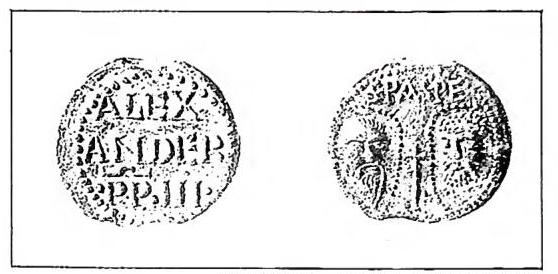
(from Serafini, Monete e bolle pontificie) ALESSANDRO III, papa - Lead bull.city. On December 12, 1254, they in fact elected Rinaldo de' Conti, bishop of Ostia, a relative of Gregory IX who had created him cardinal in 1227. He took the name of A. and proved to be much less shrewd and of a more yielding character than his predecessor; he immediately found himself struggling against Manfred, son of Frederick II, who at first claimed to operate in the Kingdom as a defender of the rights of Conradin of Hohenstaufen. The Pope instead, on April 9, 1255, renewed the investiture to Edmund, son of Henry III king of England, who had already received it from Innocent IV, thus putting himself in conflict with Manfred; he left Naples in May to take refuge in Anagni, while leaving Cardinal Ottaviano degli Ubaldini as legate in the Kingdom. But the legate was unable to stand up to Manfred, who succeeded in getting rid of his adversaries and forging an alliance with Genoa and Venice, so much so that, upon the spread of the rumor of Conradin's death, on August 11, 1258, he had himself acclaimed and crowned in Palermo as king of Sicily and Puglia. With this act, however, Manfred violated the rights of supreme feudal lordship always upheld by the Church, putting himself in open contrast with Pope A., who on April 10, 1259, solemnly excommunicated Manfred and his adherents; a sentence that he renewed on November 18, 1260, including therein the Sienese and the Florentine Ghibellines who, with Manfred's aid, had won the battle of Montaperti against Florence; such a victory increased the standing that the new king was acquiring throughout central Italy and even as far as the north. A.'s relations with Rome were also difficult; there, Brancaleone degli Andalò from Bologna ruled as senator and captain of the people. When he was forced to leave office and was imprisoned by the Romans at the end of 1255, Emanuele de Maggi of Brescia was elected senator. The latter, however, incapable of controlling the riots, was killed in 1257 and the Pope, who had moved to Rome, was forced to take refuge in Viterbo. Brancaleone was recalled at the end of May; he acted in agreement with Manfred; and on his deathbed in 1258 he ensured that his uncle Castellano was designated senator. The latter, however, was driven out in April 1259 and finally, with the Pope's consent,
(from Serafini, Monete e bolle pontificie) ALESSANDRO IV, papa - Lead bull.two Roman nobles, Napoleone Orsini and Riccardo Annibaldi, were elected senators.
Meanwhile, another event had occurred to complicate the affairs of Europe. In 1256 Emperor William of Holland had died; A. had opposed Conradin's candidacy; the German princes were divided: some elected Richard of Cornwall, brother of Henry III of England, others Alfonso X the Wise, king of Castile, but the elected ones commanded no authority in Germany. A., at first uncertain, showed himself favorable to Richard and had him appointed senator of Rome for life in 1261 with the hope that he would counterbalance the power that Manfred had by then acquired in Italy.
Like Gregory IX, A. showed great favor to the Franciscans; he canonized St. Clare, condemned William of Saint-Amour, a doctor of Paris who had dared to write against the privileges of the Mendicants, and had the chairs in those universities from which they had been barred restored to them. A. died in Viterbo on May 25, 1261.
BIBL.: P. Balan, Storia d'Italia, IV, 2ª ed., Modena 1895; E. Jordan, Les origines de la domination angevine en Italie, Parigi 1920; R. Morghen, Il tramonto della potenza sveva in Italia, Milano 1936, p. 149 sg. Pio Paschini
Cite this article
“ALESSANDRO IV, PAPA.” Enciclopedia Cattolica, vol. I (1948), p. 486. Azione Romana digital edition, https://azioneromana.com/article/alessandro-iv-papa.