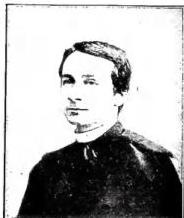
UBALDINI, OTTAVIANO, CARDINALE

UBALDINI, OTTAVIANO, cardinal. – Born certainly after 1210, died in 1273. He came from the Ghibelline family that long held sway in the Mugello and in Tuscan Romagna; he was uncle of the archbishop Ruggieri of Pisa (cf. Dante, *Inf.*, XXXIII, 14).

He was archdeacon of Bologna, subdeacon and apostolic chaplain when the Chapter nominated him as bishop (21 February 1240); but since he was not yet 30 years old, Gregory IX on 17 June 1240 appointed him administrator *in temporalibus et spiritualibus*. He was created cardinal deacon of S. Maria in Via Lata on 28 May 1244 by Innocent IV, who sent him as legate to Lombardy in 1247; he favoured Ottone Visconti of Milan. After the defeat of Frederick II at Parma (18 February 1248), he entered that city; but coming into conflict with the other legate, the Guelph Gregory of Montelongo, he crossed into Romagna. From May onwards, with the forces of the Bolognese, he took Forlì, Forlimpopoli, Cesena, Imola, Cervia, Ravenna, and in June Ferrara and Rimini. In May 1251 he was in Genoa and persuaded Innocent IV to remain in Lombardy. He succeeded in influencing Alexander IV, who in May 1255 appointed him legate to conduct the expedition against Manfredi: he occupied Barletta and Monopoli, but when besieged in Foggia by Manfredi he concluded a treaty with him which the Pope could not accept, and Ubaldini was accused of betraying the cause of the Church. He was a friend of Brancaleone degli Andalò, senator of Rome, who worked in favour of Manfredi; he did not hesitate to sacrifice the Church itself to the interests of his own family or of a group of Ghibellines from Florence, and took part in the military expedition that, with the aid of Siena and Manfredi, brought victory to the Ghibellines at Montaperti (1260) and secured their domination of Florence (cf. Dante, *Inf.*, X, 83 ff.). After the victory of Charles of Anjou at Benevento (1266), he did not hesitate to support in Rome the party of the senator Arrigo of Castile against Charles; but after the defeat of Conradin (1268) and during the long vacancy of the papacy, his intrigues came to nothing. He was a “worldly man,” indeed an “Epicurean,” so that it could be said that he did not believe in the immortality of the soul, and the saying was attributed to him: “If there is a soul, I have lost it for the Ghibellines” (*Inf.*, X, 120). Fra Salimbene did not spare him bitter reproaches.
Article illustration

---

**UBALDO, Saint** – Bull of Celestine III for the canonization of St Ubaldo (5 March 1192) – Gubbio, Archivio comunale.

---

**

Bibl.:** G. Levi, *Registri dei cardd. Ugolino d'Ostia e O. degli U.*, Rome 1890, pp. XVII ff., 157 ff. (few acts); P. Balan, *Stor. d'Italia*, III, Modena 1894, pp. 642 ff.; IV, ibid. 1894, pp. 24 ff.; R. Morgen, *Il tramonto della potenza sveva in Italia*, Rome-Milan 1936, pp. 176 ff.; E. Dupré-Theséider, *Roma dal comune di popolo alla signoria pontif.*, Bologna 1952, pp. 53, 57, 70, 147 ff. Cf. Potthast, 10895-69; *Corpus Chron. Bonon.*, in *RIS*, XVIII, II, II, p. 113. Pio Paschini

---

**UBALDO, Saint** – Restorer of canonical life and bishop of Gubbio, born there of a feudal family of Germanic origin between 1080 and 1085, died there on 16 May 1160.

Orphaned at an early age, he began his studies in the collegiate church of S. Secondo and continued them at Fano and again at Gubbio in the cathedral chapter, whose regular life was in a state of complete decline; for this reason he asked to be allowed to return to the clergy of S. Secondo. Through the intercession of Bishop Giovanni of Lodi, Ubaldo returned to the cathedral chapter (1105) and succeeded in completely reforming it between 1120 and 1122; ordained priest in 1114, by about 1117 he was already prior; in 1119 he went to Ravenna to acquaint himself fully with the Portuense Rule, which he then introduced into his chapter. After the great fire of 1125 which destroyed part of Gubbio, Ubaldo, having spent a short time at Fonte Avellana, set about rebuilding the cathedral, the chapter house, and a hospital. But while he was engaged in this work of reconstruction, the people of Perugia chose him as their bishop: Ubaldo opposed this and, having gone to Rome, asked Honorius II to release him. Having obtained this favour, he returned to Gubbio, but on the death of Bishop Stefano (late 1128–early 1129) he had to accept the bishopric of Gubbio, which he governed with firmness and gentleness for 31 years. Notable are his effective interventions at the time of the struggle for the creation of the commune (1135–40), during the siege of the city by the eleven allied cities under the leadership of Perugia (1135), and with Frederick Barbarossa who threatened Gubbio with the end of the duchy of Spoleto (August 1135). He was buried in the cathedral, of which he soon became co-patron; after his canonization by Celestine III (5 March 1192: Cenci, *Codice diplomatico*, cited in bibliography, pp. 459–60), his body was translated to the church on Colle Ingino (11 September 1194), where it is still venerated incorrupt. St Ubaldo is invoked against unclean spirits and against rabies. That St Ubaldo is the eponym of the famous sanctuary (13th century) of Thann in Alsace (from P. Cenci, in *Archiv. per la Stor. cec. dell'Umbria*, 2 [1913], p. 273).

---

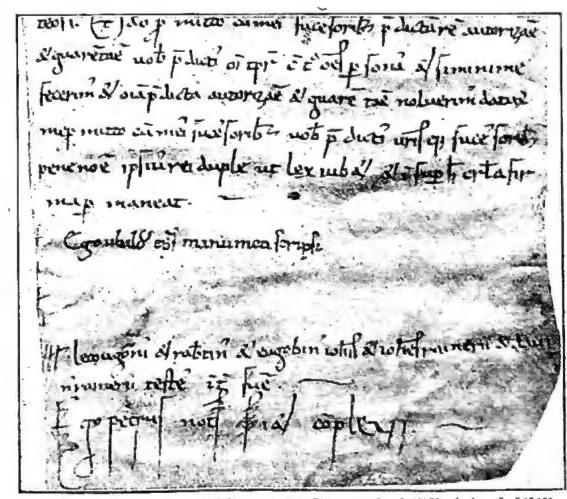
**Ubaldo, Saint** – Donation of St Ubaldo to the chapter of S. Mariano (1138) with the saint’s autograph signature. – Gubbio, Archivio dei Conti della Porta.

![page_423_image_2.png](page_423_image_2.png)