
GENOVA, ARCIDIOCESI di. — Capital of Liguria.
SUMMARY:
I. Geographical information
II. Historical information
III. Distinguished figures
IV. Cultural institutions, libraries, archives
V. Monuments and shrines.I. GEOGRAPHICAL INFORMATION
A metropolitan see since 1133. Suffragan dioceses: Albenga, Bobbio, Chiavari, Noli, Sarzana-Spezia-Luni-Brugnato, Savona, Tortona, Ventimiglia. Seat of the Ligurian Regional Ecclesiastical Tribunal.The archdiocese covers an area of 980 sq. km., with 750,000 inhabitants; it has 234 parishes, 63 of them in the city; 6 urban vicariates and 31 rural vicariates. There are 86 male convents and religious houses, and 272 female ones. The major seminary was founded by Archbishop Cardinal Stefano Durazzo in 1657, enlarged by Cardinal Archbishop Placido M. Tadini in 1840, and by Archbishop Salvatore Magnasco in 1891. The minor seminary at S. Martino d'Albaro (Chiappeto) was rebuilt a few years ago. The archbishop bears the title of «transmarine legate», granted to him by Alexander III in 1162, and is grand chancellor of the
Theological College of S. Tommaso d'Aquino, perpetual abbot of S. Siro, S. Maria Immacolata and S. Gerolamo. The patroness of all Liguria is S. Maria Immacolata; the patron of the city and of the ancient dominion is s. Giovanni Battista; the patron of the city is s. Lorenzo.
II. HISTORICAL INFORMATION
1. Civil history
The origins of «Genua, Janua» are unknown. The first nucleus of the city arose on the hill still called «Castello», a place suited to the defence of the port and of the entire area below. Roman G. was always allied with the Republic and the Empire, and for this reason in 218 B.C. it was attacked and destroyed by Mago, Hannibal’s brother and enemy of the Romans; it was soon rebuilt, however, by the praetor Spurius Cassius, and received many benefits from Rome, such as the construction of roads, bridges, aqueducts, port facilities, and buildings. The Via Postumia, built by the consul P. Postumius in 148 B.C., ran from G. through the Polcevera Valley to Dertona, Placentia, and as far as the Karst; the Via Aemilia, opened by Aemilius Scaurus in 109 B.C., crossed the entire coast from Luni to Vado, continuing the Au-(photograph Soprintendenza ai monumenti, Genova)
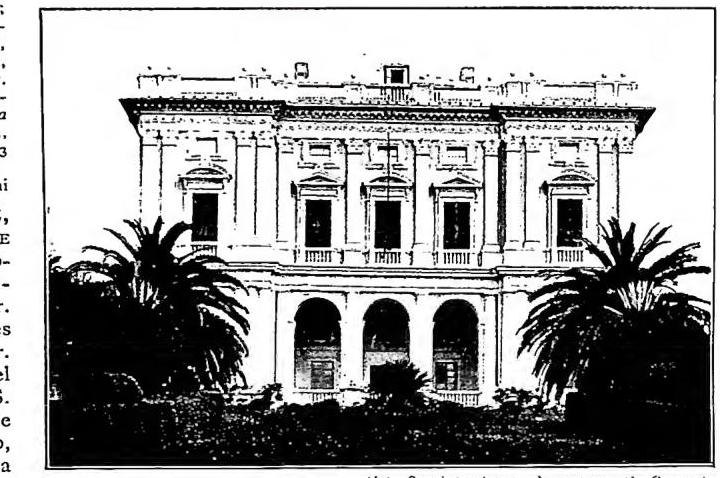
GENOVA, ARCIDIOCESI di — The façade of Villa Cambiaso, designed by G. Alessi (ca. 1560).
In 1155, faced with the threats of Barbarossa, G. took precautions by erecting the new circuit of walls, which ran from the Vacca gates to S. Agnese, Castelletto, Villetta Di Negro, S. Caterina, Piccapietra, S. Andrea, and Castello, and descended to the sea; a large part of these walls, together with the monumental Porta Soprana, still remains. The Crusades had opened the routes of the East to Genoese commerce; the Treaty of Nymphaeum (1261), concluded with the emperor Michael Palaeologus, gave rise to the Genoese colonies that were gradually established in Crimea, Syria, Constantinople, and all the regions of the Middle East—sources of immense wealth, thanks to the increased ease of commercial exchange and to the supply of raw materials necessary for the city’s industry. Increasing prosperity brought G., a Guelph city, into conflict during the thirteenth century with Ghibelline Pisa, followed by rivalry and war with Venice for supremacy in the Levant. The War of Chioggia and the subsequent Treaty of Turin of 1381 brought these unhappy events to an end; in the following century, however, the Turkish invasion put an end to the Genoese colonies.
The civil life of G. was long disturbed by internal struggles that bloodied the city, despite continually renewed efforts to quell them; the blessed Giacomo da Varazze, throughout his episcopal government, worked by every means to reconcile the factions, and in 1298, hoping that he had achieved his aim, celebrated with great solemnity in S. Lorenzo the feast of peace, which unfortunately lasted only a short time. These struggles caused the internal regime to be unstable and made it necessary to rely on foreign powers, such as the Visconti of Milan and France, in order to maintain internal order. Other events include the following: in 1528 Andrea Doria, acclaimed «liberator of the fatherland» from foreign domination, gave the city a new constitution for its peaceful government; in 1625 Carlo Emanuele, duke of Savoy, marched to conquer G. with a powerful army, but, attacked by the intrepid populations of the Polcevera and the Apennines, returned to Piedmont with his army badly battered; even more terrible for G. was the Austrian invasion of 1746–47, during which the enemy, after horribly looting and laying waste to all the villages of the Polcevera and the surrounding area, entered the city; a furious popular uprising, however, put it to flight. As the eighteenth century drew to a close, G., incited by French demagogues, was swept into the revolutionary movement, so that in 1797, after the ancient Republic had been suppressed, the Ligurian Republic was proclaimed. With the Congress of Vienna (1815), G. was annexed to Piedmont.
2. Religious history
It is natural that G., a maritime city, should have learned of the new Christian religion at an early date; the many third-century Christian sarcophagi, part of the local artistic heritage and still visible in G., show that many Christian families were living in the city at that time. The first bishop recorded with a certain date is Diogenes, present at the Council of Aquileia in 381; other bishops of the fourth and fifth centuries were Valentino, Felice, and Siro, but, owing to the lack of documents, their dates cannot be established. Pascasius signed the provincial Synod of Milan (451). To these bishops must in any case be attributed the conversion of the people to the true faith and the organization of the dioceses. The cathedral church was dedicated to the Twelve Apostles, a title later changed to that of S. Siro, the most distinguished among the ancient Genoese bishops of that age. At the Lombard invasion (569), Onorato, bishop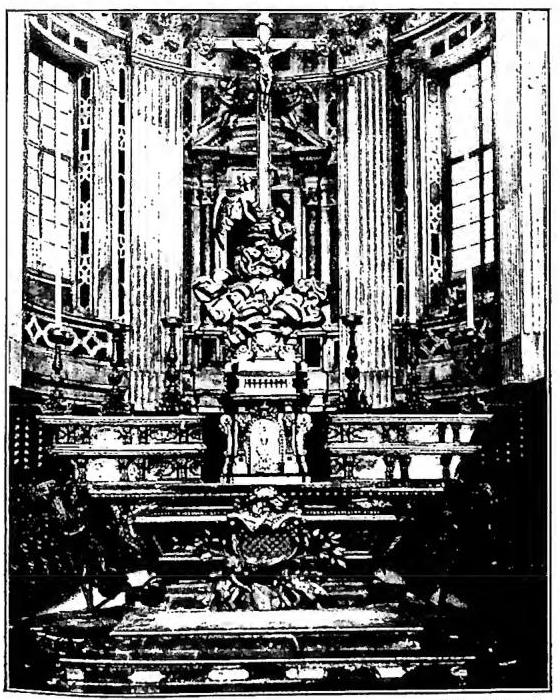
After the Milanese bishops departed, the city resumed electing its own bishops, whose names are preserved in official documents, the acts of councils, and similar sources. Among the medieval bishops, Siro II stands out: elected bishop of G. in 1130, in 1133 he was made the first metropolitan archbishop by Innocent II, and was given as suffragan sees the dioceses of Accia, Mariana, and Nebbio in Corsica, and Bobbio and Brugnato on the mainland. Genoese religious life advanced along with the great revival of civil life; Romanesque churches multiplied following the example of the Cathedral, which was consecrated by Pope Gelasius II in 1118; the diocese was increasingly well organized, and religious life developed in all its branches.
(photograph Alinari)
GENOVA, ARCIDIOCESI di — High altar of the church of S. Siro, designed by P. Puget (ca. 1670).
At the time of the Catholic Reformation, G. played a leading role in this field. S. Caterina Fieschi, together with her disciple Ettore Vernazza, brought genuine reform among the people through the foundation of many charitable works: the “Oratory of Divine Love,” the “Daughters of S. Joseph,” the “Converts,” the “Company of the Mandiletto,” “Care of the Sick at Home,” the “Lazzaretto,” and others which, inspired by the soundest piety and charity, spread love among souls and provided for all the needs of the poor. Other illustrious Genoese cooperated in this work of Catholic reform: Cardinal Federico Fregoso, Bishop Leonardo de Marini, and s. Alessandro Sauli, the apostle of Corsica.
During the fifteenth to seventeenth centuries, the Minims of s. Francesco di Paola (1487), the Capuchins (1530), the Jesuits (1554), the Somaschi (1575), the Theatines (1575), the Barnabites (1606), the Camillians, Ministers of the Sick (1594), the Oratorians (1644), the Piarists (1623), and the priests of the Mission of S. Vincenzo de’ Paoli (1645) established themselves in G. In 1872 d. Bosco established the Salesians in Sampierdarena.
III. ILLUSTRIOUS PERSONAGES
In addition to those already mentioned, the following popes may be noted: Innocenzo IV, Fieschi Sinibaldo (1243–54), and Adriano V, Fieschi Ottobono (1276); Innocenzo VIII, G. B. Cibo (1484–92); Benedetto XV, Giacomo della Chiesa (1914–22). Guglielmo Embriaco Caffaro, annalist of the Commune and diplomat. Giovanni Balbi, grammarian, author of the Catholicon. Simone Boccanegra, first doge of Genova; Andrea Doria, “liberator of the fatherland.” Bartolomeo Bosco, founder of the Pammattone Hospital. Luca Cambiaso, painter. Mons. Agostino Giustiniani, bishop of Nebbio, learned in Arabic, Chaldean, Hebrew, and the classical languages, author of a Polyglot Psalter and the Annals of the Republic of G.; Foglietta Uberto, Latinist historian; the ven. Virginia Bracelli, founder of the “Brignoline”; Cardinal Stefano Durazzo, archbishop of G. and founder of the Seminary; the b. Maria Vittoria Strata, founder of the “Celesti”; s. Leonardo da Portomaurizio; s. Giovanni Battista De Rossi, apostle of Rome; the b. Antonio Gianelli, bishop of Bobbio; Anton Brignole Sale, beneficent patrician; D. Lorenzo Garaventa, founder of the Schools of Charity; Anton M. Maragliano, sculptor; Fr. Ottavio Assarotti, a Piarist, who founded the first institute for the deaf and mute; Maria de Ferrari Brignole Sale, duchess of Galliera, founder of the Galliera Hospitals and other charitable works.IV. INSTITUTES OF CULTURE, LIBRARIES, ARCHIVES
Theological College of S. Tomaso d’Aquino, established by Sixtus IV (1471). Franzoniana Library, founded by Paolo Gerolamo Franzone (1778). Library of the Urban Mission, founded by another Gerolamo Franzone di Paolo (1727): destroyed by the bombardments of the Great War, it retained the celebrated Greek manuscripts donated by mons. Filippo Sauli (d. in 1528); Seminary Library; Archive of the Metropolitan Chapter, exceptionally rich in original documents from the twelfth century to the present; Archive of the Archbishop’s Curia; Archive of the Chapter of S. Maria delle Vigne; Archive of the fifteenth-century magistracy of mercy; parish and archives of the religious Orders.See MONUMENTS AND SHRINES. — S. LORENZO: cathedral, an imposing and austere mass from the twelfth century, consecrated in the part already built in 1118 by Pope Gelasius II; the façade dates from the mid-thirteenth century and has black-and-white bands, with three magnificent portals in French Gothic style, whose splayed arches are adorned with graceful smooth and twisted colonnettes; the bell tower, 77 metres high, was completed in 1522. The interior has three naves, divided by columns which support, on pointed arches, a gallery with Romanesque arches. This gallery belongs to the original Romanesque construction of the twelfth century,
whereas the Gothic colonnade beneath it was replaced by Marco Veneto in 1307–12. Galeazzo Alessi (sixteenth century) raised the Renaissance-style dome over the centre of the transept. In the presbytery and choir, the walls are decorated with large statues of the four Evangelists by Montorsoli and Gian Giacomo della Porta (1540–53); on the vault are frescoes by L. Tivarone. The chapel of S. Giovanni Battista is the cathedral’s most imposing work. It is followed by the chapel of the S.ma Annunziata, with the tombs of Cardinal Giorgio Fieschi (by Giov. Gaggini) and Cardinal Luca Fieschi, attributed to Giov. Balduccio of Pisa (1336).
S. MARIA DI CASTELLO: it is among the oldest churches of G., and it appears that before 1000 it was also a cathedral. The present church dates from the eleventh century. It has three naves, divided by ten granite columns, with semicircular arches. It is rich in works of art.
(phot. R. Gasparini, Genoa)
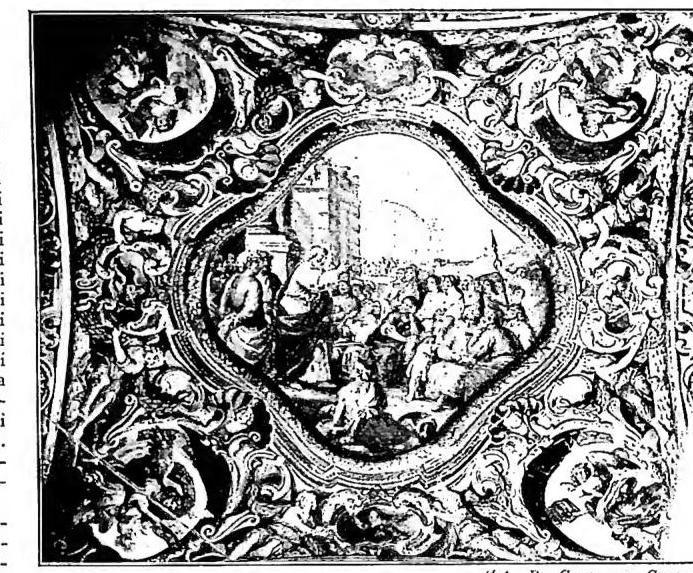
GENOVA, ARCIDIOCESI di — Preaching of St. Matthew in the church of S. Siro. Fresco by G. B. Carbone (seventeenth century).
S. DONATO: predating 1000, it was enlarged in 1170. It has three naves, divided by twelve columns, upon which rests a blind gallery divided by biforas. Above the dome rises the elegant bell tower, skilfully adorned with colonnettes and triforas, making it a perfect model of urban Romanesque architecture.
S. STEFANO: founded by the Benedictines in the tenth century on an earlier church dating from the seventh–eighth century, now reduced to a crypt, its black-and-white-banded façade dates from the twelfth century; the bell tower has squared stones and two upper tiers built later in brick. It possesses many notable works of art by Giulio Cesare Procaccini, G. B. Castello, Andrea Ansaldo, and G. Assereto, as well as the large painting of the martyrdom of St. Stephen by Giulio Romano. A silver casket, a Byzantine work, contains the relics of St. Stephen.
S. AGOSTINO: a vast three-naved church built in the mid-thirteenth century together with the two churches, now destroyed, of S. Domenico and S. Francesco. It constitutes the characteristic type of G.’s Gothic churches. The bell tower, with an elegant pyramidal spire, is faced with polychrome ceramics.
S. MATTEO: built by the Doria family in 1278, it has three not very spacious naves and a façade with black-and-white bands; in the sixteenth century it was transformed from the Gothic style into the Renaissance style. Behind the high altar stands the monumental tomb of Andrea Doria, the work of Montorsoli. The vault has frescoes by Luca Cambiaso and G. B. Castello; there are also statues by Montorsoli and his assistants. Beside the church is the cloister with paired columns, the work of Marco Veneto (1310).
ANNUNZIATA DEL VASTATO: founded in 1520 by the Conventuals, it was soon afterward, through the munificence of the Lomellini family, brought to its present splendour and richness, with noble proportions, marble, gold, and paintings, making it one of the most artistic churches of G. The three spacious naves are divided by composite-style columns encrusted with polychrome marble; the central nave and crossing have frescoes by G. B. Carbone. It possesses a wealth of works of art.
S. MARIA DI CARIGNANO: a superb structure raised by Galeazzo Alessi through the munificence of the Sauli family (1512–1564), with a majestic dome flanked by two bell towers.
S. SISO: the first cathedral of G., it is believed to have been rebuilt in the eleventh century by the Cluniacs; its bell tower, with a spire, remained until the beginning of the present century. The present church was built for the Testini family at the end of the sixteenth century by the architect Vannone. It has three broad naves divided by paired columns and is rich in marble and paintings.
S. M. DELLE VIGNE: it is the largest Marian shrine in the city, resplendent with gold, marble, and paintings, and with three naves. Its origins go back to the sixth century; it was rebuilt, together with the cloister, in the eleventh century, as Formentini holds, in a proto-Romanesque style apparent in the surviving wall, cloister, and bell tower, and in the perimeter walls concealed beneath the plaster.
S. AMBROGIO: built for the Jesuits (1589–92) by the architect Fr. G. Valeriani, in the form of a Greek cross, with a profusion of polychrome marble and frescoes; among the most distinguished paintings are Guido Reni’s Immacolata, P. P. Rubens’s St. Ignatius, and the Martyrdom of St. Andrew by A. Semino and T. Piaggio.
S. MARIA IMMACOLATA: a Greek-cross church erected to commemorate the dogmatic definition of the Immaculate Conception (1856–1873), by the architect Maurizio Dufour.
Among the shrines: N. SIGNORA DELLA GUARDIA: it is «the foremost shrine of Liguria» for «all true Genoese». For its history cf. D. Cambiaso, Nostra Signora della Guardia e il suo santuario in Val Polcevera (Genoa 1933).
S. MARIA INCORONATA: it is mentioned in records from the twelfth century; parish of the Lateran Canons Regular.
S. MARIA DI TRE FONTANE: parish of Montoggio. S. Maria de tribus fontibus is mentioned in documents of 1213. According to tradition, at an unknown time the Madonna appeared to a poor deaf-mute girl and cured her; hence the large numbers of people who flock to the shrine. Feast on 8 September.
S. MARIA DEL MONTE, east of G.: a much-frequented shrine. It is mentioned from the thirteenth century; in 1399 the Flagellants went there in procession, praying and scourging themselves; in 1444 Eugene IV granted the church to the Friars Minor, who still administer II. Attached to the convent is also a Seraphic College for the Foreign Missions.
N. SIGNORA DELL'ACQUA SANTA (Voltri): it is mentioned in 1465; a century later the archbishop Domenico Demarini, considering the large number of faithful visiting this shrine, especially from the towns of the Riviera, issued regulations for the administration of the shrine. In 1700 six priests were assigned to its divine offices. Today it draws large numbers of devotees from G., the Riviera, and Piedmont.
N. SIGNORA DEL BOSCHETTO (Camogli): the object of devotion is an image of Mary S.ma with the Child, painted on a wooden panel and venerated from time immemorial on a pillar in that wood (hence the name Boschetto); according to tradition, in 1518 the Madonna appeared to a pious young girl named Angela Schiaffino, ordering her to make known that she wished the people to erect a church there in her name; a chapel was therefore built, which in 1631 was replaced by the present church.
N. SIGNORA DELLA VITTORIA, on the Via dei Giovi (at 600 m.): the title derives from the victory won by the townspeople through the intercession of Mary S.ma in 1625 against the army of Carlo Emanuele of Savoy, which had arrived there on its way to G. After the battle, a chapel was erected on the site, in place of the pillar on which the Madonna had been painted; it was subsequently enlarged several times until, in 1750, the present shrine was built, chiefly through the zeal of a poor beggar, Gaetano Pedemonte. The feast is celebrated on 10 May. The shrine is much frequented by the inhabitants of the upper Polcevera and the Ligurian Apennines.
S. MARIA DEL GARBO (Rivarolo): è indicata nel 1365 la prima volta; oggetto della venerazione del popolo è una tavoletta di cent. 85, in cui è scolpita l'immagine di Maria col Bambino e, sotto, la scritta «Santa Maria de lo Garbo Amen» tavoletta trovata, dicesi, da alcuni fanciulli nell'incavo (in dialetto «garbo») di un albero di castagno; la chiesa odierna rimonta al sec. XVI: festa S.mo Nome di Maria; ultimamente è stata eretta in parrocchia. - Vedi tav. III.