
FRANCESCO di PAOLA, saint. — Founder of the Order of Minims. Born at Paola in Calabria on 27 March 1416. At the age of twelve he put on the Franciscan votive habit for a year and, having fulfilled his vow, went to Assisi. Passing through Rome, he venerated the tombs of the Apostles and the martyrs; then, having returned to his homeland, he withdrew into a wood, where he lived for six years as a hermit. Once his cave was discovered, some young men wished to become his disciples: thus the Order of Minims came into being.
The activity of the new apostle was directed toward extinguishing the hatreds, selfishness, and corruption of that century, calling men back from the resurgent paganism to the practice of Christian life. The example of austere penance joined to great charity, and the gift of miracles and prophecy, of which the Saint was so abundantly endowed that he could be compared with the Church’s most illustrious wonderworkers, proved extraordinarily effective. He was an outspoken defender of the people against the abuses of princes and lords. He also reproached King Ferrante d’Aragona of Naples for his misgovernment, threatening him with divine punishments. In vain he urged the monarch to desist from internal wars,
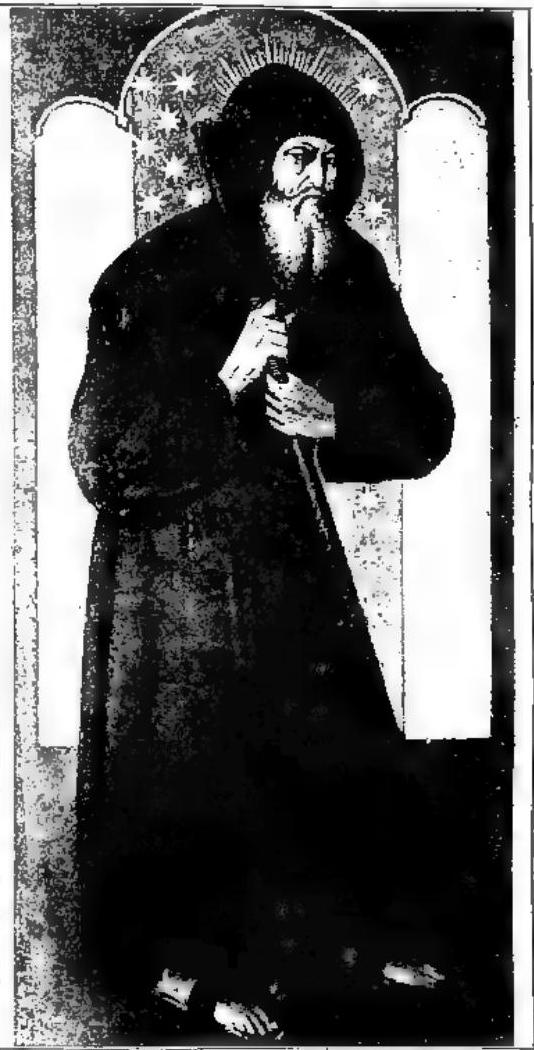
and instead to prevent the invasion of the Turks. Unfortunately, they set foot on the Adriatic coast (July 1480): Otranto was conquered, but also liberated, as the Saint had foretold, with the aid of his work and prayers.
(by courtesy of Fr. Gennaro Moretti)
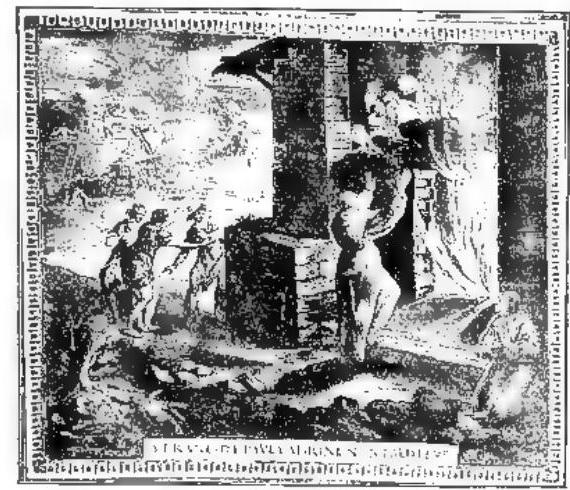
FRANCESCO DI PAOLA, saint — The Saint supports a furnace that is about to collapse. Fresco of 1580 in the Gallery of Maps — Vatican.
For the sake of peace F. proposed the marriage of Charles to Anne of Brittany (thus this beautiful province was united to France).
Characteristic virtues of s. F. di P. were humility and charity; his mortification was extraordinary: he never ate meat or dairy products, fasted almost daily, slept very little, and almost always on the bare ground. He died at Tours on 2 April 1507 at the age of 91, twenty-five of which he had spent at the court of France. He was beatified in 1513 and six years later canonized by Leo X, who called him «Sent by God to illuminate, as a mystic torch, the darkness of his century» (canonization bull).
His cult spread throughout the world; many cities and some regions have elected him as their patron. Pius XII proclaimed him in 1943 patron of the seafarers of the Italian nation. He is invoked to obtain offspring. Feast day: 2 April.
Works: besides the monastic Rules, many of his letters have been preserved. The most complete collection, although it contains a considerable number of apocryphal letters, is F. Preste, Centuria di lettere di s. F. di P., Rome 1665.
Other images, episodes from his life, and numerous miracles have been painted or sculpted by distinguished artists: G. Romano, Cav. d'Aspino, Joan de Joannes, E. Murillo, C. M. Crespi, M. Preti, N. Gandolfi, G. Reni, G.B. Tiepolo, A. Cano, L. Giordano, P. Rubens, G.B. Mayno, P. Legros, etc. — Vedi tav. CIV.