
MINIMI. – A regular mendicant order, with solemn vows and a mixed life of contemplation and apostolate, founded by St. Francesco di Paola in 1435.
I. ORIGINS AND DEVELOPMENT. – The Saint’s first followers were called Hermits of St. Francis of Assisi; only in 1492 did the Institute receive from Pope Alessandro VI the name of the Order of the M. (bull Meritis religiosae vitae of 24 February 1492). It spread rapidly throughout southern and central Italy and in Sicily. The earliest written approval known is that of the archbishop of Cosenza (Decet nos, 30 November 1471), followed by that of Sixtus IV (Sedes Apostolica, 27 May 1474). The Order spread to France, where the Saint had gone in 1483, and then to Spain and Germany. At the death of St. Francesco (1507), it had 6 monastic provinces in Italy, France, Spain, and Germany, with 32 convents. By the end of the sixteenth century, the number of provinces had risen to 20, with 200 convents; in the following two centuries, after religious had been introduced into Belgium, Holland, England, Mexico, Peru, and the Azores, the provinces increased to 32 (as well as a vicariate in Portugal and the Indies) and the convents to 500, with approximately 14,000 religious.
In the second half of the seventeenth century, decline began as a result of the well-known political persecutions: almost everywhere the convents were suppressed, very many were destroyed, and the religious dispersed. In Italy, despite the serious damage caused by the French Revolution, the Order remained active, especially in the Papal States and in the South, until the suppressions of 1866 and 1873. Everywhere, however, and almost without exception, the M. persevered in the faith, and no small number bore witness to it with their blood. At present, a general delegation has been established in Spain; in Italy, the Order continues along the path of reconstruction, preserving intact the Rule of the holy founder in its 30 convents, with various novitiates, houses of probation, and colleges of study for philosophers and theologians, one of them a general college in Rome.
II. THE RULE. – St. Francesco di Paola should have adopted one of the four ancient Rules according to the Fourth Lateran Council (1215, chap. IV); but, overcoming no small difficulties, he obtained approval for a new, original Rule that would be an effective means of reviving, in that paganizing and depraved century, the spirit of the Gospel. The Rule that Sixtus IV and Innocent VIII had refused to approve was approved by Alexander VI on 24 February 1492. The Saint amended it three times, and the Holy See approved it just as many times (Alexander VI, Vestris supplicationibus, October 1495, and Ad ea quae, 1 May 1501), and finally under Julius II (Inter caeteros, 28 July 1506). It consists of four parts: that of the Religious, with an appended Correctory, or code of penalties; that of the Nuns (Second Order); and that of the secular Tertiaries of both sexes. Taken together, these constitute a single code of religious life, similar to that of the Mendicants; but the contemplative life has precedence in it over the active life. Superiors are called correctors. The General Chapter holds legislative power, while executive power is entrusted to the general corrector for the whole Order, the provincial corrector for each monastic province, and the local corrector for each established convent. All the correctors are temporary: the general remains in office for six years, the others for three; and they are assisted in governing by three colleagues, or assistants, one of whom is charged with conducting the Order’s affairs at the Holy See and bears the name of Zeloso (procurator general). The religious are divided into three classes: clerics, to whom the Sacred Orders and authority alone are reserved; laymen, that is, brothers, to whom affairs of special importance are entrusted (St. Francesco di Paola belonged to this class); and oblates, for minor and humble offices. Poverty is so strict for the clerics and laymen that they may not “handle money,” a task reserved for the oblates (a provision mitigated in the recent Constitutions). The penitential discipline proper to all the Mendicant Orders is rendered more rigorous by the practice of the Lenten life, to be observed dail-
[Non-Text]
The quick brown fox jumps over the lazy dog.
(courtesy of Fr. Gennaro Moretti)
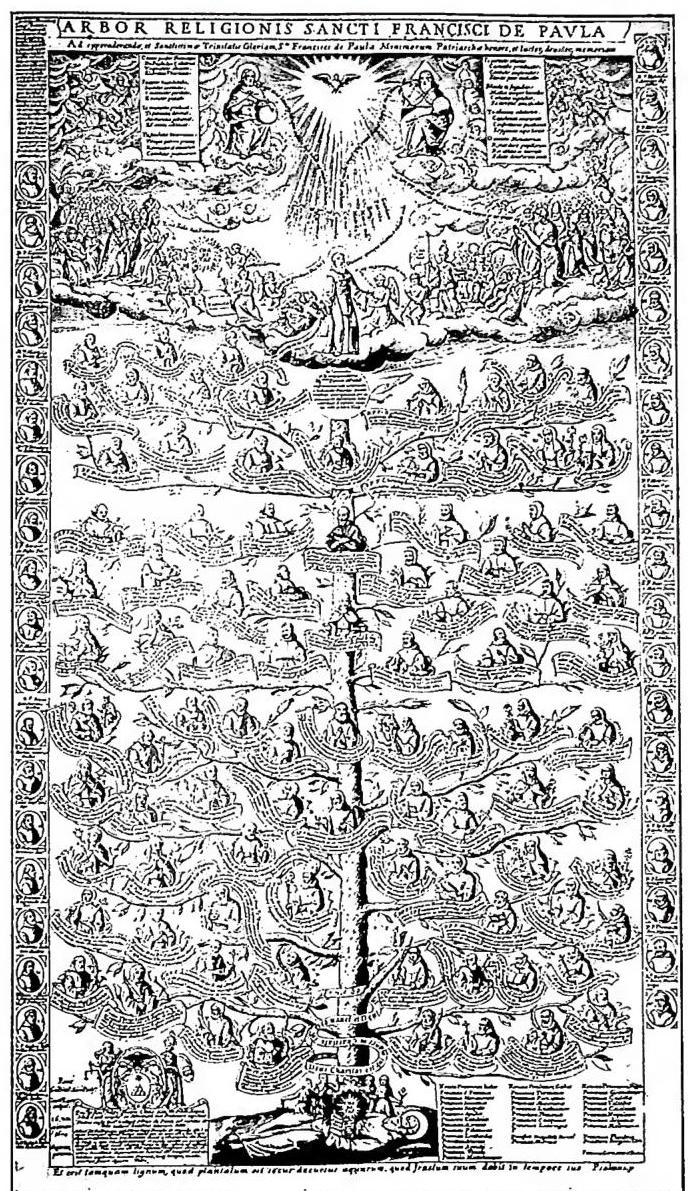
MINIMI – Tree of the Religion; conceived and engraved in Rome (Jacobus Lauro sculpati) in 1622 by Fr. Giovanni Battista Yanella, of the province of S. Francesco (Citeriore Calabria), dedicated to Cardinal Ippolito Aldobrandini, protector of the Order; reprinted in 1672 under the auspices of the Fathers of the College of S. Francesco di Paola ai Monti, dedicated to Cardinal Flavio Chigi.
daily by solemn vow, by virtue of which the M. are forbidden to consume meat and its derivatives (eggs, milk, butter, cheese) on every day of the year, without exception, not even on the most solemn feasts, such as Christmas and Easter, whether in the convent or outside II. The vow is personal and follows the religious everywhere, even if he is appointed bishop. The sole exception is illness, when the community physician so judges and the superior grants the dispensation. The sick person is then transferred to the external infirmary, separated from the convent workshops and dormitories. Like the Carthusians, the M. have obtained from the supreme pontiffs permission to eat turtles and coots
(Adrian VI, Universis, 14 Apr. 1524; Pius VII, rescript of 22 Feb. 1804). The vow is considered essential, so that, if it were hypothetically abolished, the Order of the M. would cease to exist. In addition to daily abstinence, the Rule prescribes numerous fasts: two Lents, every Wednesday and Friday, in all almost two-thirds of the year; strict silence; the wearing of coarse garments, which it is not permitted to remove even at night; bare feet, etc. A Liturgical Ceremonial, composed by the Saint himself, which, although lacking the Church’s solemn approval such as the Rules possess, has nevertheless always been held in great veneration, prescribes, in addition to the choral Divine Office with Matins at midnight, the daily recitation of the penitential psalms. Taken as a whole, the Rule of the M. is regarded as the strictest in the Church.
III. SPIRITUAL LIFE OF THE M
It results from the fusion of the spirit of penance and humility with charity. The emblem that the founder gave his sons is the radiant word charitas, which wonderfully embodies the spirituality that must be called the spirituality of love. The spirit of penance, in fact, which characterizes the Order, is nothing other than a consequence of charity, and mortification has no purpose except as an expression of love.The Rule of S. Francesco di Paola was a programme that anticipated the Church’s grand undertaking of reform, culminating in the laws of the Council of Trent.
The nascent Protestant heresy found these religious well prepared, for they were among the first to confront it resolutely through the example of a holy life and apostolic zeal. Some merited the name of «hammers and scourges of the heretics, pillars and glory of the Church»: not a few perished at the hands of the heretics. In Bohemia, a locality near the convent of Bistritz took the name of Munchschacht («Massacre of the Monks»), because more than one hundred Minimi religious were killed there around the year 1526. In France many were regarded as martyrs of the heretics, among them the Fathers Fr. Humblot, Simone and Rolando Guichard, F. Bellemere, A. Finet, E. Apuril, J. Dehem, J. Ropitel, N. Fiquet, R. Breval, J. Masselin, J. Binans, E. Camart (remembered in the Martirologio gallicano as a victor over the heretics «verbo, scriptis et opere»). Later, the M. had valiant champions of the faith in France against the Jansenist heresy.
By the founder’s will, Minimi priests were to attain such proficiency in the sacred and profane sciences as to be able to preach and hear confessions with edification (Reg., IX, 42). But, in order to safeguard humility, the Saint forbade them to obtain degrees and academic titles (ibid.). Nevertheless, when the colleges of studies within the Order began also to be attended by outside scholars (in Paris, Genoa, Marseilles, Barcelona, Messina, Florence, Naples, Rome, etc.) and not a few religious were sought for teaching in public universities, Clement XII granted permission to obtain academic degrees, «provided that this entailed no prerogative, insignia, or precedence in the Order». The schools of the M. consistently followed the doctrine of the Angelic Doctor, in accordance with the decrees of the general Chapters; in 1728 the establishment of a special chair for teaching the Summa in its original text was ordered (anticipating by two centuries the provision of Pius X, Doctoris Angelici, of 29 June 1914). Over the course of almost five centuries, the Order has had able and distinguished scholars not only in the sacred but also in the profane disciplines: excellent theologians, philosophers, men of letters, jurists, polyglots, mathematicians, physicists, musicians, and cultivated practitioners of the fine arts. The Order also gave the Church more than forty archbishops and bishops and a great number of religious who rendered delicate services to the Holy See.
In five centuries of life, the Order has never been lacking in ardour of faith and charity, the spirit of sacrifice, or the palm of martyrdom. Thus came the martyrs of Protestantism in Germany, France, and England; of the Moors in Spain; later, of the French Revolution; and finally, of the Spanish one in 1936. Nor were the martyrs of charity lacking, those who perished while assisting victims of cholera during epidemics, for example, in Lyon in 1628 and in Marseilles in 1720, and throughout Provence. Two confessors, Gaspare Bono and Nicola Saggio, were beatified by Pius VI in 1786. Two martyrs, Carlo Hurtrel in Paris and Tommaso Felton under Elizabeth of England, were both beatified by Pius XI, in 1926 and 1929 respectively. The cause for the beatification of other servants of God is in progress before the S. Congregation of Rites.
IV. THE SECOND ORDER
The Rule of the nuns is almost entirely similar to that of the friars, apart from a few differences required by the difference of sex. They are bound by papal enclosure. The first monastery was founded at Andujar in Spain in 1495, and others soon arose in Italy and France as well, where the Order boasts a most noble history of faith and sacrifice. Particularly noteworthy in Spain are: Sister Maria di Montenero (16th cent.), Agnese di Quesada (d. 1593), Sister Maria della S.ma Trinità (d. 1642), the venerable Sister Filomena di S. Coloma (d. 1868); more recently, a group of nine nuns during the persecution of 1936; in Italy, Sister Ninfa Solaro (d. 1540); Sister Dorotea Lagrotta (d. 1574); Sister Maria Maddalena del Crocefisso, foundress of the monastery of Todi (d. 1735); Sister Diomira di S. Giuseppe, foundress of the Roman monastery (d. 1791); Sister Agnese del Verbo Incarnato and Sister Virginia di S. Luigi, both of the Roman monastery, who died respectively in 1810 and 1907; in France, Sister Gabriella di Gesù (d. 1639) and Blessed Marina di S. Giorgio, foundresses of the monastery of Abeville.
V. IL TERZ'ORDINE
This too is a true Order, whose members of both sexes, while living in the world, undergo a novitiate and make a profession, not with vows, but with simple promises, guided by a special Rule, written in its entirety by the Saint and approved by the Holy See. The obligations consist in wearing a blessed cord, observing the Rule, which is summarized in the practice of the commandments of God and of the Church, in accordance with the duties of one’s state. There is an obligation to perform certain practices of piety and observe several fasts and abstinences, together with the recommendation also to observe daily Lenten practice. Its origins go back to the earliest period of the apostolate of s. Francesco di Paola, but its juridical approval dates from 1501, subsequently confirmedby Julius II (1506). The Third Order forms a single family, headed by the Order’s Corrector General.
The Third Order also contributed to the reform of the morals of the Christian people. The long list of members from its origins to the present includes figures illustrious for lineage, learning, and holiness.