
INDONESIA. — The Indo-Malayan Archipelago, also called the East Indies (or Insulindia), links two continental masses, joining the oldest to the newest of the continents, Asia to Australia, and extends from 95° E longitude to 130°, including the Moluccas; from approximately 20° N latitude to 10° S.
SUMMARY:
I. Geography
II. Evangelization
III. Ecclesiastical jurisdictions
IV. The juridical status of the Church
V. Art.I. GEOGRAPHY
An immense volcanic garland which, together with the Philippines, Japan, the Kurils, the Aleutians, etc., borders the sea along the platform of eastern Asia and northern America, arranging itself along the al-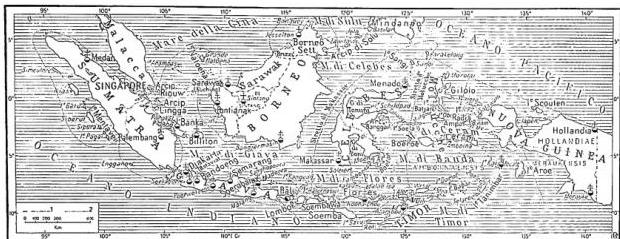
An immense labyrinth of large and small islands (approximately 3,100 are counted), all exceedingly beautiful and extending across the Equator, between the Indian and Pacific Oceans, the South China Sea and the Seas of Sulu, Java, the Sunda Islands and Banda. A characteristic feature of the relief, and evidence of the complexity of the orogenic movement, is the volcanism, which remains highly active; the activity of the endogenous forces, begun in the Tertiary, continued in the Quaternary and continues at the present time. The course of the bathymetric curves and observations of the seabed confirm the study of the fauna, according to which mammals belonging to a former territorial connection, now disappeared, are found in Borneo, Sumatra and Java. Paleontological observations lend support to this assertion, which is moreover confirmed by the fauna of the Siwalik, which has left clear traces everywhere.
The climate is distinctly oceanic equatorial, with considerable temperatures and rainfall. In I. the monsoons have a notable influence; their course is highly complex also because the monsoon circulation, whose centre lies on the Asian continent, is matched by that centred on Australia, so that the currents drawn from the southern region sometimes act in agreement and sometimes in opposition to the monsoon currents of Asia. This changing pattern of the monsoon winds not infrequently creates typhoons which strike certain regions of the Archipelago with extreme violence.
The prosperity of I. is due to the cultivation of rubber, sugar cane, coffee, tea, tobacco and coconut palms. Its forests are rich in valuable timber, while its subsoil yields tin, coal, petroleum, gold and silver. The development of production and the overall wealth, which have increased over the past fifty years (during which the population grew from approximately 12 to 80 million), have not altered the essential basis of I.’s economy, which remains agriculture, to which the government has devoted and continues to devote assiduous and intensive attention. Livestock raising and fishing also contribute to the economic well-being of the indigenous population.
| Territories | area in sq. km. | population | density per sq. km. |
|---|---|---|---|
| Java and Madiera | 132,174 | 51,000,000 | 386.4 |
| Sumatra | 425,143 | 10,000,000 | 23.5 |
| Borneo | 539,460 | 2,000,000 | 5.4 |
| Bangka, Billiton, Riouw | 48,464 | 460,000 | 9.5 |
| Western Indonesia | 759,104 | 12,000,000 | 15.8 |
| Indonesian Archipelago | 1,904,345 | 76,360,000 | 40.1 |
The great majority of the population is Muslim; there are also four and a half million pagans, 600,000 Protestants and approximately 300,000 Catholics. Altogether, 17 important languages are spoken, complicated by 200 dialects. More than three centuries of Dutch rule favoured the rise of cities by overcoming natural obstacles; the flourishing of commerce and the introduction of innovations of European type had excluded Indonesians from any role in their own government. They therefore awaited impatiently the day when the first president, Raden Soekarno, greeted the generation of Indonesian patriots who had fought to win freedom. Following the formation of a Dutch-Indonesian Union (July 1948), the United States of I. were proclaimed (27 December 1949); they now comprise the Islands of Sumatra and Java, part of Borneo, the Celebes and the Moluccas, part of Timor and New Guinea, and many other smaller islands.
The situation naturally remains highly fluid, and the U.N., of which I. is a member, is not unwilling to assist the country in implementing its new plans for social and economic development.
II. EVANGELIZATION
After the Portuguese capture of Malacca in 1511 and their arrival in the Moluccas, and especially after the occupation of Ternate and Tidore (1522), missionary activity began on various islands of the Moluccas, undertaken by ship captains and secular priests. Several indigenous chiefs converted. St. Francesco Saverio, in order to explore the possibilities of the missionary field and to confirm in the faith the abandoned neophytes, went (1546–47) to the Islands of Amboina, Ternate, and Moro (Halmahera), where he baptized and preached, leaving other Jesuits there, who developed a flourishing mission in the sixteenth century. In addition to this Jesuit mission in the Moluccas, the Dominicans founded another mission in 1562 in the Lesser Sunda Islands, centered at Solor; at the end of the sixteenth century it had 18 stations with 25,000 Christians. In the large islands of Sumatra, Java, Borneo, and Celebes, on the other hand, the results were rather ephemeral, except at Macassar and Menado in Celebes. The attemptsINDONESIA - 1) Boundaries of ecclesiastical jurisdictions; 2) railways.
(property of Enc. Catt.)
The efforts of the Franciscans and Dominicans in Borneo and Java remained fruitless.
The Calvinist Dutch seized possession in the seventeenth century of a very large part of these islands; the activity of Catholic missionaries was prohibited and the missions destroyed. Exceptions were Ternate and Menado in northern Celebes and some nearby islets, occupied until 1663, and in part until 1677, by the Spaniards coming from the Philippines; upon their departure, they destroyed everything that had been built by the Spanish Jesuits, Augustinians, and Franciscans. The Dominican missions of the Lesser Sunda Islands were also able to continue, but in the end they too were reduced to the stations of Portuguese Timor. New attempts in the seventeenth and eighteenth centuries, such as those undertaken by the Theatines in Borneo, Sumatra, and Java, did not last. Two Carmelites who accompanied an embassy of the viceroy of Goa in 1638 were martyred by the sultan of Atchin (Atjeh) in Sumatra. For this reason, at the beginning of the nineteenth century, Catholic missions, with the exception of those in Portuguese Timor, no longer existed in I. A complete renewal from the foundations was possible only after the decree of religious freedom issued by Luigi Bonaparte in 1807. The activity of the secular priests of the apostolic prefecture of Batavia, created in 1808 and extended in 1826 to all the Dutch East Indies, nevertheless remained restricted to ministry among European Catholics. Nor did the establishment of the apostolic vicariate of Batavia (1847) and the arrival of the Jesuits (1859), who subsequently formed the majority of the missionaries and in 1893 had one of their own as apostolic vicar, greatly alter the precarious condition of the missions. Toward the end of the nineteenth century, an improvement also began to emerge in the missions among the indigenous peoples. From 1902 the apostolic vicariate of Batavia was divided, and other missionary institutes gradually came to the aid of the Jesuits.
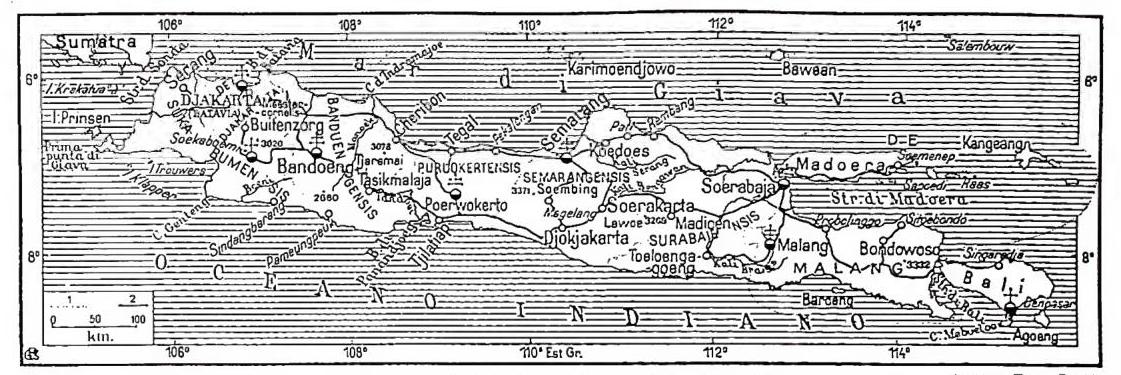
In Java, the mission among the Javanese, who constitute 65% of the population of 40 million inhabitants, began to advance from the end of the nineteenth century, especially because of the schools. Among the Sundanese and Madurese, on the other hand, fanatical Muslims, no results were obtained. In 1923 the Discalced Carmelites arrived in Java, entrusted with Malang, an apostolic prefecture in 1927; the Lazarists, who also arrived in 1923, were assigned Soerabaja, an apostolic prefecture in 1928; the Crosiers have worked since 1926 in Bandoeng, an apostolic prefecture in 1932; the Missionaries of the Sacred Heart of Jesus, assigned in 1926 but arriving in Poerwokerto in 1927, an apostolic prefecture in 1932. In 1940 an indigenous Jesuit was entrusted with the apostolic vicariate of Semarang.
(property of Enc. Catt.)
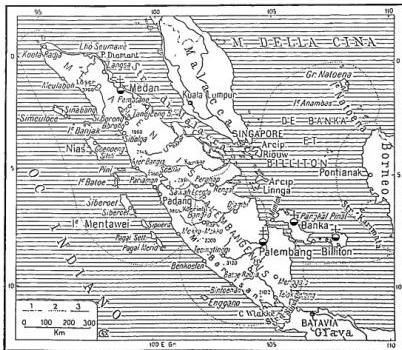
INDONESIA – 1) State boundaries; 2) ecclesiastical jurisdiction boundaries; 3) railways.
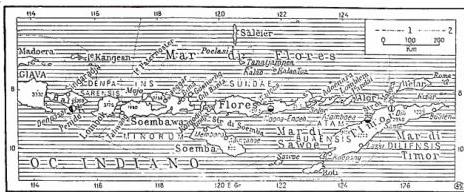
INDONESIA - 1) State boundaries; 2) boundaries of ecclesiastical jurisdictions.
the most prosperous missions of the Dutch Indies in Flores and Dutch Timor. In the other Lesser Sunda Islands, however, the mission has only just begun.
In Dutch Borneo a secular priest had already worked in 1851–52. In 1885 a permanent station was established among the Chinese of the western coast. In 1905 the Capuchins were entrusted with the mission (apostolic prefecture in 1905, apostolic vicariate in 1918) and worked with some success among the Dajaks. The Missionaries of the Holy Family arrived in 1926 in the southern and eastern part (in 1938, the apostolic prefecture of Bandjermasin). In 1948 the Montfort Fathers took over part of the Capuchin mission.
In British Borneo the apostolic prefecture of Labuan and Borneo was established in 1855; its prefect, the former captain Carlo Cuarteron (1855–79), worked there alone for a long time. In 1881 it was entrusted to the Mill Hill Society. The Missionaries achieved excellent results among the Dajaks, chiefly through educational institutions and by founding special colonies for Christian families.
In Celebes, missionaries who came occasionally from Batavia had been working since the middle of the nineteenth century. Toward the end of the century it became possible to establish stations. In 1919 the apostolic prefecture of Celebes was entrusted to the Missionaries of the Sacred Heart: their work was fairly successful among the Minahassa of the northern part of the island, although the majority of them had already converted to Protestantism. In the south, on the other hand, the Missionaries of Scheut, since 1937, have achieved only mediocre results.
The Jesuits had been working in the Kei Islands since 1888: the center of the mission was Langgoer. In 1902, when the apostolic prefecture was founded, the Missionaries of the Sacred Heart were called in; they extended their activity to other nearby islands insofar as this was possible because of Dutch missionary policy. In Dutch New Guinea, too, it became possible from 1915 onward to establish a few stations on the coast; the interior remained unexplored. In the Moluccas, the revival of the mission, which had been so prosperous in the sixteenth century, became possible only in these last few years. The Franciscans work in Ternate and in northern New Guinea.
The missions of I. suffered greatly because of the Second World War. The Japanese occupation, the internment and killing of missionaries (according to official statistics, 124 lost their lives), the closure and destruction of churches and schools, and then the Dutch-Indonesian war made virtually all missionary activity in Java and Sumatra impossible.
III. ECCLESIASTICAL JURISDICTIONS
According to the Pontifical Yearbook of 1951, I. has 23 ecclesiastical jurisdictions, comprising apostolic vicariates and apostolic prefectures, which are arranged here in alphabetical order: AMBOINA, erected as the apostolic prefecture of Nederlandsch Nieuw Guinea (Dutch New Guinea) in 1902, and as an apostolic vicariate in 1920, bearing its present name since 1949, entrusted to the Missionaries of the Sacred Heart of Jesus; AYAMBOEA, erected as the apostolic vicariate of Nederlandsch Timor (Dutch Timor) in 1936, bearing its present name since 1948, entrusted to the Society of the Divine Word; BANDJARMASIN, erected as an apostolic prefecture in 1936 and as an apostolic vicariate in 1949, entrusted to the Missionaries of the Holy Family; BANDOENG, erected as an apostolic prefecture in 1932 and as an apostolic vicariate in 1941,entrusted to the Order of the Holy Cross (Crocigeri); BANKA and BILLITON, erected as an apostolic prefecture in 1923, entrusted to the Society of the Sacred Hearts of Jesus and Mary (Plepus); DEN PASAR, erected as an apostolic prefecture in 1950, entrusted to the Society of the Divine Word; DJAKARTA, erected as the apostolic prefecture of Batavia in 1807 and as an apostolic vicariate in 1841, bearing its present name since 1950; HOLLANDIA, erected as an apostolic prefecture in 1949, entrusted to the Franciscans; KLAINE SOENDA ELLANDEN (Little Sunda Islands), erected as an apostolic prefecture in 1913 and as an apostolic vicariate in 1922, entrusted to the Society of the Divine Word; MAKASSAR, erected as an apostolic prefecture in 1937 and as an apostolic vicariate in 1948, entrusted to the Congregation of the Immaculate Heart of Mary (Scheut); MALANG, erected as an apostolic prefecture in 1927 and as an apostolic vicariate in 1939, entrusted to the Carmelites of the Ancient Observance; MANADO, erected as the apostolic prefecture of Celebes in 1919 and as an apostolic vicariate in 1934, bearing its present name since 1937, entrusted to the Missionaries of the Sacred Heart of Jesus; MEDAN, erected as the apostolic prefecture of Sumatra in 1911, named Padang in 1923, and as an apostolic vicariate in 1932, bearing its present name since 1941, entrusted to the Capuchins; MEBAUKE, erected as an apostolic vicariate in 1950, entrusted to the Missionaries of the Sacred Heart of Jesus; NORTH BORNEO (Northern Borneo), erected as the apostolic prefecture of Labuan and Borneo in 1855, bearing its present name since 1927, entrusted to the Society of St. Joseph of Mill Hill; PALEMBANG, erected as the apostolic prefecture of Benboelen in 1923 and as an apostolic vicariate in 1939 under the name of Palembang, entrusted to the priests of the Sacred Heart of Jesus; POERWOKERTO, erected as an apostolic prefecture in 1932 and as an apostolic vicariate in 1941, entrusted to the Missionaries of the Sacred Heart of Jesus; PONTIANAK, erected as the apostolic prefecture of Nederlandsch Borneo (Dutch Borneo) in 1905 and bearing its present name since 1938, entrusted to the Capuchins; SARAWAK, erected as an apostolic prefecture in 1927, entrusted to the Society of St. Joseph of Mill Hill; SEMARANG, erected as an apostolic vicariate in 1940, entrusted to the Jesuits; SINTANG, erected as an apostolic prefecture in 1948, entrusted to the Missionary Priests of the Company of Mary (Montfortians); SOEKABOEMI, erected as an apostolic prefecture in 1948, entrusted to the Franciscans; SOEBARAJA, erected as an apostolic prefecture in 1928 and as an apostolic vicariate in 1941, entrusted to the Lazarists. Giovanni Rommerskirchen
IV. LEGAL STATUS OF THE CHURCH
The principal obstacles that in the past placed a brake on the spread and organization of Catholicism in I., a mosaic of human races, nationalities, tribes, clans, languages, customs, cultures, religions, flora, and fauna, were:1) Dutch legislation, specifically art. 177 I. S. (Indische Staatsregeling; governmental regulation for the Indies), whose wording is as follows: «Teachers of the Christian faith, priests, and preachers must be provided with a special permit, to be issued by the governor-general himself or in his name, in order that they may carry out their activity in a specific place in the Dutch Indies. Such permit, if it should be judged capable of causing harm, or if the relevant conditions are not observed, may be revoked by the governor-general». Now this permit was in practice refused until the very latest period, for example, for Bantam (apostolic prefecture of Sukabumi) and for the western part of New Guinea.
2) Islâm, which is irregularly widespread throughout the Indonesian archipelago. A distinction must be made between administrative Islam and religious Islam. The former means that births, marriages, and deaths are surrounded by Muslim ritual, that the civil calendar is Islamic, and that agrarian, commercial, penal, and other law follows the Qur’an.
Religious Islam is always distinguished by its character of fanaticism, by its firm hostility toward Christianity, even when the latter is embodied only in a more or less numerous group.
3) Protestantism: it entered the archipelago at the beginning of the seventeenth century with the arrival of the Dutch, who replaced the Portuguese and Spanish. The Reformed religion (Calvinism) was able to spread, between 1602 and 1622, undermining the Catholic organization, until it forced the Catholic missionaries to abandon the field. It was the East India Company that supported the Calvinist pastors in their work of penetration. In accordance with Calvin’s principles, according to which civil authority must also concern itself with religious interests, the public administration issued ordinances on religious matters. Subsidies were then paid for the operation of schools and hospitals and for the support of Protestant ministers of religion. Later, Catholic missionaries, schools, and hospitals also succeeded in benefiting from such subsidies.
A change is now to be hoped for after libera-
(from E. Malmani, L'Aria di sud-est, in Geografia universale, IV, Turin 1556, p. 281)
INDONESIA - An indigenous house in Celebes built on stilts.
Liberation from the colonial regime, the transfer of sovereignty that took place in Amsterdam on 27 December 1949, and the establishment of the federal state, under which various small states were grouped, later consolidated into three large federated republics: Djoeja, Makassar, and Medan, and finally (17 August 1950) into the Unitary State of Indonesia under the name of the Republic of Indonesia. Before the opening of the Round Table Conference in The Hague, where the statutes of the new sovereign country were drafted, Catholic Missions had presented a minimum program, which can be summarized in two points: a) freedom of worship, teaching, and social and charitable activities; b) equality of rights, by virtue of which the Catholic religion and missionary activities would obtain the same official recognition and enjoy the same treatment as other religions, such as Islam. Catholic Missions would thus receive, for schools, hospitals, and charitable works of general interest, the same financial support as other religions. A draft for the new definitive constitution is now under study by the Indonesian Parliament. The legal status of the Church will rest on principles that establish the idea of the One God as the fundamental basis of said constitution and recognize full freedom for each religious confession to organize and live.
The main points of the proposed constitution are reported here.
Art. 18 - Everyone has the right to freedom of religion, conscience, and thought.

Art. 31 - Freedom is recognized to establish social and charitable works, to found organizations for this purpose and also in favor of private education, and to seek and hold possessions for this purpose, subject to the supervision of public authority.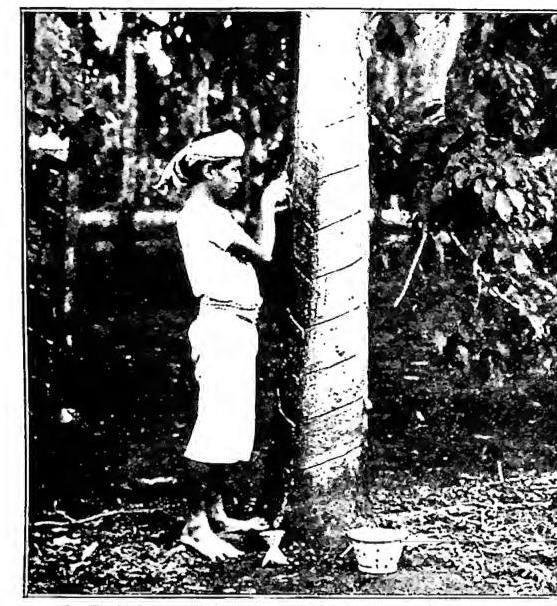
5 - Students of a private school, which meets the requirements of solidity set by law for the
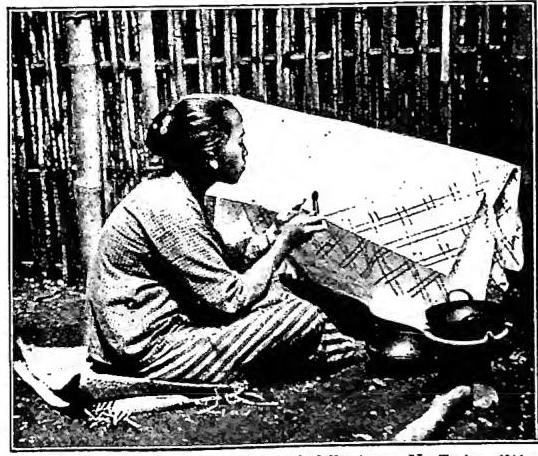
INDONESIA - Woman painting fabric (batik painting) - Java.
(from E. Malzani, L'Asia di sud-est, in Geografia universale, V. Turin 1936, p. 735)
INDONESIA - Rubber harvesting - Java.
public education, shall have the same rights as pupils of public schools.
Art. 43, 1 - The State is based on belief in the one God.
2 - The State guarantees the freedom of each inhabitant to embrace the faith he desires and to profess worship according to his faith and belief.
3 - Public authority protects all corporations and organizations that have been recognized. Assistance given, in any form, to ministers of worship and to religious corporations and organizations is regulated on the basis of equal rights.
V. ART
The most significant expressions of art that developed in the Sunda Islands, the Moluccas, and the Philippines are certainly those of Javanese origin. Derived from Indian art, since the island was subject to Hindu rule until the 6th century B.C., it managed to preserve its characteristics until around the 16th century, when it fell under Muslim domination. An original reworking of South Indian art is that which developed from the 6th to the 8th century on the Dieng Plateau, in the center of the island, and which ultimately influenced, to a greater or lesser extent, the art of all the smaller islands. One of the main features of this art is a marked linearism that intensified under Islamic influence, as seen in the creations for the Wayang theatrical performances.Christian Art. - Even for Indonesia, the question of Christian art arose in relatively recent times. In sculpture, works from the workshop of the sculptor Iko, assisted by his son-in-law Adi and the Chinese Yong-Shoi-Lin, have earned deserved recognition; a fine altar with a statue of the Sacred Heart and two adoring angels is preserved in the Lateran Museum in Rome. In architecture, for small votive temples, models of ancient small temples were followed (notable is the votive temple of the Sacred Heart of Jesus in Batavia, partly inspired by the temple of Shiva at Prambanan); for churches, however, it was naturally impossible to use the indigenous temple, which provided only a cell sufficient for the statues of the deities and a few officiants. Nevertheless, even in this case, an effort was made not to depart from the basic elements of Hindu sacred constructions, from the characteristic pyramidal crowns on terraces, and among others, the churches of Padang, Pematang-Siantar (Sumatra), Nanggoelan, and Sadan-Toradja (Celebes) are noteworthy. In the industrial arts, notable products include those of batik art and other marvelous techniques of indigenous decorative art.