
AUSTRALIA. – The smallest of the continents (approximately three-quarters the size of Europe), the farthest from Europe, and the only one situated entirely in the Southern Hemisphere (apart from Antarctica).
CONTENTS:
I. Geography
II. Catholicism in A
III. Councils of A
IV. Educational system.#### I. GEOGRAPHY.
A. consists of an ancient plateau (as in Africa), levelled by erosion and surmounted on its eastern side by a folded range, the so-called Australian Alps, extending from Cape York to Tasmania. To the west, the plateau, averaging about 500 m. in elevation, is here and there broken by higher granite ridges (up to 1500 m.), except near the coast (desert or sandy), or covered with low, impenetrable scrub (scrub); and here and there hollowed out into closed basins (salt lakes). To the east, the Australian Alps, which culminate in Mt. Kosciusko (2241 m.), descend steeply to the sea, cut by deep valleys but with the gentle forms of medium-altitude mountains. Between the two stretches a long depression interrupted by hills and mountains (Mt. Flinders), crossed by temporary watercourses (creeks); to the south it embraces the Murray-Darling basin (the only important river in A.: 3700 km. in length, with a basin of 90,000 sq. km.) and Lake Eyre, which lies below sea level (–12 m.).
Approximately two-fifths of A. lies in the torrid zone and the remainder in the temperate zone; extending through 32° of latitude (as between Cagliari and Lake Tana in Ethiopia), A. has varied climatic conditions. Its general characteristics, however, are marked thermal contrasts and the irregularity, even more than the scarcity, of rainfall. In the north and north-east the climate is tropical, with abundant summer precipitation (monsoons); in the east and south, subtropical, with mild winters and hot summers (rainfall in the intermediate season); in Victoria and Tasmania, temperate, with clearly defined summers and sufficient rainfall (in winter). In the interior, aridity and continentality prevail to a greater or lesser degree everywhere. Only slightly more than one-third of the territory drains into the ocean; closed basins occupy more than two-fifths, and areas without surface drainage approximately one-third. The damage caused by drought is nevertheless moderated by the use of underground waters, tapped by means of numerous artesian wells, and even by the distillation of seawater (pipeline from Perth to Kalgoorlie).
Vegetation and fauna display pronounced archaic features, with distinctive endemic forms. In the forests, especially luxuriant in the north and east, eucalyptus trees and tree ferns predominate; in the scrub, bush acacias and thorny shrubs. A. lacked monkeys, carnivores (with the exception of the dingo), and ruminants; on the other hand, the monotremes (echidna, platypus) and marsupials (kangaroo) are characteristically Australian. Domestic animals were introduced by the Europeans and spread rapidly.
Europeans arrived in A. in 1778 (groups of English convicts); the first free settlers (Scots) arrived in 1820. In 1851 the discovery of gold brought about a considerable wave of immigration; subsequently the influx was restricted.
Australian Confederation. – The Australian Confederation (Commonwealth of A.) is a federation of six States, one territory, and one federal district, and constitutes one of the members of the British Empire (British C. of Nations), to which it is bound by a govern-
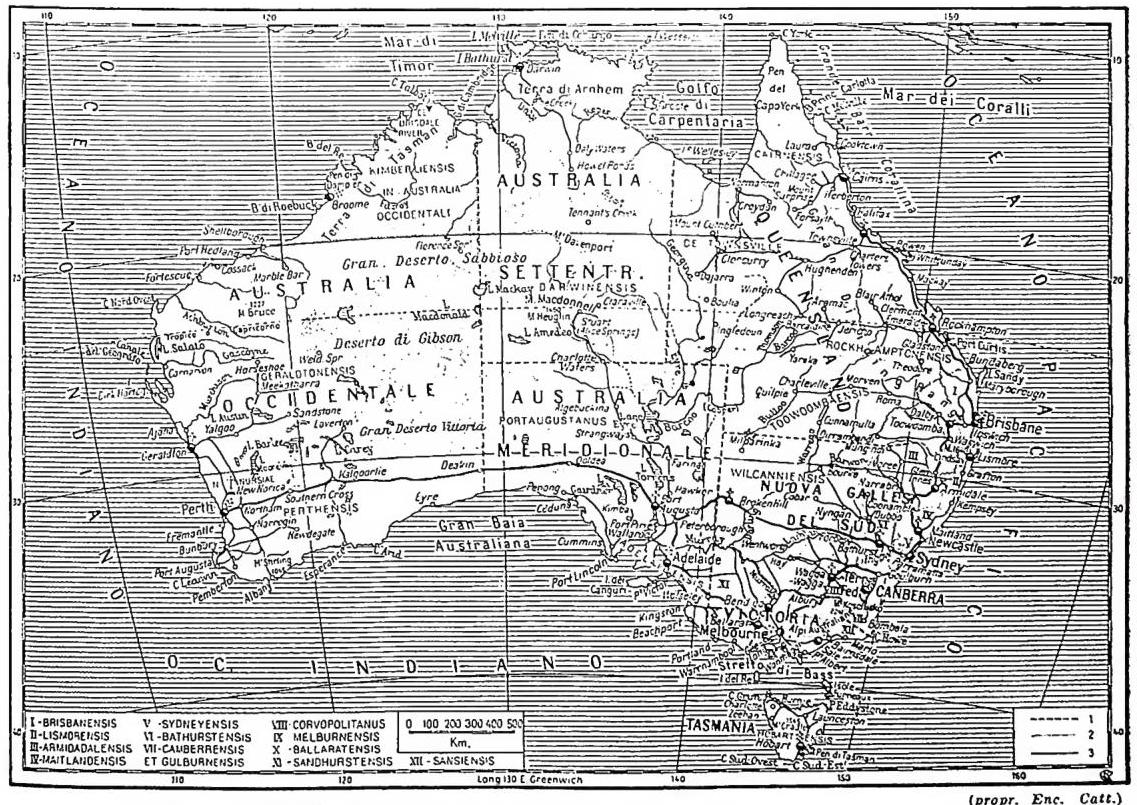
| Nuova Galles del Sud (1788) | sq. km. | 801 | inhab. | 2925 |
|---|---|---|---|---|
| (Capital: Sydney inhab. 1484) | ||||
| Tasmania (1825) | » | 68 | » | 251 |
| (Hobart inhab. 72) | ||||
| A. Occidentale (1829) | » | 2528 | » | 494 |
| (Perth inhab. 273) | ||||
| A. Meridionale (1834) | » | 984 | » | 636 |
| (Adelaide inhab. 375) | ||||
| Victoria (1851) | » | 228 | » | 2031 |
| (Melbourne inhab. 1227) | ||||
| Queensland (1859) | » | 1737 | » | 1091 |
| (Brisbane inhab. 402) | ||||
| Territ. N. (1863) | » | 1356 | » | 5 |
| (Darwin inhab. 2) | ||||
| Distretto Federale (1911) | » | 2 | » | 15 |
| (Canberra inhab. 11) |
The Australian Confederation covers 7.7 million sq. km.; 6.9 million inhabitants were settled there in 1938, and 7.6 million in 1947 (less than 1 inhabitant per sq. km. overall!). In addition, there are approximately 60,000 indigenous people (Australids), more than two-thirds of whom live a nomadic existence in the least-favoured regions. The white population is almost exclusively (97%) of English origin; the Australian Confederation is therefore, of all the British dominions, the most ethnically homogeneous. Foreigners number about 60,000, of whom 18,000 are Italians.
The great majority of the population is Protestant; Catholics number 1.4 million.
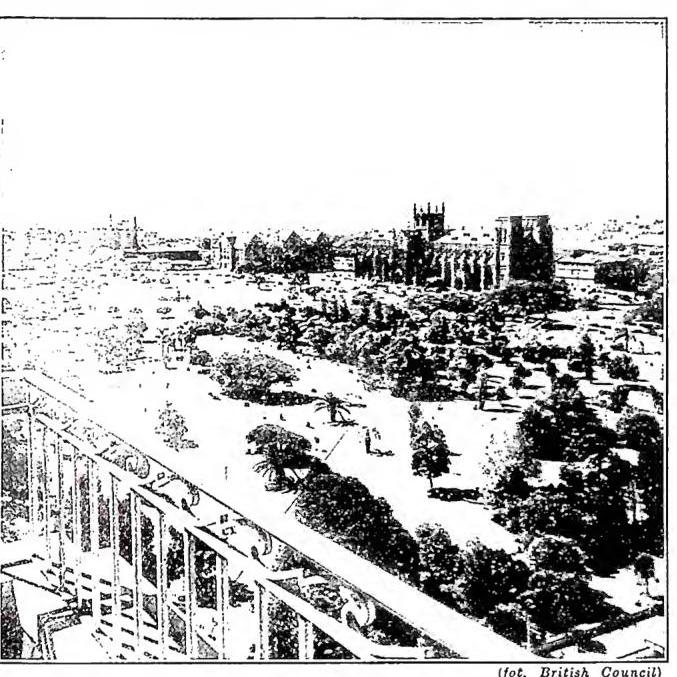
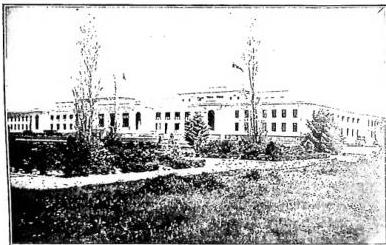
Three-fifths of the population is concentrated in urban centres, two of which have more than one million inhabitants: Sidney (1.5) and Melbourne (1.2); there are also 4 other cities with more than 100,000 inhabitants (Brisbane, Adelaide, Perth and Newcastle). Since 1927 the capital has been Canberra, a small, highly modern centre inhabited almost exclusively by state officials (12,000 inhabitants).
Only a tiny portion (1.7%) of the immense territory is cultivated (especially in the S.-E.), producing cereals, sugar cane, grapes and fruit in quantities exceeding domestic consumption. Forests cover barely 1% of the total area and yield valuable timber, especially for cabinetmaking. Mineral resources are considerable (gold in the S.-W., silver, copper, tin, lead, coal, especially in the S.-E., etc.; petroleum, however, is lacking), but their products are exported for the most part in raw form. The principal source of national wealth is livestock raising; in sheep (96 million head), the Australian Confederation ranks first in the world, and by far first in wool production (one-quarter of the world total). There are also numerous cattle (13 million head), horses (1.2 million) and pigs (1.3 million); exports of butter, cheese, fats, preserved meat and hides are substantial. Only livestock raising has given rise to industrial activity on an adequate scale; the other industries (metallurgy, iron and steel, cement), however, made decisive progress during the last decade. In 1945–46 the value of manufactured goods exceeded that of agricultural products by more than three times.
The railways (44,000 km.) serve the marginal sectors of the E. (especially the S.-E.) and the S.-W., from which numerous lines extend into the interior, though they are not interconnected; there are also significant differences in gauge from one network to another, hampering trade. The E.-W. Transcontinental (from Sydney to Perth) is in operation; the N.-S. line (from Darwin to Adelaide) is under construction and has currently reached a point 450 km. from Darwin.
Foreign trade produces extremely high per-capita figures (54 pounds sterling in 1946–47): more than one-third of exports and one-third of imports are absorbed by Great Britain. In 1946–47 imports reached 183.7 million pounds sterling, compared with 246.7 million in exports. The former consist chiefly of textiles (silk and cotton), petroleum, chemical products, machinery, paper, electrical goods, etc.; the latter of wool (slightly less than half of the total by value), flour, meat, hides, leather, lead, etc. In this trade first place is held by the State of Nuova Galles del Sud, which alone accounts for slightly less than half of the total; it is followed by Victoria and Queensland. Italian-Australian trade is modest: in 1946–47 exports to Italy exceeded imports by as much as six times (2.4 million pounds sterling).
Under the administration of the Australian Confederation are: 1) the territory of Papua (since 1 September 1906; 234,490 sq. km. with 302,000 inhabitants) on the island of Guinea; 2) the mandated territory of Nuova Guinea (since 17 December 1920; 241,000 sq. km. with 675,000 inhabitants), comprising, in addition to part of the island, the Bismarck Archipelago; 3) the Solomon Islands (29,676 sq. km. with 95,000 inhabitants); 4) the atoll of Nauru (22 sq. km. with 2,321 inhabitants); 5) the tiny islands of Ashmore and Cartier in the Timor Sea, S. of the Malay Archipelago (1.89 sq. km., uninhabited); 6) the Antarctic Territory, comprising all the islands and the continent S. of 60° S. and between 160° and 45° E. Greenwich (with the exception of Terra Adélie), uninhabited.
Giuseppe Caraci
II. IL CATTOLICESIMO IN A.
In the sixteenth century the existence of a «Terra australe incognita» was already known; Portuguese navigators had caught sight of its northern and western coasts. A century later the Dutch also explored its southern coasts and gave it the name of Nuova Olanda, but the newest continent continued to remain a mystery for another century and a half, until Cook, in 1770, discovered the eastern coasts, thereby making it possible to trace its outline. Nevertheless, as early as 1666 the S. Congregazione di Propaganda Fide had established a mission of the Terra Australe, entrusting it to the French priest de Pomiera, who intended to evangelize it with the assistance of the Sulpicians; the project, however, was never carried out. Fifteen years later, the same mission was entrusted to the apostolic prefect of Formosa, who was then residing in the Philippines, but he was unable to go there or to send missionaries there. After these first two attempts had failed, the mission of the Terra Australe was no longer mentioned until near the end of the eighteenth century, when A. became an English colony.
After the American War of Independence, England, no longer able to send to the penal colonies of America, as it had done from 1716 to 1776, its numerous convicts sentenced to deportation, established, in the southeastern part of New Holland, the colony of New South Wales, reserved for deportees. These were not all criminals; on the contrary, given the systems then prevailing in England, most were people punished for minor offenses or for political reasons; among the latter were numerous Irishmen, condemned for rebellions against the laws of their rulers. Thus it came about that the first white inhabitants to settle in A. were the 696 deportees who, on 20 January 1778, landed with their escort at the place where Sydney would later arise.
Other expeditions followed this first one for three quarters of a century, with an average that at certain times reached approximately 6,000 deportees per year. The history of the penal colonies of A., like that of those in America, is a history of horrors and depravity, of oppression and brutalization, which provoked great indignation and frequent protests. Deportation was abolished in New South Wales only in 1840 and did not disappear entirely from
A. until 1866. From almost the beginning, however, groups of free colonists began to settle alongside the colonies of deportees, and they were joined by released convicts. The free colonists had already become more numerous than the deportees when, around the middle of the 19th century, the discovery of the gold mines attracted a very strong current of immigrants to A.
There were also Catholics among the deportees, but they were granted no freedom of worship. Indeed, under the threat of very severe penalties, they were forced to attend Anglican religious services, and their children were educated in the Anglican faith. In 1792 the Catholics numbered approximately three hundred among the deportees and about fifty among the free colonists; at the beginning of the 19th century they numbered nearly two thousand, and among them were three priests, who were strictly forbidden to exercise any sacred ministry. One of them, Fr. Dixon, finally succeeded in 1803 in obtaining, under supervised liberty, permission also to celebrate Mass once a month. A year later the permission was revoked; then, one after another, the three priests were sent back to Ireland, and the conditions of the Catholics became worse than before.
In 1816 the Sacred Congregation of Propaganda appointed the Cistercian Fr. O'Flynn apostolic prefect of New Holland; but he was able to exercise his ministry only secretly among the 6,000 Catholics whom he found in A.; after a few months he was arrested and sent back to his homeland, without being able to consume the Sacred Species, which remained secretly venerated for two years in the house of an Irish colonist named Davis. A Sanctuary was later built on the site, a destination for pilgrimages. The brutal and illegal treatment inflicted on Fr. O'Flynn caused a sensation in England and brought to light the religious persecution to which the deportees and Catholic colonists in A. were subjected.
In 1819 the Congregation of Propaganda entrusted the mission to the apostolic vicar of the Mascarene Islands, who obtained that two of his missionaries be appointed by the government as chaplains for the Catholic deportees. This took place in May 1821, and that date marks the beginning of religious toleration in A. The first Catholic priests of A., especially Fr. Therry and, after him, the Benedictine Dom Ullathorne—who had been appointed vicar general for all A. by the apostolic vicar of the Mascarene Islands—had to endure
At the request of the apostolic vicar, Mgr Polding, the first bishop of A., the Holy See proceeded in 1842 to establish the ecclesiastical hierarchy there, dividing the vicariate into three parts and establishing Sydney as a metropolitan archiepiscopal see, with the two suffragan dioceses of Hobart and Adelaide. Other dioceses soon followed these first ones: Perth, capital of the colony of Western A., was erected as a suffragan diocese of Sydney in 1845; Melbourne, Maitland
and Port Victoria, now Darwin, in 1847. The extraordinary influx of immigrant gold-seekers increased the number of Catholics from 60,000 in 1851 to 250,000 in 1861 and made necessary the creation of other dioceses, namely: Brisbane in 1859, which that same year had been made the capital of the new colony of Queensland; Goulburn in 1864; Bathurst in 1865; and Armidale in 1869. Meanwhile, the mission of the Spanish Benedictines, founded as early as 1846 for missions among the aborigines and dependent on the bishop of Perth, was erected in 1867 as an abbey nullius, Norcia (v.), with its own territory. Until 1874 all the dioceses of A.
were suffragans of Sydney; in that year the diocese of Melbourne was elevated to a metropolitan see for the entire territory of the colony of Victoria, with two suffragan dioceses: Sandhurst and Ballarat. In order to attempt the evangelization of the aborigines of Queensland, the northernmost territory was detached (1877) from Brisbane and, erected as the apostolic vicariate of Queensland (called Cooktown in
1887 and becoming the diocese of Cairns in 1941), was entrusted first to the Seminary of Saints Peter and Paul in Rome and then to the Irish Augustinian Recollects. At present, as a diocese, it is entrusted to the secular diocesan clergy. In 1882 the new diocese of Rockhampton was likewise detached from Brisbane.
The Catholics continued to increase rapidly (according to the government census of 1881, they numbered 539,556 in a total population of 2,245,448 souls). Following the vote of the First Australian National Council held in 1885 (the same year in which A. was honored by the appointment of Mgr Moran, archbishop of Sydney, as cardinal), the new dioceses of Grafton, later called Lismore (1900), and Wilcannia, later Wilcannia-Forbes, were erected in New South Wales in 1887; Sale in Victoria; Port Augusta in South A.; and the apostolic vicariate of Kimberley in Western A., created for the evangelization of the aborigines. The dioceses of Brisbane, for the colony of Queensland, and Adelaide, for South, Central, and North A., were elevated to metropolitan archiepiscopal sees. The following year Tasmania too had its see of Hobart elevated to an archdiocese; with the erection of the diocese of Geraldton, the nineteenth century came to a close. On 1 January 1901 A. ceased to be a colony and became a federation of six States under the name of “Commonwealth of A.” At that time it had 3,782,182 inhabitants, of whom 856,068 were Catholics; there were 5 archdioceses, 14 dioceses, 2 apostolic vicariates, and one abbey nullius.
In the twentieth century there were few territorial changes in the Catholic hierarchy: in 1910 Drisdale River mission (v.) was created in Kimberley for the evangelization of the aborigines and entrusted to the Benedictines of the abbey of New Norcia; in 1913 Perth too was elevated to an archdiocese and constituted a metropolitan see for the whole of the State of Western A.; in 1914 the apostolic delegation of Australasia was established, with its residence in Sydney; in 1917 the new diocese of Wagga-Wagga was erected in New South Wales; in 1929 that of Toowoomba and the following year that of Townsville, both in Queensland. In 1948 the diocese of Goulburn was elevated to an archdiocese under the name of Canberra-Goulburn. Naturally, parishes, religious houses, schools, and the various institutions of culture and charity multiplied, and seminaries and scholasticates were established for the formation of priests, who in the preceding century had come almost exclusively from Ireland; new religious congregations were introduced, others were founded in A., and almost all opened novitiates. After the First Australian Plenary Council of 1885, three others followed,
What constitutes the gravest concern of the bishops and parish priests, and the pride of Australian Catholics, are their schools. The question of the Christian education of youth has been a burning issue from the very beginning of the colony, obliging Catholics to engage in a continuous struggle. First they obtained that the children of Catholics should no longer be obliged to undergo the religious instruction of the Anglicans; then came freedom of education; next the Catholic schools obtained government subsidies, on an equal footing with Protestant schools; finally, State schools, agnostic in character, arose, and around 1880 all subsidies to denominational schools were withdrawn. Since then Australian Catholics, in addition to paying their share of taxes for the State schools, which they do not use, have borne the heavy burden of maintaining their own schools entirely. Today A. possesses a national system of parish schools, placed under the direct control of the bishops, which provides elementary education for almost all the children of Catholics. Even in small scattered localities, where the priest can go only once a week or once a month to celebrate Mass, there is always a little school run by the sisters. In centers of some importance there are secondary schools of various kinds, directed by religious. In 1939 the parish schools numbered 1,065, and the secondary schools 62, with a total of 203,344 pupils.
In a country where Catholics are a minority and live scattered among Protestants, mixed marriages are unfortunately unavoidable, often causing painful losses for the Church; on the other hand, a consoling promise for the future is the established fact that, although Catholics constitute only one fifth of the population, among them the birth rate exceeds two fifths of the Australian birth rate.
The central Government of Canberra has no official relations with the Holy See, because the Apostolic Delegate, in accordance with the prescriptions of canon law, is not accredited to that Government. Since 1947 the Apostolic Delegation has been renamed the Delegation of Australia, New Zealand, and Oceania.
The evangelization of the Aborigines, now reduced to fewer than 60,000 in A., has been much discussed and planned; the provincial and national councils dealt with it; the Holy See, as has already been mentioned, erected vicariates and missions; repeated unsuccessful attempts were made by various religious congregations: Benedictines, Trappists, Jesuits, Missionaries of the Seminary of the Holy Apostles Peter and Paul, Missionaries of the Sacred Heart, Pallottines, Salesians, and secular clergy; but the results were unstable and meagre. At present there are in A. ten missionary stations for the Aborigines: three in the apostolic vicariate of Kimberley (Pallottines), two in the mission of Drisdale River (Benedictines), four in the diocese of Darwin (Missionaries of the Sacred Heart), and one in the diocese of Townville (a secular priest). Taken together, however, the Catholic Aborigines do not exceed one thousand, while the catechumens number approximately three times as many.
According to the latest statistics, A. has 1.4 million Catholics in 7 archdioceses (one for each State, with the exception of New South Wales, which has two), and 17 dioceses, one millius abbey, 1 apostolic vicariate, and one sui iuris mission, with 904 parishes and 2,319 churches. There are 2,455 priests (of whom 80 are religious), 1,300 brothers, and 10,862 sisters. In the seminaries and houses of formation, 602 candidates are preparing for the priesthood. Charitable institutions include 50 hospitals, 46 orphanages, and 65 other institutions and homes. The Catholic press is represented by 9 weeklies and 21 other periodicals.
For the religion of primitive peoples, V. PRIMITIVI, religione dei.
### III. CONCILI DELL'A.
The erection of new dioceses in A., and especially of a second ecclesiastical province, that of Melbourne (1874), soon created the need for a first plenary Council of A. and New Zealand, which met in Sydney from 14 to 29 November 1885 under the presidency of Cardinal Francesco Patrizio Mosan, archbishop of Sydney. Fifteen bishops took part, including one apostolic vicar, together with 52 theologians and other distinguished persons. In 13 private and 5 public sessions, the Council dealt with the First Vatican Council, ecclesiastical discipline, the education of the young, and other matters of practical importance, on which the fathers issued 274 decrees. During the Council, the first diocesan seminary of A. was blessed. This first plenary Council, whose acts were approved by Rome by decree
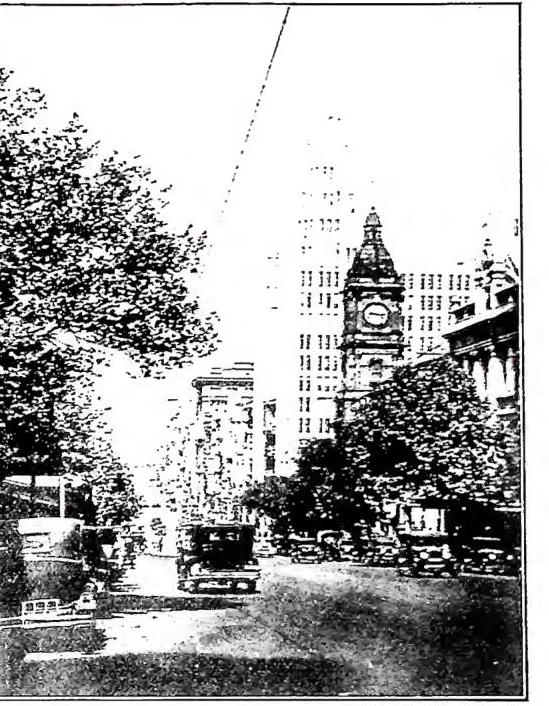
AUSTRALIA - Collies Street, Melbourne.
The Second Plenary Council took place from 17 November to 1 December 1895 under the presidency of the same cardinal archbishop, with the participation of 20 bishops, 2 apostolic administrators, 49 theologians, and other persons. Fourteen private sessions and 3 public sessions were held, at which the fathers published 344 decrees intended to confirm or expand the previous legislation; the Congregation of Propaganda approved its acts by decree of 22 January 1898.
The Third Plenary Council convened in 1905 under the presidency of the same Cardinal Moran, with the participation of 6 archbishops, 22 bishops, an abbot millius, and other persons (cf. H. W. Cleary, s. V. in The Catholic Encyclopedia, II, p. 117). At its conclusion, Pius X addressed the participants in a letter dated 29 October 1905 (Pii X P. M. Acta, II, Rome 1907, p. 176).
The Fourth and last Plenary Council of A. and New Zealand was held from 4 to 12 September 1937, under the presidency of the apostolic delegate, Monsignor Giovanni Panico, with the participation of 7 archbishops, 23 bishops, 22 theologians, 16 religious superiors, and other distinguished persons. There were 7 private sessions, 3 public sessions, and 2 general sessions, at which particular attention was given to adapting national ecclesiastical legislation to the new Code of Canon Law, to the means of developing Catholic Action, and to combating the communist danger. To this end, 685 decrees were published, arranged according to the order of the CIC. The Council’s decisions were approved by the Congregation of Propaganda by decree of 14 March 1938.
In addition to these plenary councils, there have been
others. In 1844 the Provincial Council of Sydney; in 1862 the Provincial Council, the First of A., at Melbourne; and there also the Second in 1869. Other diocesan councils were held at Melbourne, Maitland, and Sydney.
IV. SCHOOL SYSTEM.
In A., education is regulated by the individual States that make up the Australian Commonwealth. These are particularly intent on reducing the number of illiterate persons, which has fallen to only 5%. For this reason, particular care is devoted to elementary education, which is not always easy to provide because of the enormous distances and the scarcity of communications. In addition to the ordinary elementary schools, “Full-time-schools,” there are “Half-time-schools,” where pupils spend only part of the day studying, while they spend the rest of the day working. There are also temporary elementary schools, “Provisional schools,” in small settlements where the number of children reaches 10; if this number cannot be reached and the distance from the nearest settlement is too great, elementary instruction is provided through the systems of “House to house schools,” “School with substituted teachers,” and “Correspondence schools.” In the first case, the teacher reaches his pupils by train, carriage, or bicycle, gives the lesson, and corrects their work; in the second case, instruction is entrusted to a substitute for the teacher, who comes from time to time to supervise the work carried out by his replacement; in the third case, instruction is provided by correspondence. New South Wales has established “Travelling schools” and Queensland two “Railway cars schools”; these are the so-called mobile schools, which move from one settlement to another, remaining for six to eight weeks, where the children, and especially the girls, learn not only to write but also the skills necessary for the household.
Secondary education is divided into two-year and three-year courses. The former include: “Farm-rural-schools” and “Higher primary small lipper classes.” The latter include: “Intermediate-high-schools” and “High-schools.” These are lower secondary schools. From the two-year schools, students may proceed to “Hawkesbury Agriculture College,” and from the three-year schools to “High-schools” lasting 4 or 5 years. At the end of the course, students receive the “Leaving certificate,” which entitles them to attend a “Teachers College” or one of the six universities. The universities are those of Sydney, founded in 1852; Melbourne, founded in 1853; Adelaide, founded in 1874; Brisbane, founded in 1893; Perth, founded in 1901; and Hobart, founded in 1989.
Catholic emancipation in England in 1829 greatly improved the living conditions of Australian Catholics, who were permitted to establish schools that were recognized by the State in 1912.
There are 532 “Boys-Colleges,” 201 “Girls-Boarding-schools,” 222 “Superior-Day-schools,” and 1064 “Primary schools.” The education of the clergy is provided for in 9 ecclesiastical seminaries. - Vedi Tav. XXX.