Machine translation of the 1948–1954 Italian original. The original text is authoritative.
FORMOSA. - Island of the Far East, annexed to China in 1683, ceded to Japan in 1895 and returned to China in 1945. One and a half times the size of Sardinia (35,961 sq. km. including the Pescadores Islands), it has 6.1 million inhabitants, almost all Chinese (in the interior, covered by forests, live about 150,000 Malays in a savage state).
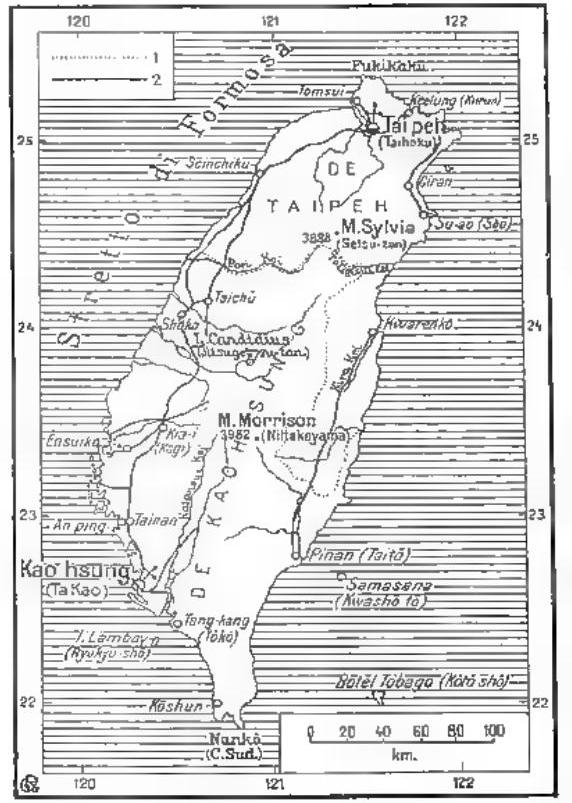
FORMOSA - 1) Boundaries of ecclesiastical jurisdiction; 2) Railways.It has a tropical climate and monsoonal rains. Agricultural production (rice, tea, sugarcane, cotton) and forestry (camphor, 90% of the world's total) are rich, and mining potential (coal, gold, sulfur, petroleum) is also notable. There are numerous large population centers: Taipeh (capital, 340 thousand inhab.), Tainan (124 thousand inhab.), Takao (110 thousand), etc.
BIBL.: J. W. Davidson, The island of F., Londra 1903; H. Fahrenberg, Die Insel F., Amburgo 1926. Giuseppe Caraci
EVANGELIZZAZIONE - The first missionaries landed in F. in 1626, sent by the Dominicans of the province of the Most Holy Rosary of the Philippines. Fr. Bartolomeo Martinez was the inspirer and soul of the noble missionary expedition which began on February 28, 1626. A temple was raised to the Lord of Heaven and dedicated to All Saints in Kilung. The firstfruits of the Christian religion in F., Dominican history states, were two sons of a Christian Chinaman who had long been married to a pagan islander. He was the first inhabitant of the Island to enter into a trusting relationship with the ministers of God and had his two children publicly baptized to the great astonishment and wonder of the natives. Subsequently, conversions were numerous and martyrs were not lacking. Fr. Francesco di S. Domingo can be considered its protomartyr. But the expulsion of the Spaniards, after barely sixteen years, at the hands of the Dutch and the subsequent rule of the pirate Koxinga arrested and destroyed Catholicism. The missionaries in vain endeavored to re-enter F. after the Chinese conquest of 1683 and during the various attempts at rebellion that followed one another for nearly two centuries.
In 1854 the council of the Dominican province of the Philippines decided, on Dec. 14, to make a new attempt, electing Frs. Fernando Sainz and José Dutras. These men, assisted by an experienced missionary to China, Fr. Angelo Bofurull, landed in F. and restored the ancient mission of Kilung and founded another among the aborigines called Ban-Kim-Chiang. In 1868 the evangelical work was continued by Fr. Angelo Chinchon. In 1872 a new mission was inaugurated in Daitotei, in the northern part of the island. In Dec. 1872 Leo XIII divided the vast vicariate of Fukien into two: one northern with its seat in Fukien, the other center-southern with its seat in Amoy. To the latter was joined the Island of F. In 1895 F. became a Japanese possession by the Treaty of Shimonoseki which ended the war between China and Japan. The chapels were destroyed or stripped, the Christians dispersed, and some killed by the Japanese. But with peace the missionary stations revived and developed. On July 9, 1913, the mission of F., detached from the vicariate of Amoy, was erected into an apostolic prefecture. On Dec. 30, 1940, from the same mission the northern provinces of Teipeh, Schinchu, Hoalien were severed and erected into the apostolic prefecture of Taipeh while the remaining territory, consisting of the center-southern provinces of Taichung, Tainan, Kaohsung, and Taitung, received, in place of the old denomination of apostolic prefecture of the Island of F., the name of Kaohsung (v.).
BIBL.: AAS, 3 (1913), pp. 367-68; I.M. Alvarez, F. geografica y storicamente considerada, 2 voll., Barcelona 1930, passim; MC, pp. 165-66; GM, pp. 174-175. Edoardo Pecorino
Cite this article
“FORMOSA.” Enciclopedia Cattolica, vol. V (1950), p. 908. Azione Romana digital edition, https://azioneromana.com/article/formosa.