
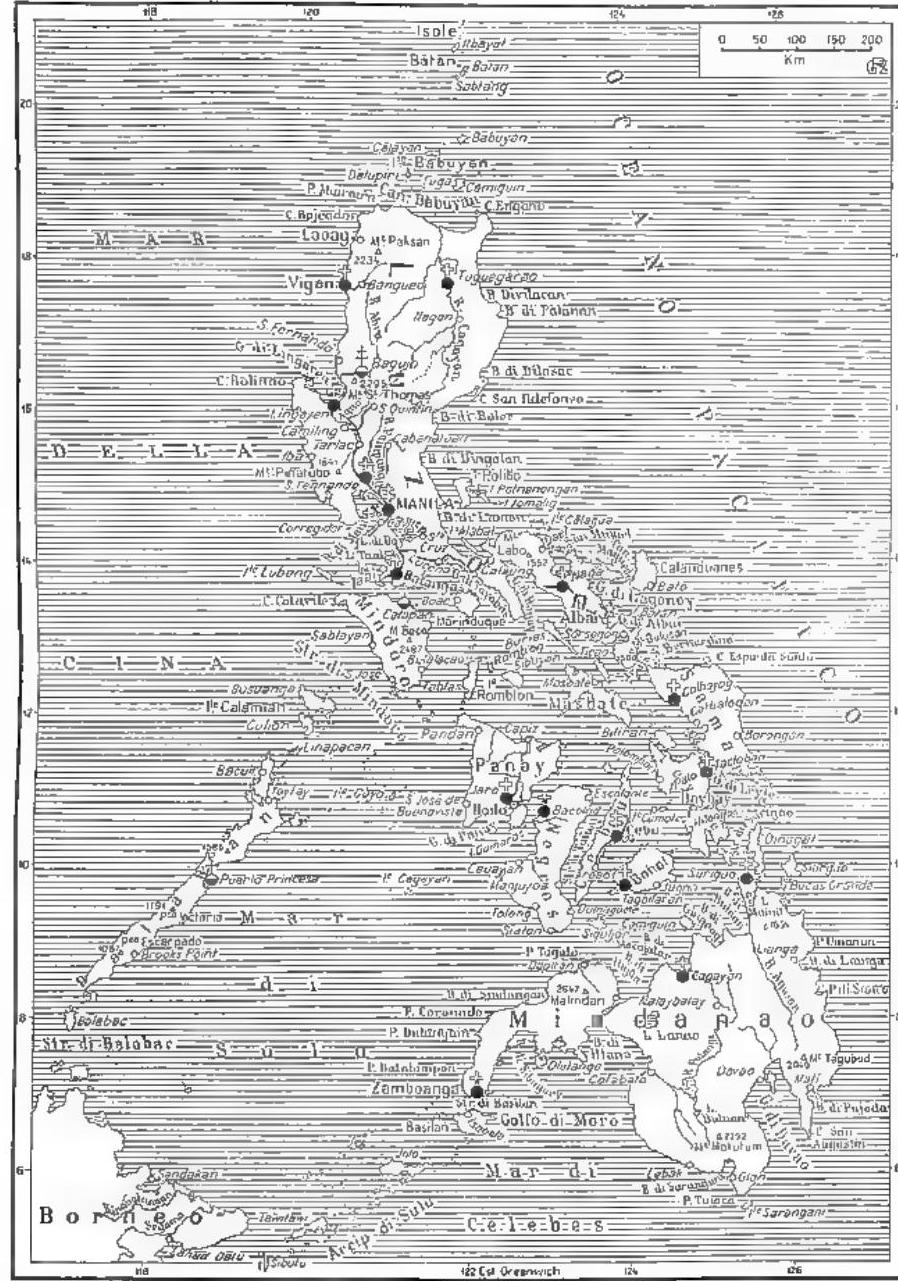
PHILIPPINES. - Archipelago of 7,083 islands, which closes the South China Sea to the south. It has an area of 396,285 sq km (slightly less than Italy) with 19.5 million inhabitants (66 per sq km).
The islands are mostly volcanic in nature and crossed by mountains; nevertheless, vast alluvial plains are not lacking. The climate is equatorial, with monsoon rains; the vegetation is splendidly luxuriant (69% of the soil covered by forest). Among the crops, the predominant ones are they profess pagan cults, or are devoted to Islam; for the rest (80%) Catholicism predominates, introduced by the Spaniards with the conquest: the P. are indeed the only predominantly Christian country in eastern Asia. The P., occupied by Philip II in 1570, passed to the United States in 1569, which on July 4, 1946 recognized their full political independence. The archipelago is constituted as a bicameral parliamentary republic.
The capital Manila (684,000 inhabitants) is the only truly large urban center; also Cebú, on the island of the same name, Zamboanga and Davao on Mindanao exceed 100,000 inhabitants.
Bibliography3 works
Giuseppe Caraci
EVANGELIZATION OF THE PHILIPPINES
During the first discovery of the Philippines by Ferdinand Magellan in 1521 some natives of the island of Samar were baptized; but true missionary activity began only after Miguel Lopez de Legazpi had definitively occupied the archipelago in 1565.
The well-known navigator and cosmographer Andrés de Urdaneta (1498-1568), of the Hermits of St. Augustine, together with 4 other Augustinians had accompanied Legazpi's Spanish fleet, and thus the missionary work began on the island of Cebú; from 1571 on that of Luzon at Manila, and in 1569 a religious province was erected there. The Franciscans followed in 1577, with their own province from 1586, the Dominicans in 1579, with their own province from 1592, in 1579 the Jesuits, with a vice-province from 1594 and a province from 1606, and finally the Recollect Augustinians in 1606, who formed their province in 1622. In 1578 the diocese of Manila was erected, whose first bishop was Francisco Domingo de Salazar (1512-94); in 1595 it was elevated to a metropolis, with three suffragans: Nueva Segovia, Nueva Cáceres and Cebú. In the following centuries the five religious Orders vied with one another in the conversion of the natives, striving to gather the scattered inhabitants into central stations, founding villages (pueblos) and building numerous roads and bridges. They published dictionaries, grammars and catechisms in the various native languages (cf. Bibliotheca missionum, IV, which presents various publications in the Tagalog, Zambal, Ilocano, Pampanga, Pangasinan, Bicol, Cebuano and Cinere languages). From the earliest beginnings the missionaries also devoted themselves to the conversion of the Chinese (Sangleyes) who dwelt in large numbers in Manila and its suburbs, and later the Spanish, Franciscan, Dominican and Augustinian missions in China, Japan and Indochina were founded from the Philippines. They also erected many schools, where the parish priest was habitually the teacher. In 1605 the Dominicans founded the College of Our Lady of the Rosary, later of St. Thomas, and from 1645 a royal and pontifical university, which still exists. The University of the Jesuits, on the other hand, founded in 1621, was closed in 1767 with the expulsion of the Fathers of the mission. In the 18th century a great part of the population was won to the Christian faith. From the census of Fr. Juan J. Delgado (Historia general sacro-profana, politica y natural de las Islas del Poniente llamados Filipinas [Manila 1892]) it is gathered that in 1750 there existed 569 pueblos with 904,116 Christians, without counting children under seven years of age. Of these pueblos, 142 with 147,269 souls were cared for by the native secular clergy, the others were entrusted to the Spanish religious. From 1744 the Jesuits had begun the difficult mission among the Muslim Moros of Jolo and Mindanao, which was abandoned after their expulsion from the Philippines in 1767. At the same time the struggle began against the other religious, who in the parishes were replaced by native secular priests, for the most part natives and poorly prepared. Consequently the Spanish government restored the religious to their parishes, and during the 19th century kept the native secular clergy in secondary positions. During the same century the friars continued their beneficial work both in the parishes and in the evangelization and stabilization of the tribes still pagan. From 1859 the Jesuits were able to resume their scientific activity and the missions of Mindanao. From 1862 the Lazarists took into their hands the direction of the diocesan seminaries. In 1865 the diocese of Jaro was erected. Toward the end of the 19th century the greatest part of the population was Catholic, with the exception of some mountain tribes and the Moros. The statistics of 1885 (Estado general de los pueblos del arzobispado de Manila y de los Obispados sufraganeros de Nueva Cáceres, Nueva Segovia, Cebú y Jaro, formado por el M. R. Arzobispo de Manila [Manila 1886]) give 2,830,860 Christians with 1311 Spanish religious and 840 secular priests, for the most part natives. In 1896 a revolution broke out, during which not a few priests were killed. After the Spanish-American War the Philippines in 1898 passed under American domination. The Spanish friars for the most part left the archipelago and the Spanish bishops tendered their resignations en masse, after negotiations with the Holy See, [and were] replaced by Americans.
In 1902 by the apostolic letters of Leo XIII (Quae mari sinico) the ecclesiastical hierarchy was reorganized, 4 new dioceses were created (the execution, however, took place only in 1910) and an apostolic delegation was erected. In 1907 a provincial council was held at Manila, promulgated in 1910. The introduction of non-religious schools by the Americans, the invasion of Protestant sects, and the schism of the priest Gregorio Aglipay from 1902 (who in 1906 was condemned to the restitution of the ecclesiastical property of Catholics) had disastrous consequences for the Church, as well as the shortage of priests. The tireless efforts of the apostolic delegate Ambrose Agius O.S.B. (1856-1911) succeeded in introducing new congregations into the country: the Fathers of Mill Hill, of Scheut, the Missionaries of the Sacred Heart, the Fathers of Steyl and the Redemptorists. After the First World War there also arrived the American Jesuits, the Fathers of Maryknoll, the Oblates of Mary Immaculate, the Fathers of St. Columban and of the Seminary of Québec; the apostolate among the tribes still pagan was resumed: the Fathers of Scheut among the Igorots in the northern mountains of Luzon, the Fathers of Steyl in the province of Abra. Even today, however, the scarcity of clergy is still great, since the population has increased from 7,635,426 in 1903 to 19,013,628 at present, of whom 15,554,641 are Catholics, 1,581,417 Aglipayans, 419,982 Protestants, 761,790 Muslims and 712,579 pagans or without religion (according to the official census of 1948). The priests are only 1870, of whom 1140 are native seculars (according to the Annuario pontificio 1950).
Ecclesiastical organization: Metropolis: Manila (diocese in 1578, archdiocese in 1595) with suffragans: Lingayen (1928), Lipa (1910), Nueva Cáceres (1595), Nueva Segovia (1595), San Fernando (1948), Tuguegarao (1910). Metropolis: Name of Jesus or Cebú (diocese in 1595, archdiocese in 1594) with suffragans: Bacolod (1932), Cagayan (1933), Calbayog (1910), Jaro or Santa Elisabetta (1865), Palo (1937), Surigao (1939), Tagbilaran (1941), Zamboanga (1910). There are still an apostolic vicariate: Montagnosa (apostolic prefecture in 1932, apostolic vicariate in 1948) and two apostolic prefectures: Mindoro (1936) and Palawan (1910).
Bibliography2 works
1906. - Franciscans: Francisco de Santo Inés, Cronica de la provincia de S. Gregorio Magno de Religiosos Descalzos de N. S. P. Francisco en las Islas Filipinas, China, Japón, etc., 2 vols., Manila 1892. - Dominicans: I. Ferrando-J. Fonseca, Historia de los pp. Dominicos en las Islas Filipinas y en sus misiones del Japón, China, Tungbin y Formosa, 6 vols., Madrid 1870-72. - Jesuits: F. Colin, P. Pastella, Labor Evangelica, Ministerios Apostolicos de los obreros de la Compañía de Jesús, Fundación y progresos de su provincia en las Islas Filipinas, 3 vols., Barcelona 1900-1902; P. Pastella, Misión de la Compañía de Jesús de Fil. en el siglo XIX, 3 vols., ibid. 1916-17. - In general: D. P. Barrows, A history of the Philippine Islands, New York 1905, new ed., ibid. 1924; Fr. X. Clark, The Philippine Islands, ibid. 1936, p. 48.
Giovanni Rommerskirchen